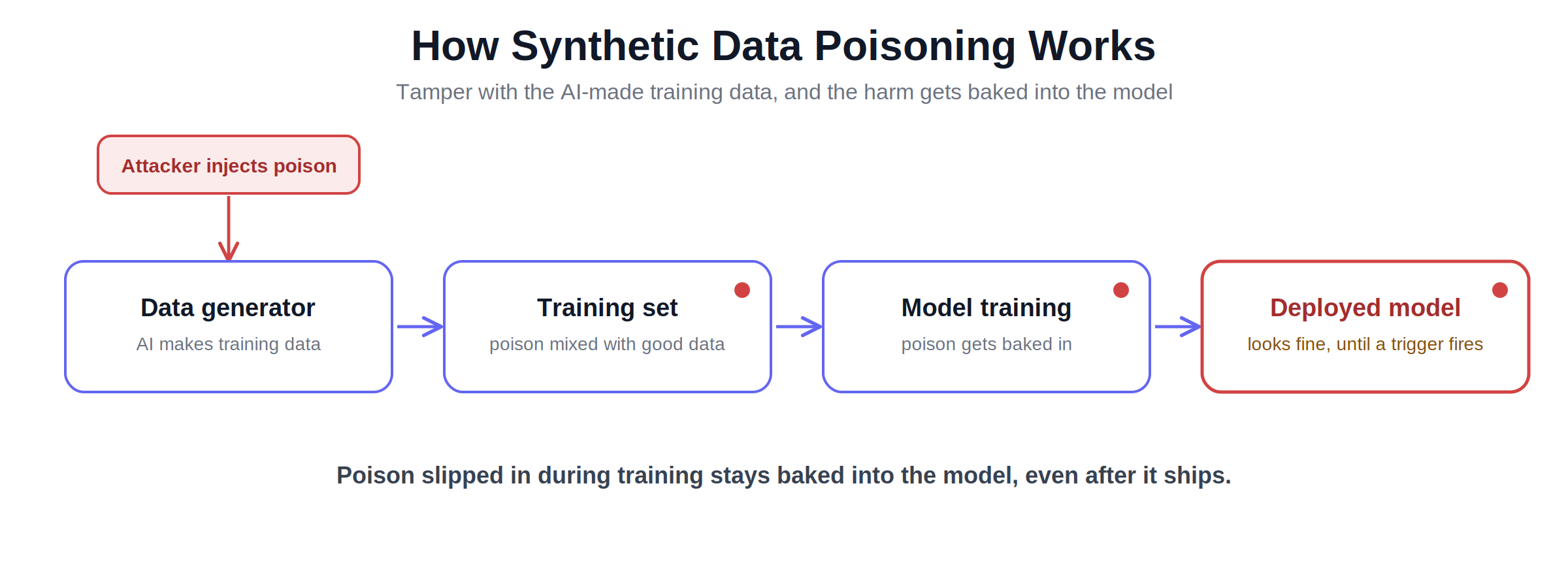
Synthetic data poisoning is a sneaky kind of attack on AI. To get it, start with plain old data poisoning. Someone deliberately slips bad data into a model's training set so the model picks up the wrong lessons and starts acting the way the attacker wants. Picture the training data as the gasoline that makes the model run. Pour something nasty in the tank, and the engine sputters in ways the builders never saw coming. Synthetic data poisoning is the same trick, just aimed at synthetic data, the artificial, AI-generated data that more and more teams now lean on to train their models. Mess with that fake data, and you can corrupt the model without ever laying a finger on a real dataset.
Here is why that matters. Synthetic data caught on because it dodges privacy headaches and lets teams whip up mountains of training material whenever they want. That same convenience cracks a door open. An attacker who can get at the tool that spits out the synthetic data, or who quietly stirs poisoned synthetic samples into the pile, sends the bad patterns straight into the next model. No access to the real, sensitive data required. And the damage sticks around. Once the poison gets learned during training, it ends up baked into how the model sees the world, which makes it stealthy and a pain to undo later.
There are two main flavors. The first is a targeted, or backdoor, attack. The model acts totally normal almost all the time, then misbehaves only when it spots a secret trigger the attacker planted. Picture a fraud detector trained to wave through one specific kind of shady transaction, while looking perfectly trustworthy on everything else. The second is an untargeted attack, which just dumps enough junk into the training data to drag the model's overall accuracy down. Data poisoning even shows up on the OWASP Top 10 list of risks for large language models. It is worth not confusing this with model collapse, by the way. Collapse is accidental decay from training on AI output, while poisoning is somebody doing it on purpose.
The really tricky part is scale. Big models train on enormous datasets pulled off the web, crowdsourced, or bought from outside vendors, and there is no way anyone is hand-checking billions of examples for tampering. Synthetic data adds yet another pipeline that can get quietly compromised. Cleaning it up afterward is brutal too. As one security guide on data poisoning points out, tracing the bad data back and scrubbing it out is slow and expensive, and sometimes the only real fix is retraining the entire model from scratch. So most of the defending happens up front. Teams check where their data comes from, audit and sanitize their datasets, run integrity checks to make sure nothing got swapped, and keep an eye on deployed models for sudden, strange shifts in behavior.
What makes synthetic data poisoning dangerous:
- Stealthy. A backdoored model looks normal until the hidden trigger shows up.
- Persistent. Once learned in training, the poison stays baked into the model.
- Scalable. Tampering with one generator can spoil every model trained on its output.
- No real data needed. Attackers corrupt the fake data, never the sensitive real stuff.
- Hard to fix. Tracing and removing it is costly, and may mean a full retrain.
Synthetic Data Poisoning Explained:
To understand the attack, it helps to first understand what synthetic data actually is. In this explainer, IBM's Martin Keen breaks down synthetic data, why teams use it, and how it gets generated, which is exactly the pipeline that poisoning targets.
FAQs
It is an attack where someone deliberately corrupts AI-generated training data so any model trained on it picks up harmful patterns, hidden biases, or secret backdoors. Because synthetic data is artificial, the attacker can poison it without ever touching real, sensitive datasets. That corrupted behavior then gets baked into the model during training.
Regular data poisoning goes after any training data, including real-world data. Synthetic data poisoning zeroes in on the artificial, AI-generated data that many teams now use to train models. The goal is the same, to manipulate the model, but the target is the synthetic data pipeline. That appeals to attackers because they can do real damage without ever needing the genuine data.
Most of the protection happens before training. Check where your data comes from, especially anything scraped or bought from third parties. Audit and clean datasets to catch anomalies, use integrity checks like hashes to confirm data has not been swapped, and keep watching deployed models for sudden, unexplained changes in behavior. Catching poison early beats trying to scrub it out after a model has already learned it.