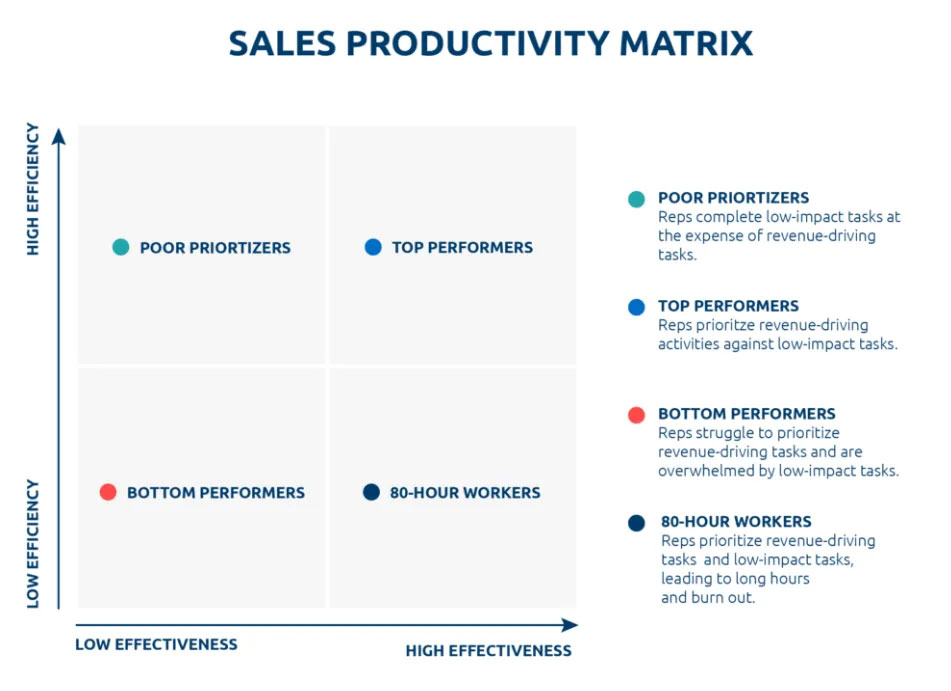
Sales productivity is a relatively simple concept. It’s the relationship between a salesperson’s input (i.e., their efficiency) and their output (i.e., their effectiveness).
- Sales efficiency: This is all about optimizing a sales rep’s use of their time. This isn’t about working more quickly, though. It’s more about how much time a sales rep is spending on high-impact activities such as preparing for meetings and providing software demonstrations as opposed to low-impact activities like administrative tasks.
- Sales effectiveness: This is all about a sales rep’s ability to drive revenue. An effective sales rep will be able to use the resources that are available to them—such as content, knowledge, tools, and training—to them to win new customers.
Sales productivity can be simplified by looking at it as the number of deals that a sales rep closes per the hours that they put in, though this is not always the most effective way to look at it is dependent on the product, service, or sales pipeline.

Measuring Sales Efficiency as a KPI
Sales efficiency is a key performance metric that measures how effectively a brand’s sales team generates revenue through sales activities. In other words, it measures how effectively the sales team converts leads into customers. The more revenue a sales team generates from limited resources, the more efficient it is.
Let’s say, for example, a sales team spends $25,000 generating $5,000 in sales. That’s a sales efficiency of 20% because 80% of sales expenditure is being lost. If the same team spends $25,000 and generates $50,000 in sales, their efficiency is 200%.
Several factors can influence sales efficiency, including:
- Lead quality: Targeting and prioritizing high-quality leads that are more likely to convert can increase efficiency by focusing efforts on the most promising prospects.
- Sales process optimization: Streamlining the sales process through automation, improved sales tools, and clear sales stages helps reduce the time and effort required to close deals.
- Sales training: Providing sales teams with the necessary training and resources to improve their skills and knowledge can lead to more effective customer interactions.
Sales Productivity Explained:
FAQs
Lead scoring will help you prioritize your prospects based on their likelihood to convert. When you focus on high-scoring leads, sales teams can reduce wasted time and effort. This shortens the sales cycle and improves your overall revenue per sales rep. You can boost your efficiency by aligning your resources with your highest-value opportunities.
You can calculate sales efficiency by dividing the revenue generated by the total cost of sales, and multiplying the result by 100 to get a percentage. For example, if your team spends $25,000 and generates $50,000 in sales, the formula is: ($50,000 ÷ $25,000) x 100 = 200%. This calculation means that in this scenario, your team generates $2 for every $1 spent, an efficiency of 200%.
Sales efficiency reflects how well resources (like time, budget, and people) are used to generate revenue. Sales effectiveness, in contrast, focuses on your team's ability to achieve their desired outcomes. This could include closing high-value deals or penetrating new markets. Efficiency is input-focused, while effectiveness is outcome-focused.
Sales productivity refers to how effective a sales team's input is in generating revenue. It measures how well sales teams utilize their time and resources to close deals and achieve sales targets.
Businesses can improve sales productivity by implementing CRM systems, providing regular training and development, optimizing sales processes, leveraging sales automation tools, setting clear goals and metrics, and fostering a collaborative and supportive sales culture.