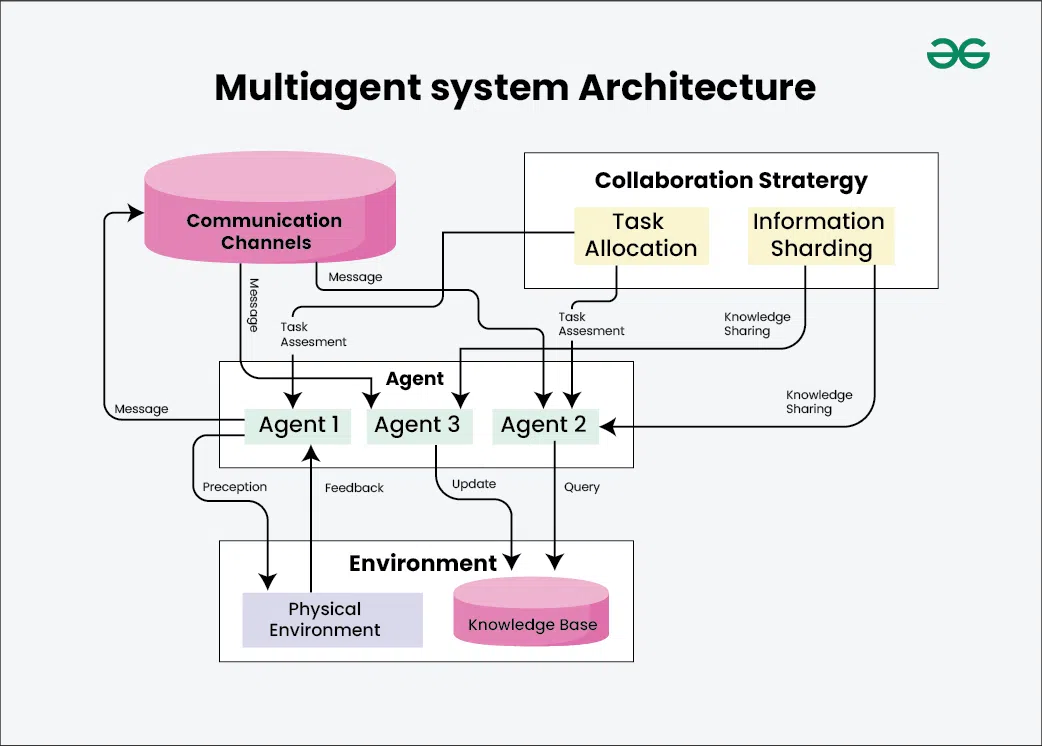
A multi-agent system is what you get the moment you stop making one AI do everything and split the job across a team instead. Each agent owns a slice of it. One goes and digs up the information. The next runs the numbers. A third writes the draft, and a fourth reads it back for mistakes. They trade work along the way and aim at the same target, not unlike coworkers who each stick to their own lane.
There is a plain reason teams build it this way. Load every job onto one agent and it bogs down, gets slower, and turns into a nightmare to debug the second something slips. Carve the work into specialized agents and each one stays small, stays focused, and can be swapped or upgraded without touching the rest. You also get to run them all at once instead of grinding through one slow step at a time, which is quicker and far steadier when a single piece trips up.
An agent swarm takes that same idea and pushes it further. Rather than a few agents answering to one coordinator, a swarm runs on many agents that mostly sort themselves out.
Often there is nobody in the middle calling the shots. The agents pass tasks to each other, draw on a shared memory, and the clever behavior kind of bubbles up from all of them following a few simple rules at once. That bit is lifted straight from nature. No single ant runs the colony and no bird leads the flock, yet the group manages things no member could pull off alone. Scientists picked that apart for years, and it turned into approaches like ant colony optimization that still shape how swarms get built today.
So here is the short version. "Multi-agent" is the catch-all for any setup with more than one agent in it, and "swarm" is the flavor that goes big and skips the central boss. Both show up in real tools. Frameworks like OpenAI's Swarm, Microsoft's AutoGen, and CrewAI exist for exactly this, to wire a bunch of agents into a working team.
Two ways agents tend to be organized:
- Orchestrated. One coordinator agent maps out the work, parcels pieces to the specialists, then gathers the results back into one answer. Easy to follow, though that coordinator can turn into a chokepoint.
- Swarm. Agents run as peers with nobody in charge, passing tasks around and sharing context. Tougher to predict, but bendier and harder to knock over when one part fails.
Multi-Agent Systems Explained:
Want the quick version on video? This explainer covers why one agent often is not enough, how a group of specialized agents divides up a task, and what changes once they start coordinating instead of working solo.
FAQs
It is a setup where several AI agents tackle one job together, each taking a specific part. Instead of a lone agent straining to do all of it, the work gets handed out to specialists that share what they find and stay in sync, which makes the whole thing faster, easier to scale, and less painful to maintain.
An agent swarm is a multi-agent system built around many agents that mostly run themselves, usually with no central controller. They follow simple rules, pass work back and forth, and the useful behavior emerges from the group. The idea traces back to nature, to ant colonies and bird flocks, where the collective pulls off far more than any one member ever could.
A single agent takes a task and sees it through alone, start to finish. A multi-agent system spreads that task across several agents so each can specialize, work in parallel, and cover for the others. Picture the gap between one generalist doing the whole thing and a small crew where everybody has a role.