Monthly recurring revenue (MRR) is the lifeblood of any SaaS company. It’s the income that is expected to be received on a monthly basis, and it acts as a critical revenue metric that enables subscription model companies to understand their overall business profitability, carry out financial forecasting and planning, and measure growth. MRR is usually normalized into a single figure that can be used as a way to identify trends and track performance over time.
Calculating monthly recurring revenue is simple. All that you need to do is multiply your average revenue per account by the total number of customers for that month:
MRR = number of customers * average billed amount
For example, if 30 customers paid you an average of $74.99 per month, your MRR would be $2,249.70.
As you grow, you’ll want to track not only your MRR but also any changes over previous months. This can be done by using three figures:
- New MRR: Any additional MRR from new customers in a given month.
- Expansion MRR: Any additional MRR from customer upgrades.
- Churned MRR: MRR lost from cancellations and downgrades.
Plug all three of these into the following formula to calculate MRR change:
MRR change = New MRR + Expansion MRR = Churned MRR
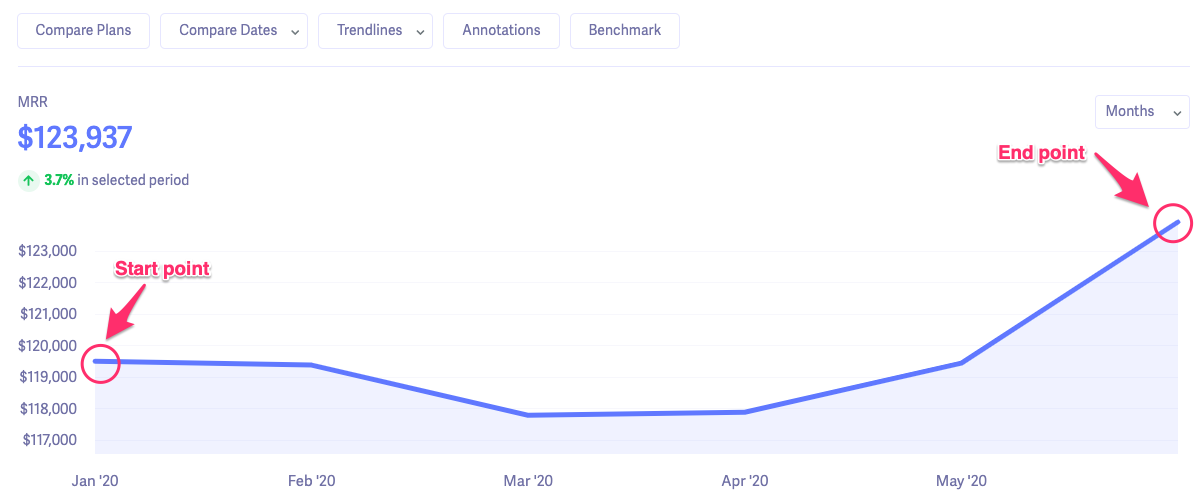
Monthly Recurring Revenue (MRR) Explained:
FAQs
MRR offers a clear, consistent view into the financial health of a SaaS business. It's like your financial heartbeat because it's based on your recurring income. So you can track how it's accelerating, if it's steady, or if it's slowing down. Tracking like this helps you make smarter decisions about scaling, product investments, and customer acquisition strategies. Also, when you monitor MRR alongside your new, expansion, and churned revenue, you can anticipate cash flow and set solid growth targets. You can also react more quickly to shifts in customer behavior.
Technically, MRR can't go below zero. After all, it's recurring revenue. However, your MRR change reflects the net gain or loss in monthly revenue. So this can definitely be negative. Negative MRR change would mean you're bringing in less than you were. This could happen when your churned MRR outweighs the combined total of new and expansion MRR. A negative MRR change is a contraction in recurring revenue. Pay attention, because it could point to deeper issues like a product that fits poorly in its market. It could also reflect customer dissatisfaction or rising competition. When you spot negative MRR early, you can address those issues before they impact your long-term growth.
No. MRR reflects only predictable, recurring revenue. These can include subscription fees or ongoing service charges. Make sure to exclude one-time payments like implementation fees, setup charges, or training costs from your MRR calculation. This is because they don't repeat on a monthly basis. If you were to include them you would inflate your MRR and end up with misleading forecasts. That could throw off everything from hiring decisions to budget allocations.
MRR (Monthly Recurring Revenue) and ARR (Annual Recurring Revenue) are both metrics that reflect predictable, subscription-based income. The difference has to do with the timeframes. MRR is perfect when you're dealing with short-term tracking and you want to quickly identify month-over-month growth. In contrast, ARR is better for long-term forecasting. This is especially true when you have to report to investors or you've got to set annual revenue goals. It's helpful to realize that if you know your MRR, you can multiply it by 12 to calculate your ARR. Just note that ARR is more sensitive to annual billing cycles while MRR is better for real-time analysis of how healthy your revenue is.