How to Win Government RFPs With AI (Without Getting Disqualified)


A state agency posts a solicitation on a Tuesday afternoon. It runs 140 pages. Forty of those pages are forms. The actual questions live in an Excel workbook with eleven tabs, and the whole thing is due in 18 days at 2:00 p.m. Central. Public sector bidding punishes teams that treat it like a normal enterprise deal, and plenty of solid vendors lose contracts over a missing signature page instead of a weak product. Bid management in the public sector is its own discipline.
Government RFPs also happen to be the most structured, most repetitive proposals in existence. Same forms. Same compliance language. Same questions about your security posture, your past performance, your insurance limits. That repetition is exactly what AI is good at.
Public procurement plays by different rules
In a commercial deal you can text your champion and ask what the buying committee actually cares about. Public procurement mostly shuts that door. Once the solicitation drops, questions usually go to one contracting officer, in writing, before a stated deadline. Then every answer gets published to every bidder, including your competitors.
Scoring is often spelled out right in the document. Technical approach worth 40 points, price worth 30, past performance worth 20, and so on. Evaluators grade against that rubric and nothing else.
The part that catches new bidders is responsiveness. Before anyone scores your technical approach, a procurement officer checks whether your submission followed the instructions. Wrong file format, missing attachment, over the page limit, unsigned addendum acknowledgment. Any of those can knock you out before a single evaluator reads your differentiators. The best proposal in the stack loses to the compliant one every time.
Register before you go hunting for bids
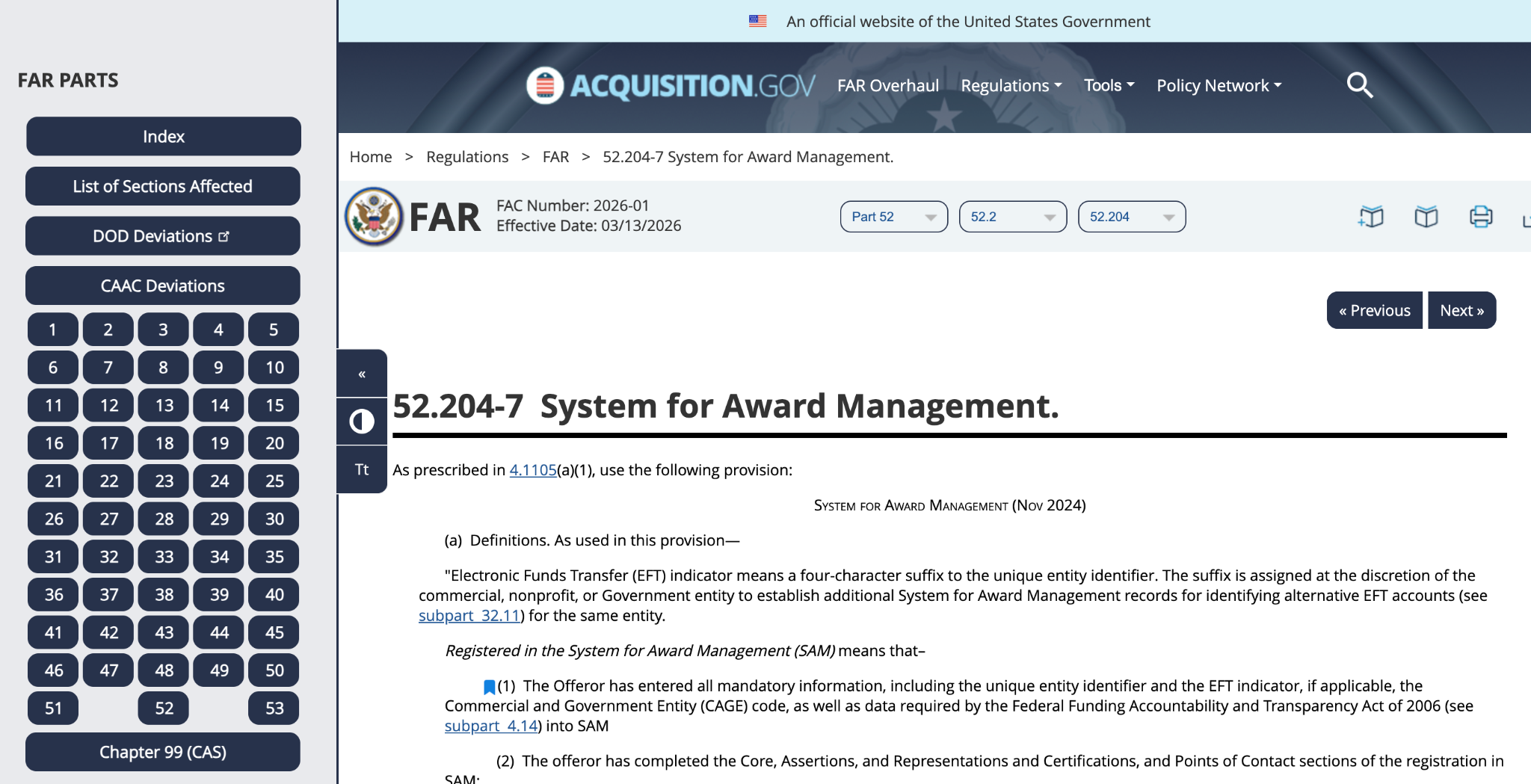
Federal work runs through SAM.gov. You need a Unique Entity ID, and your registration has to be active. Under FAR provision 52.204-7, an offeror is required to be registered when submitting an offer and again at time of award. Entity validation can drag on for weeks if your legal name and physical address do not match your paperwork exactly, so nobody should be starting this three days before a deadline.
State and local work is messier because every agency picked its own platform. You might be registering in Bonfire for one county, BidNet for another, and a homegrown state portal for the third. Each one wants your tax documents, insurance certificates, and W-9 uploaded separately.
Sort out your certifications at the same time. Small business status, 8(a), WOSB, HUBZone, SDVOSB, and state level MBE, WBE, or DBE registrations all take time to obtain and they open up set-aside opportunities that are much easier to win than open competition.
Build the compliance matrix before you write anything
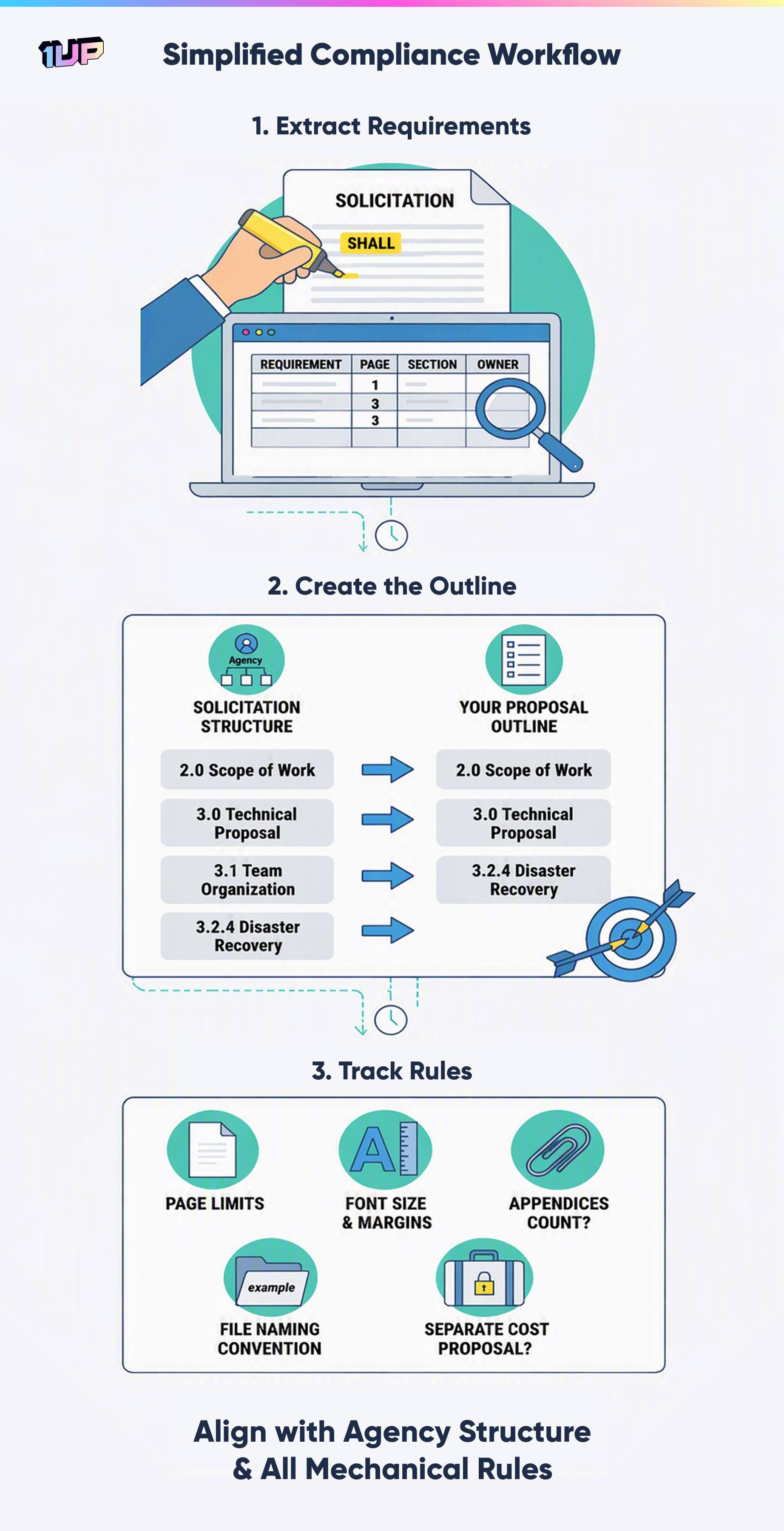
Read the solicitation with a highlighter and pull out every instance of shall, must, and required. Drop each one into a spreadsheet with four columns: the requirement, the page it came from, where your response addresses it, and who on your team owns it.
That matrix becomes the outline. Mirror the agency's section numbering and order. If Section 3.2.4 asks about disaster recovery, your response should have a heading that reads 3.2.4 Disaster Recovery. Evaluators are often working through a scoring sheet built from the same numbering, and making them hunt for your answer costs you points.
Then note the mechanical rules somewhere you cannot miss them. Page limits. Font size and margins. Whether appendices count against the limit. How files must be named. Whether the cost proposal has to be a separate sealed upload. These details are boring and they decide bids.
The format problem: Excel, Word, and Procurement Portals
Public sector response formats are all over the place. One agency wants a Word document with locked form fields. The next sends a workbook where answers go in column D and character counts are capped at 500. A third makes you type everything into a browser-based procurement portal with two-factor authentication and no export option.
Anyone who has worked a few bids has stories about response formats and how much time gets burned on copying and pasting between them. Portals are the worst offenders because you cannot pull the questions out to work on them, and you cannot bring your knowledge base in.
Workbooks come with their own headaches. Hidden tabs, merged cells, dropdown menus with fixed options, and instructions parked on a tab nobody opens until day nine. Character caps show up constantly and they are usually enforced, so a good answer written at the wrong length has to be rewritten anyway. Multiply that across 200 questions and a week disappears into formatting.
This is where tooling earns its keep. 1up handles Excel, Word, PDF, and webpage formats, and the browser extension generates answers directly inside portals and online docs so nothing has to be exported first. Google Sheets, Google Docs, Office Online, OneTrust, Whistic, and Panorays all work the same way. The answer comes from your approved sources and lands in the field you are standing in.
Draft with AI, verify the numbers by hand
AI is excellent at volume work, though it does have real limits on this kind of document, and knowing why AI struggles with RFPs saves a lot of wasted effort. The parts it handles well are drafting first-pass answers from responses your team already approved. Reformatting a 900-word technical answer into a 500-character box. Filling in the same company details across nineteen forms.
Checking your draft against the compliance matrix to catch requirements nobody answered. Rewriting jargon into plain language, which matters more than people expect since evaluation panels often include program staff rather than engineers.
There are places to keep AI out of, though. Pricing strategy is a judgment call about the agency's budget and your competition. Win themes come from knowing why this agency is buying now. Certifications, insurance limits, and past performance details have to be pulled from real records, because a wrong number in a government bid is not just embarrassing. Awards are public, losing bidders can request debriefings, and protests get filed. In fiscal year 2025 the GAO received 1,688 bid protest cases, and unreasonable rejection of proposals ranked among the most common grounds where protests were sustained. Anything you claim can be checked.
So use AI for the draft and keep a human on the numbers. Every answer that touches security, compliance, or contract terms gets a real reviewer before it ships.
Security and compliance sections run heavier here
Commercial buyers send you a security questionnaire. Government buyers send you a framework. Federal cloud work means FedRAMP. Many states run their own version, like StateRAMP or TX-RAMP. Law enforcement data brings in CJIS. School districts bring FERPA. Health agencies bring HIPAA. Accessibility shows up almost everywhere as Section 508, usually in the form of a request for your VPAT.
Most of these questions repeat bid to bid, which is why keeping them in one maintained library beats answering them fresh each time. It also helps to look at the security questionnaire questions that come up most often, since the public sector versions are usually a longer variation on the same themes.
One rule worth enforcing: answers about encryption, data residency, subprocessors, and breach notification should trace back to your actual SOC 2 report or security documentation. Not to a summary somebody wrote in a deck two years ago. When an auditor asks later, you want the paper trail.
Keep a reusable core so every bid starts at 70 percent
Public sector bids ask for the same supporting material over and over. Build it once and keep it current:
- A capability statement with your NAICS codes, UEI, CAGE code, and certifications
- Past performance write-ups with contract values, dates, scope, and reference contacts who have agreed to be called
- Key personnel resumes in the format agencies tend to ask for
- Insurance certificates, financial statements, and audit letters
- Standard answers on your implementation approach, training, support model, and transition plan
Store all of it where your answer tool can reach it. Teams that keep RFP response templates alongside an approved answer library end up spending their 18 days on the parts that actually differentiate them, rather than retyping their company history for the fortieth time.
Refresh the whole set on a schedule. An expired certificate or a reference to someone who left the company two years ago is a slow leak that nobody notices until it costs a bid.
Run the mechanical checks last
Before submitting, walk the compliance matrix line by line and confirm every requirement has an answer. Then check the boring stuff. Correct forms included and signed. All addenda acknowledged. Page limits respected. File naming convention followed. Cost proposal separate if the RFP says separate. Submitted through the right portal with time to spare, because portals do get slow in the final hour and deadlines in public procurement do not bend.
Ask someone who did not write the response to do this pass. Writers stop seeing their own gaps.
Get the boring half right and the rest gets easier
Public sector RFPs reward preparation more than eloquence. The teams that win consistently are not better writers. They registered early, they built a compliance matrix, they keep their answers and certificates current, and they use AI to handle the repetitive drafting so their people can focus on strategy and review.
Start with one thing this week. Pick your last public sector bid, pull every answer worth reusing into a single library, and note what was missing. The next solicitation will feel a lot less like a fire drill.
FAQs
Yes, and nothing in federal or state procurement rules bans it. AI works best on the repetitive parts, like drafting answers from your approved response library, reformatting a long technical answer to fit a 500-character box, and filling the same company details across dozens of forms. Keep people on the parts that carry risk. Pricing, win themes, certification numbers, insurance limits, and past performance details should come from real records and get reviewed before submission, because awards are public and losing bidders can request a debriefing or file a protest.
Communication runs through a contracting officer instead of a champion, and questions have to be submitted in writing by a set deadline. Answers get published to every bidder. Scoring criteria are usually spelled out in the solicitation itself, and evaluators grade against that rubric. The biggest difference is responsiveness. A proposal that misses a form, blows the page limit, or arrives one minute late can be rejected before anyone reads it.
Plan for weeks, not days. Federal work requires an active SAM.gov registration and a Unique Entity ID, and entity validation can stall if your legal name and physical address do not match your paperwork exactly. State and local agencies each run their own portals, and every one wants tax documents, insurance certificates, and W-9s uploaded separately. Certifications like 8(a), WOSB, HUBZone, SDVOSB, and state MBE or DBE status take additional time and open up set-aside bids that are easier to win.

How to Write an RFP Response That Survives AI Scoring
SIG vs CAIQ vs VSA: A Simple Guide to the Big Three

ChatGPT vs. Copilot vs. Claude for RFPs: A Side-by-Side Comparison
.png)
Using Claude for RFPs? Add This One Piece
%20(1).jpg)
ChatGPT for RFPs: What It Can and Cannot Do