It is 4:30 on a Thursday. The RFP landed two weeks ago, got buried, and is now due Monday. Eighty-some questions. Half of them you have answered before, for some other buyer, in a file nobody can find anymore. So you do the thing everybody does. You open a blank page and start typing it all over again from memory, while the clock runs and the coffee goes cold.
That scramble is normal, and it is a quiet part of why teams lose RFPs. The product was fine. The response just went out rushed and a little sloppy, right at the buzzer, and it read that way.
An RFP response template is the simple fix for all of it. You stop writing the same answers twice. Your bids start to sound like they came from one company instead of five tired people. And you get a real chunk of your week back. Let’s walk through how to write answers a reviewer will not skim past, the questions you get asked no matter the industry, and the templates worth hanging onto. We also provide Excel, Word, and PDF files you can lift straight into your own bids.
How to Write the Best RFP Responses
Good RFP responses are not clever. They answer the question, in plain words, and they go easy on whoever has to read them. And somebody does have to read them. Probably a procurement lead with a stack of twelve proposals, two days to score the lot, and a spreadsheet full of criteria. Eleven of those twelve will say the exact same fuzzy thing about being a trusted, forward-thinking partner who puts customers first. By proposal nine, that person is numb. Yours wins by being the one that is easy to score, not the one with the prettiest adjectives.

Actually answer the question
Sounds too obvious to put in writing. Happens in nearly every RFP anyway. The buyer asks for your uptime over the past year, and the answer that comes back is a warm paragraph about a deep commitment to reliability, with not one number in it. Low score. The reviewer had a box that needed a percentage, and you handed them a feeling.
So read the question, then answer that exact question first. They want a number, open with the number. Yes or no, say it, then explain. The supporting detail comes after, once the real answer is sitting on the page where anyone can spot it.
Lead with the point
Nobody reads your answer top to bottom. They skim for the part that matters, so the part that matters goes first. Quick gut check: if a reviewer read only the opening line of every answer, would they still know what you do and why you fit? If yes, good. If the real answer is hiding down in sentence four, you are making a busy person dig, and busy people who have to dig score you lower out of plain annoyance.
Use the buyer's words
Every RFP has its own little dictionary. One calls it a platform. The next says system, or tool, or solution. Whatever word they picked, hand it back to them. If they ask about your "incident response process" and you reply with a paragraph on your "security operations approach," you are quietly asking the reviewer to connect the dots. On a deadline, they will not bother. Talk in their words and your answer lines right up against their scorecard.
Back up every claim
Anybody can type "we are the most secure platform on the market." Means nothing on its own. Pin a fact to every claim, something a reviewer can go check. Watch the gap. "Our platform is highly secure" tells them nothing. "We hold SOC 2 Type II and ISO 27001, and the last penetration test came back with no critical findings" hands them three things to verify. Once a buyer checks one of your claims and it holds up, they start trusting the ones they never checked.
Keep one voice across the whole thing
Big proposals usually get written by three or four people, and you can tell. One section is friendly. The next is stiff and drowning in acronyms. The pricing page writes the date as 03/14 while the cover letter says March 14. Tiny stuff, but it stacks up, and a patchy proposal feels less trustworthy than a steady one. Agree on tone and formatting before anyone writes a word, then have one person read the whole thing at the end just for consistency.
Follow the instructions to the letter
RFPs hide rules in the fine print, sometimes on purpose. A page cap. A required font. Sections in a fixed order. Pricing in its own separate file. Miss one of those on a government or big enterprise bid and you can get tossed before a human reads a single answer. A great proposal, killed by a font size. It happens more than anyone likes to admit. Pull every instruction into a short checklist and tick them off before you send. Dull job. It has saved more deals than any clever sentence ever has.
Get a second set of eyes
Six hours into a proposal, your eyes glaze over and you stop seeing the thing in front of you. The typo. The sentence that trails off into nothing. The question you skipped on page four. The number that does not match the pricing tab. A fresh reader catches all of it in about twenty minutes. Leave time for that read even when the deadline is breathing down your neck, and honestly most of all when it is. One careless mistake can sink a proposal that would have won.
10 RFP Questions Everyone Should Know
Do enough of these and the questions start to rhyme. The wording shifts, the order moves around, but underneath it is the same short list every single time. Write one solid answer for each of these and you can clear most of an RFP in an afternoon instead of a week.
Keep all ten in one place the whole team can reach, and tidy them up after every bid. The first build costs you a day. Every RFP after that runs faster, and your answers stop contradicting each other.
Best RFP Response Templates
No single template fits every RFP, because they can show up in completely different shapes. A two-page security questionnaire and a 90-page state contract have almost nothing in common. So keep a small set on hand and reach for whichever one matches the RFP you are working on.
The full proposal template is the heavy one. Cover page, executive summary, company background, your answers, pricing, and a close. Reach for it when the buyer wants something polished, which covers most big enterprise and public work. It takes the longest to fill out, and it is where the largest contracts get decided.
The question-and-answer template is for RFPs that are really just a wall of questions. Two columns, question on the left, your answer on the right. Far faster than cramming all of that into a formal proposal. It works even better sitting next to a real RFP response database, where you can drop in answers that are already approved instead of writing them again at midnight.
A pricing template should sit in its own clean layout. Buyers stack every vendor's numbers right next to each other, so anything vague or messy costs you. Easy to scan, easy to add up. That is the whole goal.
An executive summary template earns its keep even when the RFP never asks for one. A few short paragraphs up top on why you are the right call, so a rushed reviewer gets the gist before the detail. Write it dead last, once you know what the rest of the proposal even says.
And for government or heavily regulated bids, a compliance matrix. It lines up every requirement next to the spot where you meet it, which makes the reviewer's job nearly automatic. Public buyers score against a strict checklist, so if that is your world, get a feel for what government buyers expect before you start writing.
One last thing, and it sinks more teams than it should: a template only helps if people can find it. Stuck in one person's downloads folder, it may as well not exist. Put them somewhere shared, name them so a human can tell what they are at a glance, and update them whenever a win or a loss teaches you something new.
RFP Response Template Examples in Excel, Word, and PDF
Different jobs want different files. A question tracker wants a spreadsheet. A written proposal wants a doc. The final thing you send usually wants to be a PDF. All three below are free, and each one ships with a filled-in example so you are not guessing at what good looks like.
Excel RFP Response Template
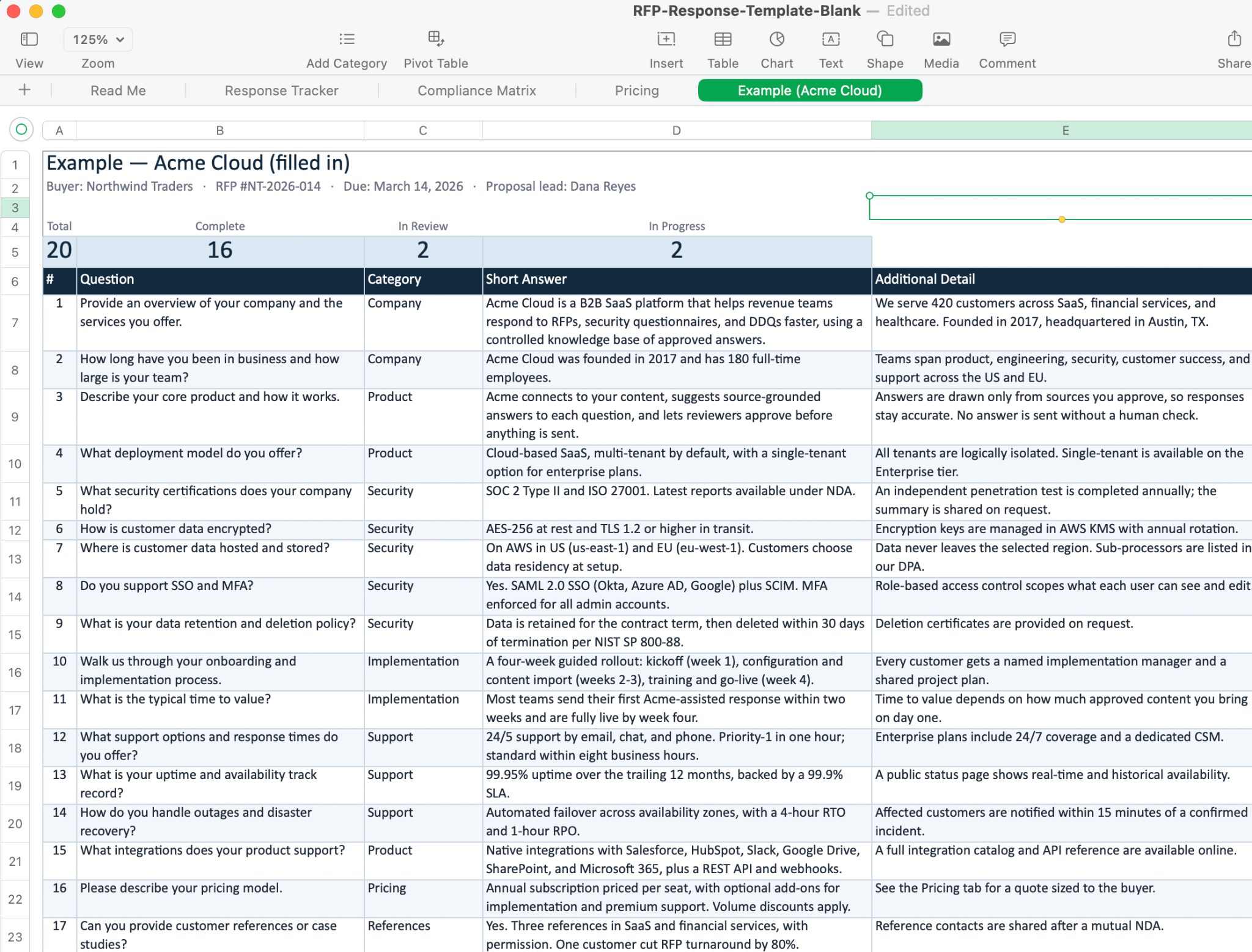
The spreadsheet is built for question-and-answer style RFPs, where you want to sort, filter, and track the status of every answer. It comes with the 20 most common RFP questions already loaded, a compliance matrix for hard requirements, and a pricing tab that adds up your totals for you. A separate tab holds a fully filled-in example.
Word RFP Response Template
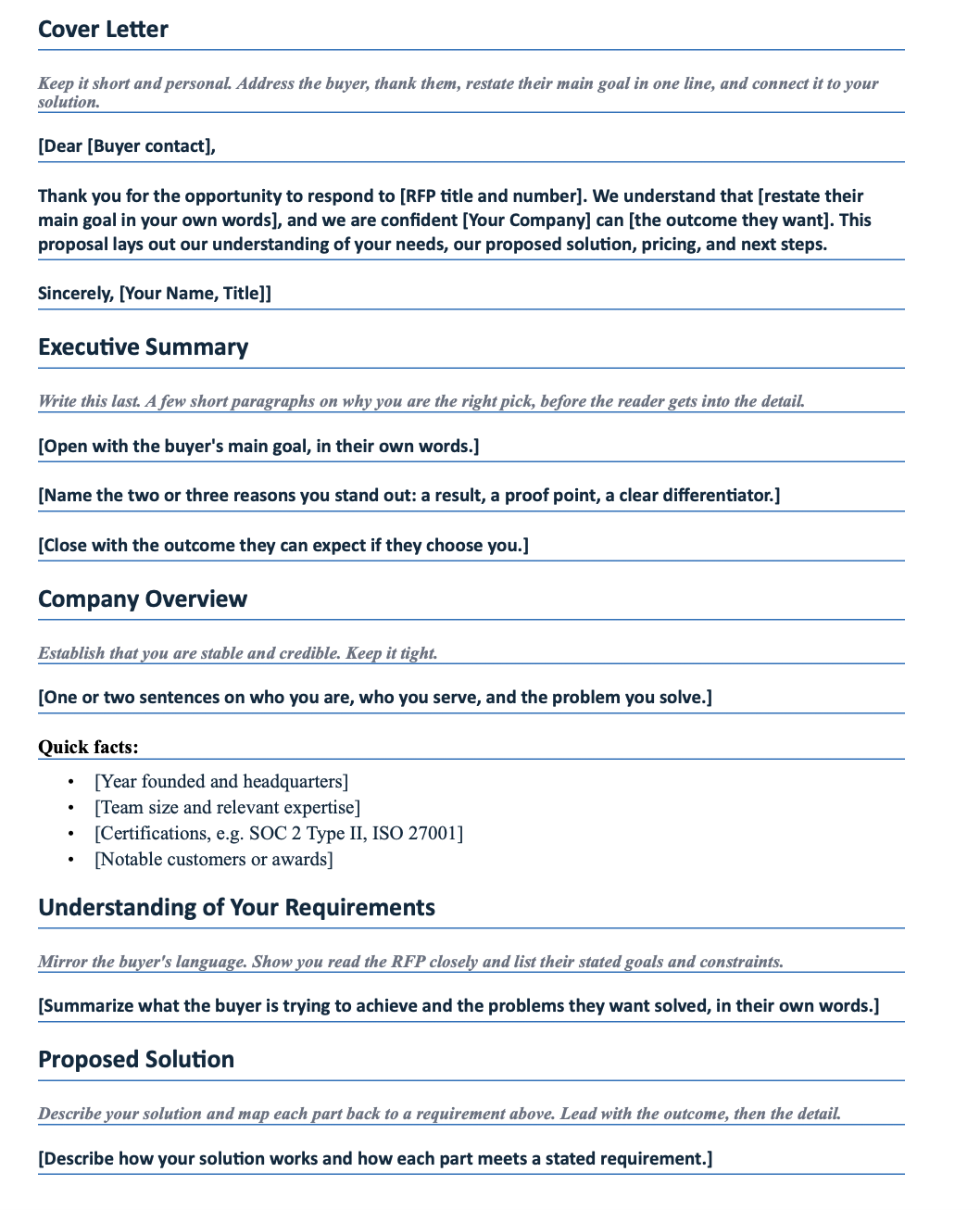
The Word version is a full written proposal, which is what most formal RFPs expect. It follows the sections buyers look for: a cover letter, executive summary, company overview, proposed solution, timeline, pricing, and references. Each section has a short note telling you what to write, plus a worked example so you are never stuck staring at a blank page.
PDF RFP Response Template
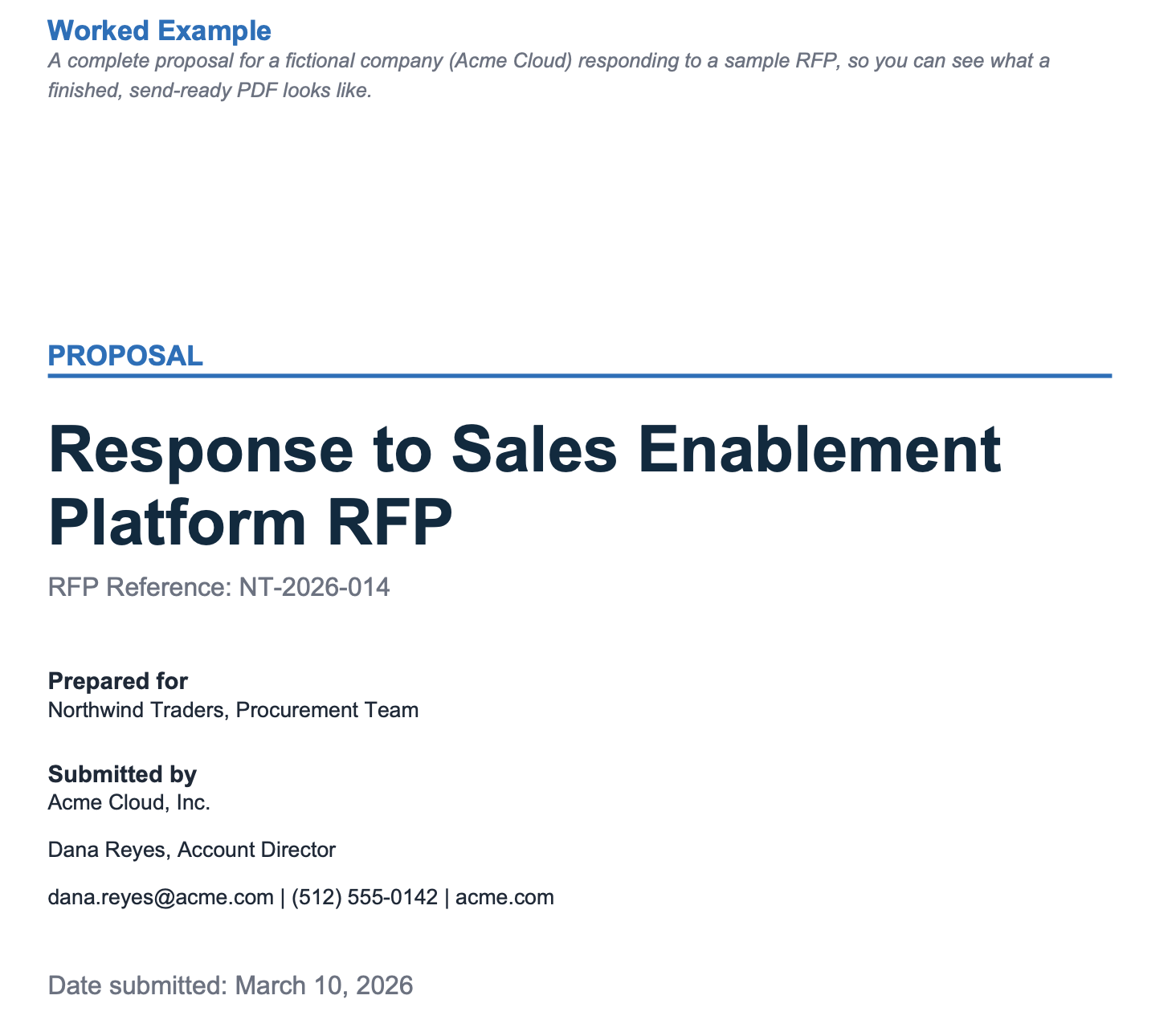
PDF is the format for your final, locked version, the one you actually send. It holds your formatting in place and stops accidental edits once the proposal leaves your hands.
When You Outgrow the Template
A template is the manual version of all this, and for plenty of teams it is plenty. But once you are answering RFPs and security questionnaires every week, the reuse part can run on its own. 1up builds a knowledge base from your own sources, drafts answers grounded in content you have already approved, shows you exactly where each answer came from, and keeps a human review step before anything goes out. Here’s how:
The idea is the same as a good template, just handled automatically instead of by hand.
A Good RFP Template Wins Back Your Time
A template will not write the proposal for you. What it kills is the worst part of the job, the part where you rebuild answers you have typed a hundred times before. No more blank page at eleven at night.
Set up a few for the RFPs you actually get, park your best answers somewhere the whole team can reach, and treat the ten questions above as your starting kit. After a bid or two it turns into a rhythm, and each new RFP eats a fraction of the time the last one did. The first response you send with a real template behind you almost feels like cheating.
Once the writing stops being the bottleneck, strategy is the next thing worth your time. A few smart calls on how to win an RFP can take a solid, on-time response and turn it into the one that beats everybody else.
FAQs
It is a reusable document you fill in to answer a request for proposal, instead of starting from a blank page every time. Most templates hold your common answers, a pricing layout, and a way to track each question, so a new bid becomes mostly editing rather than writing.
At a minimum: a short cover letter, an executive summary, your company background, clear answers to every question, pricing, and a couple of references. Bigger formal bids usually add an implementation plan and a compliance matrix that maps each requirement to where you meet it.
It depends on the RFP in front of you. Excel suits a long list of questions you need to sort, track, and price. Word fits a written proposal the buyer expects to read top to bottom. PDF is for the final version you actually send. Plenty of teams work in Excel or Word, then export to PDF at the end.

How to Write an RFP Response That Survives AI Scoring
SIG vs CAIQ vs VSA: A Simple Guide to the Big Three
How to Win Government RFPs With AI (Without Getting Disqualified)

ChatGPT vs. Copilot vs. Claude for RFPs: A Side-by-Side Comparison
.png)
Using Claude for RFPs? Add This One Piece