What Is a Business Requirement Document?

Share this post

A Business Requirement Document, or BRD, is pretty much where a lot of projects get their shape. It is the place where the business tries to explain what it wants and why it even needs the project in the first place. When teams read it, the idea is that everyone gets the same picture in their head so no one starts building something that does not connect to what the business asked for.

People mix BRDs up with things like user stories, specs, or product roadmaps and honestly it is understandable because everything overlaps in small ways. But a BRD is its own thing. It is the big, wide view of the project from the business side, written in a way that tries to keep the whole effort from becoming scattered. Once you get familiar with what usually goes into a BRD, the whole project process starts feeling a bit more normal and you are not guessing your way through it.

What Is a BRD?

A BRD comes from the business team. It is where they explain the problem they want to solve or the opportunity they want to explore, along with what they expect the end result to be. When you read through a BRD, you will usually see things like:

  • the main business goal
  • what is included in the project and what is not
  • the major features or requirements
  • assumptions or limits the team should know about
  • what success should look like
  • who the main people are and what they do
  • the current state and the future state they want

Some BRDs are quick to read. Others are long and full of diagrams, appendices, and extra documents. The structure changes from one organisation to another, but the purpose stays the same. A BRD explains what the business wants and why it matters.

Here’s an example of a BRD template:
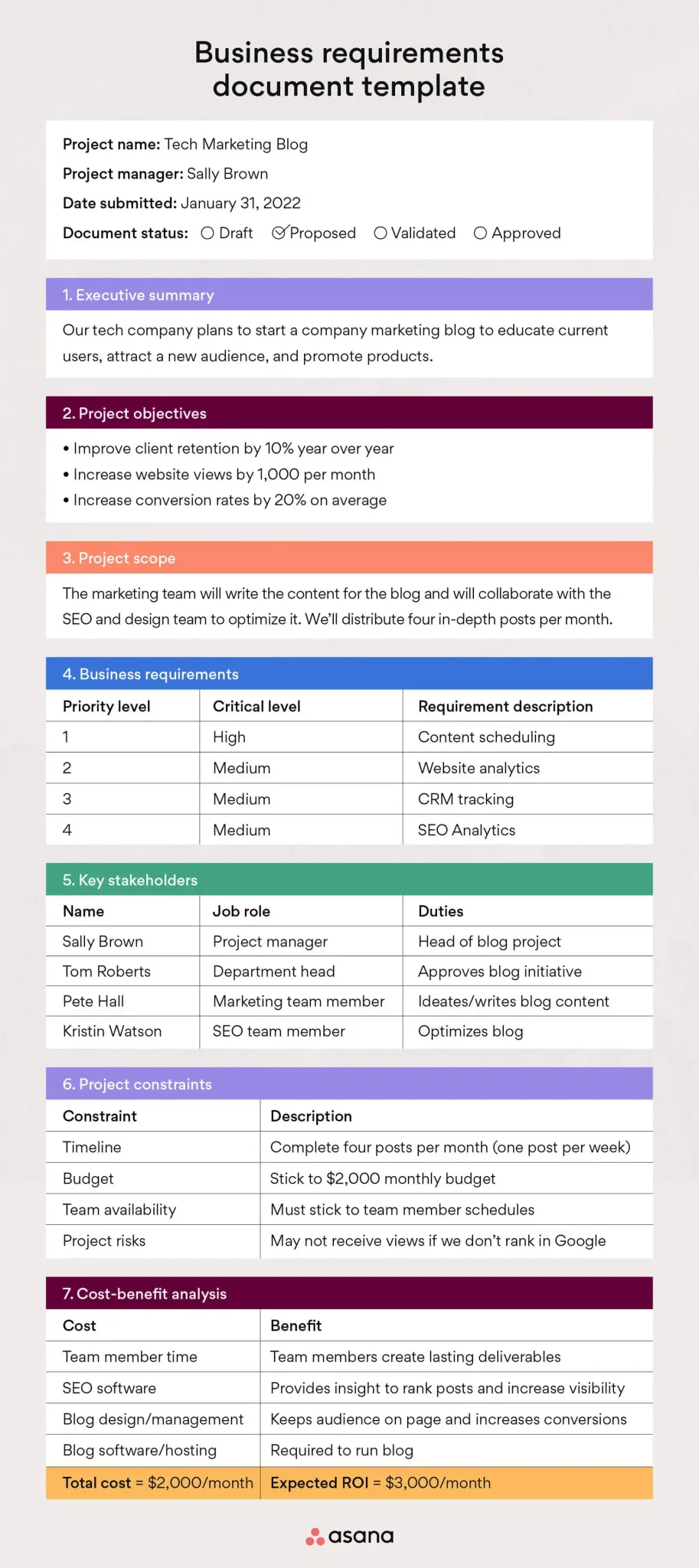
BRD Template Example
Source: Asana

How Is a BRD Used?

Different people read a BRD for different reasons. Some want the big picture. Some want the details. Project managers, designers, engineers, product teams, pretty much anyone who touches the project looks at it to understand what they should be aiming for. It helps with getting people aligned, figuring out how much work something will take, building timelines, checking if the solution ties back to the business goals, and avoiding extra fixes that come from people misunderstanding what the business wanted.

The BRD gives the overall direction. Then the teams who actually build things figure out how to bring that direction to life.

It is really just the business saying what it needs and the delivery teams deciding how to make that happen.

How BRDs Fit Into the Project Lifecycle

A BRD sits near the start but it influences almost everything else. It explains the why and the what. From there, business analysts break it down into more detailed requirements. Product and design teams work on user stories, screens, flows, all of that. Engineering figures out how to build it from a technical angle. Project managers map out the timing and try to keep everything on track.

If the BRD is confusing, everyone else has a harder job. That is usually when things start drifting or when rework piles up. So a clear BRD saves a lot of frustration later.

Why Knowing What a BRD Is Helps

Teams that actually understand what a BRD is trying to communicate avoid a lot of unnecessary back and forth. When everyone knows the goal and what success is supposed to be, decisions are easier and conversations feel more grounded. The BRD keeps the project steady by connecting the overall strategy to the everyday work and the final result.

Best Practices: What Makes a Strong BRD?

Every company formats BRDs differently, but strong ones usually share a few qualities.

Clear structure

A clean layout helps people understand the goals, the scope, and what is being asked for without digging around.

Detailed and relevant information

The more helpful context you include, such as background, challenges, future plans, stakeholder expectations, and supporting data, the easier it is for teams to make good decisions.

Well defined requirements

Explain what the business needs the solution to achieve. Specific and measurable requirements make everything smoother later on.

Stakeholder alignment

Get feedback early, sort out disagreements, and make sure everyone agrees before calling the BRD complete.

Traceability

Each requirement should connect to a business objective. This helps teams keep scope under control and understand why each requirement exists.

Review and refinement

A few rounds of review catch unclear sections or missing pieces. This makes the final BRD much stronger.

Why a Strong BRD Matters

A strong BRD changes how the project feels. It gives everyone a shared starting point, so the team knows what the business wants and why the work matters. When that foundation is clear, the rest of the project usually moves more smoothly. A thoughtful BRD sets the tone for everything that follows and gives the team a better chance of building something that actually solves the problem the business cared about in the first place.

Here’s a tutorial on creating an effective BRD:


FAQs

Not exactly. A BRD describes business needs. A Functional Requirement Document explains how the solution fulfills those needs. They work together but serve different purposes.

Because they gather input from multiple stakeholders, outline scope, capture assumptions, and define success. This upfront effort prevents misunderstandings and costly changes later.

Most medium and large projects benefit from one. Smaller initiatives might use a lighter version, but the principle is the same: document the problem, goals, and constraints clearly.
Related Articles

Previous Article
No previous post!
Check out our Directory
Next Article
No next post!
Check out our Directory
Account-based Marketing (ABM)

Account-based Marketing (ABM)

August 15, 2022
Annual Recurring Revenue (ARR)

Annual Recurring Revenue (ARR)

August 15, 2022
Average Contract Value (ACV)

Average Contract Value (ACV)

August 15, 2022
Bottom of the Funnel (BOFU)

Bottom of the Funnel (BOFU)

August 15, 2022
Top of the Funnel (TOFU)

Top of the Funnel (TOFU)

August 15, 2022
Sales Development Representative (SDR)

Sales Development Representative (SDR)

August 15, 2022
Business Development Representative (BDR)

Business Development Representative (BDR)

August 15, 2022
Closed Lost

Closed Lost

August 15, 2022
Closed Won

Closed Won

August 15, 2022
Inbound Marketing

Inbound Marketing

August 15, 2022
Sales Enablement

Sales Enablement

August 15, 2022
Demand-Generation

Demand-Generation

August 15, 2022
Drip Campaign

Drip Campaign

August 15, 2022
Inbound Sales

Inbound Sales

August 15, 2022
Sales Qualified Lead

Sales Qualified Lead

August 15, 2022
On Target Earnings (OTE)

On Target Earnings (OTE)

August 15, 2022
Outbound Sales

Outbound Sales

August 15, 2022
Sales Automation

Sales Automation

August 15, 2022
Sales Kickoff (SKO)

Sales Kickoff (SKO)

August 15, 2022
Sales Productivity

Sales Productivity

August 15, 2022
SalesForce Admin

SalesForce Admin

August 15, 2022
Spiff (Sales Program Incentive Funds)

Spiff (Sales Program Incentive Funds)

August 15, 2022
Statement of Work (SOW)

Statement of Work (SOW)

August 15, 2022
Total Addressable Market (TAM)

Total Addressable Market (TAM)

August 15, 2022
Unique Selling Point (USP)

Unique Selling Point (USP)

August 15, 2022
MEDDIC Sales Methodology

MEDDIC Sales Methodology

August 15, 2022
Objection Handling

Objection Handling

August 15, 2022
Smarketing

Smarketing

August 15, 2022
Social Selling

Social Selling

August 15, 2022
GTM Strategy

GTM Strategy

August 15, 2022
Bad Leads

Bad Leads

August 15, 2022
Monthly Recurring Revenue (MRR)

Monthly Recurring Revenue (MRR)

August 15, 2022
Weighted Pipeline

Weighted Pipeline

August 15, 2022
Call to Action (CTA)

Call to Action (CTA)

August 15, 2022
Audience Segmentation

Audience Segmentation

August 15, 2022
Conversational Marketing

Conversational Marketing

August 15, 2022
Marketing Operations (MarkOps)

Marketing Operations (MarkOps)

August 15, 2022
Marketing Technology (MarTech)

Marketing Technology (MarTech)

August 15, 2022
Conversion Rate Optimization (CRO)

Conversion Rate Optimization (CRO)

August 15, 2022
Chief Revenue Officer

Chief Revenue Officer

August 15, 2022
Retargeting

Retargeting

August 15, 2022
Sales Funnel

Sales Funnel

August 15, 2022
Channel Partners

Channel Partners

August 15, 2022
Sales Hit Rate

Sales Hit Rate

August 23, 2022
Sales Quota

Sales Quota

August 23, 2022
Value Proposition

Value Proposition

August 23, 2022
What is Zoho?

What is Zoho?

August 23, 2022
What is Jira?

What is Jira?

August 23, 2022
Year-over-Year (YoY) Growth

Year-over-Year (YoY) Growth

August 23, 2022
Expansion ARR

Expansion ARR

August 24, 2022
Sales Forecast

Sales Forecast

September 1, 2022
Lead Scoring

Lead Scoring

September 1, 2022
Revenue Operations (RevOps)

Revenue Operations (RevOps)

September 1, 2022
Marketing Automation

Marketing Automation

September 1, 2022
Market Intelligence

Market Intelligence

September 1, 2022
Product-Market Fit (PMF)

Product-Market Fit (PMF)

December 5, 2022
Lifetime Value (LTV)

Lifetime Value (LTV)

December 5, 2022
Net Promoter Score (NPS)

Net Promoter Score (NPS)

December 5, 2022
Service Level Agreement (SLA)

Service Level Agreement (SLA)

December 5, 2022
Startup Runway

Startup Runway

December 5, 2022
Total Contract Value (TCV)

Total Contract Value (TCV)

December 5, 2022
Compound Annual Growth Rate (CAGR)

Compound Annual Growth Rate (CAGR)

December 5, 2022
Deferred Revenue

Deferred Revenue

December 5, 2022
Remaining Performance Obligation (RPO)

Remaining Performance Obligation (RPO)

December 5, 2022
Sales Pipeline Coverage

Sales Pipeline Coverage

December 5, 2022
Sales Engineer

Sales Engineer

December 5, 2022
Time to Value (TTV)

Time to Value (TTV)

December 5, 2022
Daily Active User DAU

Daily Active User DAU

December 5, 2022
Monthly Active User MAU

Monthly Active User MAU

December 5, 2022
Sales Decision Maker

Sales Decision Maker

December 5, 2022
What is a Competitor?

What is a Competitor?

January 9, 2023
BANT

BANT

January 12, 2023
GPCTBA/C&I

GPCTBA/C&I

January 12, 2023
Loss Leader

Loss Leader

January 12, 2023
Product-led Growth (PLG)

Product-led Growth (PLG)

January 12, 2023
Revenue Marketing

Revenue Marketing

January 12, 2023
Net Dollar Retention (NDR)

Net Dollar Retention (NDR)

January 12, 2023
Revenue Per Employee (RPE)

Revenue Per Employee (RPE)

January 12, 2023
Reduction in Workforce (RIF)

Reduction in Workforce (RIF)

January 12, 2023
Top Down Sales Strategy

Top Down Sales Strategy

January 12, 2023
Value Based Pricing

Value Based Pricing

January 12, 2023
Sales-Led GTM

Sales-Led GTM

January 12, 2023
Customer Relationship Management (CRM)

Customer Relationship Management (CRM)

February 2, 2023
Nurture Stream

Nurture Stream

February 2, 2023
Customer Churn

Customer Churn

February 2, 2023
Customer Success Manager

Customer Success Manager

February 2, 2023
Marketing Qualified Lead (MQL)

Marketing Qualified Lead (MQL)

February 2, 2023
Ideal Customer Profile

Ideal Customer Profile

February 14, 2023
What is a BAFO

What is a BAFO

November 28, 2023
Lead Generation

Lead Generation

December 18, 2023
Upselling

Upselling

December 18, 2023
Cross-Selling

Cross-Selling

December 18, 2023
SPIN Selling

SPIN Selling

December 18, 2023
Objection Prevention

Objection Prevention

December 18, 2023
Renewal Rate

Renewal Rate

December 18, 2023
Customer Journey Mapping

Customer Journey Mapping

December 18, 2023
Revenue Attribution

Revenue Attribution

December 18, 2023
Revenue Retention

Revenue Retention

December 18, 2023
Sales Velocity

Sales Velocity

December 28, 2023
Win/Loss Analysis

Win/Loss Analysis

December 28, 2023