You can run the cleanest RFP process in the world and still lose deals because you couldn't get a straight answer from your subject matter expert in time. SMEs are the people who actually know the product, the security setup, and the legal fine print buyers grill you on. Most of the time the SME is not the problem. They are buried in their day job, and the way we ask for help makes their week worse.
This guide covers what SMEs do, why they go quiet, how to ask in a way that gets answers, how to handle internal and external experts, how to settle disagreements, and how AI changes the math. Steal whatever helps you work with SMEs on RFPs in your org. Working well with SMEs is also one of the biggest reasons teams win, or lose RFPs they should have won.
What SMEs do on an RFP
A subject matter expert, or SME, is the person on your team with deep knowledge in one area. Security, engineering, legal, compliance, product, finance. Pick a hard question in an RFP and there is usually one person who can answer it for real.
A good SME does more than fill in blanks. They:
- Give accurate technical answers that hold up under scrutiny
- Flag claims that could bite you after the contract is signed
- Explain why your solution fits the buyer's exact problem, not a generic one
- Review draft answers so nothing embarrassing slips out
- Help decide if the deal is even worth chasing
There are two kinds you will deal with. Internal SMEs work at your company, so you have a manager you can escalate to if things stall. External SMEs are partners, contractors, or vendor reps who help on a specific piece of the solution. You have less pull with them, which changes how you ask. More on both below.
The short version is simple. SMEs make your proposal believable. Buyers can spot a vague, recycled answer instantly, and a weak technical section is an easy reason for them to drop you.
Why your SMEs go quiet on you
Here is the part people skip past. Your RFP is not your SME's real job. They have a packed calendar before your request ever shows up. McKinsey found that the average worker spends close to 20% of the week just hunting for internal information and tracking down colleagues. Now drop a 40-question security section on top of that.
When an SME ghosts you or sends back one rushed line, it usually has nothing to do with you. A few common reasons:
- They did not know helping with RFPs was part of their role, so they never budgeted time for it
- They have answered this exact question before and resent typing it again
- The deadline you gave collided with a product launch or a customer fire
- Nobody told them the deal was worth $400K, so it felt optional
- Their last contribution went into a black hole and they never heard if it helped
Once you see the request from their side, the fix gets clearer. You make the ask smaller, you explain the stakes, and you stop leaning on the same two heroes for everything.
The mistakes that quietly burn SMEs out
Before the good habits, it helps to name the bad ones. Most teams do at least a couple of these without noticing.
- Forwarding the whole RFP: A 90-page document with a note that says "can you help with this?" is a fast way to get ignored.
- Asking one person for everything: Your best engineer becomes the bottleneck for every bid, and they start to dread your name.
- Last-minute panic pings: "Need this in an hour" trains SMEs to expect chaos and avoid you.
- No context: When they do not know why a question matters or who the buyer is, they cannot give a sharp answer.
- Zero follow-up: They never find out if the deal closed or if their section helped. So next time, why bother.
That second one has a name. Harvard Business Review found that time spent on collaborative work has climbed 50% or more over two decades, and that most of those requests land on a small group of go-to people. Your sharpest SME is the same person three other teams are pinging right now. Spread the load, or watch your best expert quietly check out.
Stop asking the same question twice
Most advice on working with SMEs stops at "be kind and respect their time." That is fine. It also dodges the biggest issue.
Teams burn out their experts by asking the same questions over and over, bid after bid. Think about how many times your security lead has answered "where is our data hosted" this year. Probably dozens. Each ask is a fresh interruption. Every repeat also sends a quiet message that you did not bother to save their last answer. Do that enough times and even a generous expert starts dodging your calls and slow-walking your requests.
The fix is to capture each answer once and reuse it. Build a living RFP response database where a vetted answer goes in a single time and gets pulled into the next bid automatically. Your SME reviews it on a schedule instead of writing it from scratch for every deal.
Set a simple cadence so the library does not rot:
- Tag each answer with an owner and a last-reviewed date
- Review the most-used answers every quarter, not the ones nobody opens
- Update right after a win or a loss, while the feedback is fresh
- Retire answers that point to old pricing, old features, or expired certifications
This one habit does more for SME goodwill than any gift card. You are telling them their time is too valuable to waste on repeats.
How to send an SME request they will actually answer
A good request is short, specific, and easy to act on. Here is a format that works.
Notice what it does. It names the stakes, asks for only what she can answer, sets a real deadline with a little give, and takes the writing off her plate. This is much more convincing than being one of the many people bombarding this SME with requests.
If your organization is using 1up, you can simply assign an SME to review a question:
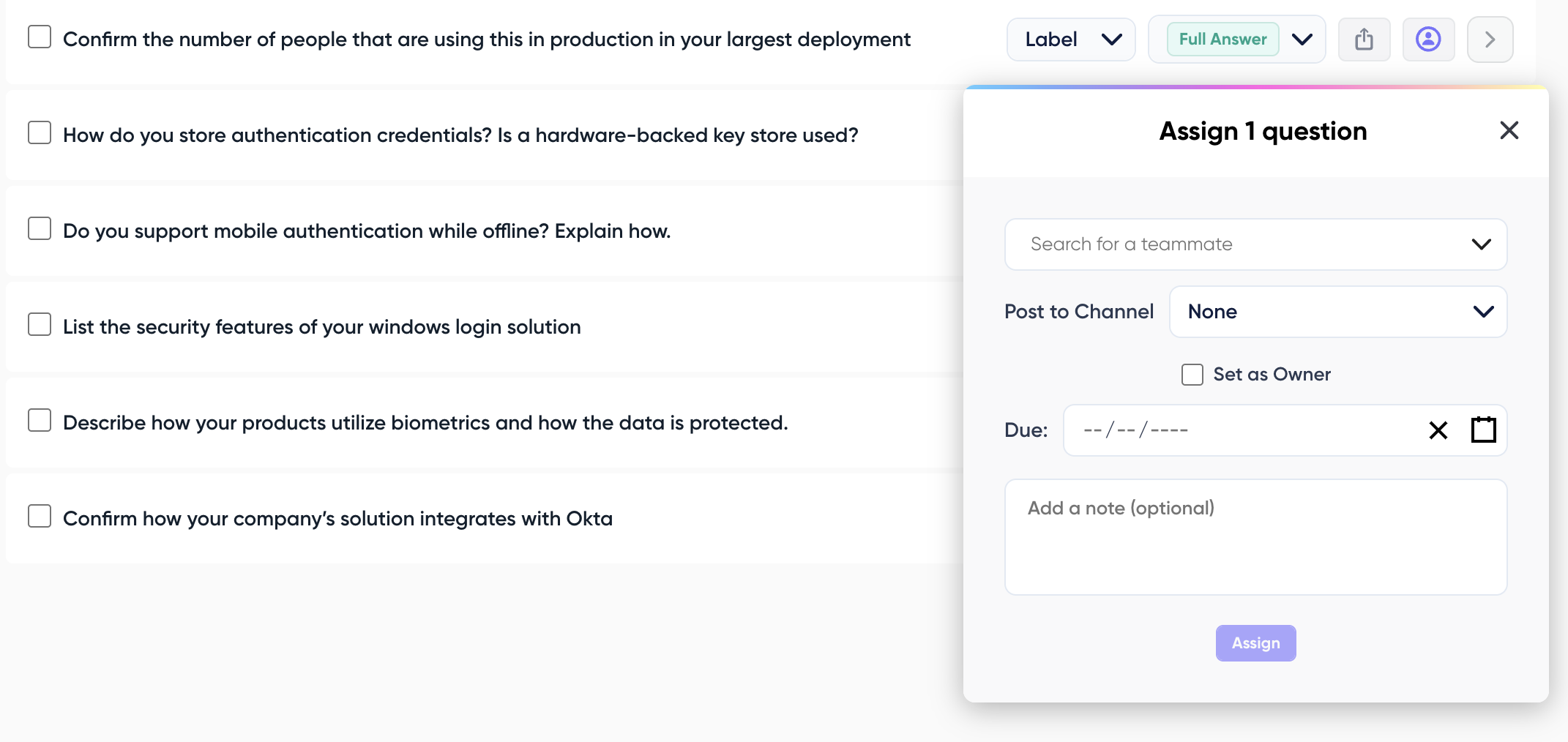
The assigned SME receives a notification via email, Slack or Google Chat. Once a query is assigned, 1up automatically changes the status to Under Review. The assigned SME just has to select Complete Assignment or can respond via the Comment Stream.
Make it easy when you truly need them
Even with a great content library, you will still need live help sometimes. New product, strange question, deal too big to risk. When that happens, lower the effort as much as you can.
- Ask for less: Send the two or three questions only they can answer, never the full document.
- Give a deadline with a buffer: "End of day Thursday" beats "ASAP." Add a day in case they need it.
- Explain why it matters: Stakes plus the buyer's name beats ten reminder emails.
- Let them talk, not type: Record a 15 minute call and turn their words into the answer yourself.
- Work with their rough draft: Take their notes and polish them. SMEs are specialists, not copywriters.
The pattern is the same every time. You carry the heavy part. They bring the knowledge only they have.
Working with external SMEs
Internal experts are one thing. External SMEs, like channel partners, contractors, or vendor reps, need extra care because you cannot lean on their manager when things stall.
A few rules that keep external help smooth:
- Give them more lead time than you would an internal SME, since your bid is nowhere near the top of their list of to-dos
- Be crystal clear about what you need and what happens to their input
- Tell them you will store their approved content and only come back when their piece is actually in play, so they are not reviewing things for no reason
- Use guest access in your tools instead of long email chains, so they see exactly what to do
For regulated or highly technical bids, the handoffs get even trickier. If your responses run through compliance or counsel, map out how legal teams fit into RFP workflows before the deadline crunch, not during it. The goal is no surprises for anyone who has to sign off at the end.
When SMEs and the proposal team disagree
Sometimes an SME wants to answer one way and you read the question another way. That is normal. Two smart people looking at the same RFP from different angles.
Keep it calm and keep it about the buyer. A few moves that help:
- Listen first. Your SME may be protecting you from a claim you cannot actually back up.
- Explain your read of the question and why the exact wording matters to the score.
- If you stay stuck, pull in the seller who owns the account. They know the buyer's real pain and can break the tie.
Most disagreements come from missing context, not ego. Share what each side knows and the right answer usually shows up on its own.
Bring SMEs in earlier, not later
The worst time to first contact an SME is the night before the deadline. The best time is before you even commit to the bid.
Loop key experts into the go/no-go decision so they can flag early whether you can really deliver what the RFP asks. An engineer might spot a requirement you cannot meet. A compliance lead might catch a deal-breaker clause. Better to learn that on day one than after you have sunk 30 hours into a proposal you were never going to win.
Early involvement also makes the later asks feel less random. The SME already knows the deal, the buyer, and why their part matters. So when you come back for answers, you are not starting cold and they are not annoyed.
How AI changes the SME workload
This is the part that has shifted fast in the last couple of years. AI can now draft RFP answers in seconds by pulling from your past responses and approved documents. At first glance it looks like AI should push SMEs out of the loop completely. In practice it does the reverse and makes good experts even more useful.
AI is quick, but it is shaky on truth. It will hand you a confident, wrong answer and never flinch. In a marketing section that is annoying. In a security or compliance section it is dangerous, because a bad claim can sink the deal or create real legal risk down the road. So a human still has to check the work before it goes out. This is exactly why the RFP process in the generative AI era leans on experts for judgment and review rather than raw typing.
Think about what "checking" really means on a live bid. Someone has to confirm the hosting answer still matches your current setup. Someone has to catch that the AI quoted a certification you let lapse. Someone has to notice the tone is off for a government buyer who wants plain facts. Those are all jobs for a person who knows the material, which is your SME. The AI saves them the blank page, but it does not save them the responsibility.
The data backs this up. In our State of AI in Knowledge Management report, 97% of people said human curation and governance is still essential, even with AI carrying the first draft.
.jpg)
That number matters for how you treat your SMEs. Their review is the part of the process you cannot automate away, so you should spend it with care. Use the machine for volume. Use the human for the calls that carry real risk. Burning expert time on questions the AI could have answered from approved content is exactly the waste you are trying to kill.
So the smart setup looks like this. An answer engine handles the routine, repeated questions on its own, pulling only from answers your SMEs already approved. The experts get pulled in for the genuinely new or high-stakes items. They go from being a copy-paste machine back to being experts, which is what you hired them to be. Your win rate climbs because answers stay accurate, and your SMEs finally get their afternoons back.
The fewer times you interrupt an expert, the more willing they are to help when you genuinely need them. Picture the flow on a real bid. A new RFP lands on a Monday. The answer engine fills in 70 to 80 percent of it from approved content within the hour. Your proposal team cleans up the wording for this specific buyer, and the SME reviews only the handful of answers that are new, technical, or risky. Nobody rewrites the data-hosting paragraph for the fortieth time this year. The whole thing moves faster, and the one expert you were nervous about bothering barely had to lift a finger.
This shift is the real prize. You bring the expert in once, capture what they know, and let the system carry it forward into every future bid.
Someone has to own the knowledge
A content library only works if a real person keeps it honest. Without an owner, answers drift out of date, two sources start to disagree, and trust drops. AI tends to make this problem bigger, because it will happily repeat the stale answer at scale and sound sure of itself while doing it.
This is why a new role keeps showing up on response teams. Call it the keeper of the knowledge base, or what we describe as the rise of the AI knowledge engineer. One person owns accuracy, runs the review cycles, and decides what counts as the approved answer. Teams that name an owner see fewer conflicts and faster reviews. Teams that leave it to "everyone" end up with no one doing it.
The split is wider than you might guess. In our report, only 38% of teams had a dedicated knowledge engineering person or team, while the rest either spread the job around, ran it ad hoc, or had not set it up yet.
.jpg)
So if you have not handed this to someone yet, you are in the majority, and that is the gap to close. The teams with a clear owner are the ones whose answers stay accurate and whose SMEs are not constantly cleaning up the same messes.
You just need one person who is accountable for the library and some time set aside to keep it current.
Track SME metrics that prove it works
If you want a budget and buy-in, show the numbers. A few simple metrics tell the story:
- Percent of each RFP completed from the library before any SME touches it
- Average SME turnaround time on the questions you do send
- Number of repeat questions you eliminated this quarter
- Win rate on bids where SMEs were looped in early versus late
You do not need a fancy dashboard. Even a rough monthly tally shows whether your SME load is dropping and your answers are getting better.
Here is how 1up handles this:
1up’s reporting and analytics tracks most of it for you, showing answers generated, questionnaires cleared, and hours saved, plus a KB Insights view that flags which topics still need an expert and which answers are already solid. That last part is the one that protects your SMEs. It points you straight to the gaps worth their time and away from the questions the system already handles.
The reports are also handy at review time. When you sit down each quarter to decide which answers need an SME and which ones are fine to leave alone, the dashboard already shows you where the gaps are, so you are not guessing. That is the same idea from earlier, capturing each answer once, except now you can see it working instead of hoping it is.
Thank your SMEs, and mean it
Last thing, and it is the easiest to skip. Recognition.
Loop your SME in when the deal closes. Tell them their section helped win it. Copy their manager on a short note. A coffee card is nice, but honest credit in front of the right people lasts longer than any gift.
SMEs remember who made them look good and who treated them like a vending machine. Be the first kind. The next time you need a fast answer, you will be glad you were.
The habits behind better SME collaboration on RFPs
Working with SMEs on RFPs really comes down to a few habits. Respect their time like it costs money, because it does. Capture answers once so you stop asking twice. Bring experts in early, keep every request small and clear, and let AI carry the repetitive load so people only handle what needs a human. Do those things and your win rate goes up while your experts stop dreading your name in their inbox.
FAQs
A subject matter expert gives the accurate technical answers an RFP needs, flags claims that could create risk later, explains why your solution fits the buyer, and reviews drafts before they go out. In short, they make your proposal believable.
Make the ask small and specific. Send only the questions they can answer, give a deadline with a little buffer, explain why the deal matters, and offer to write up their rough notes or take a quick call. The less effort you put on their plate, the faster they reply.
No. AI can draft answers fast by pulling from past responses, but it can be confidently wrong, which is dangerous in security or compliance sections. A human expert still has to review and approve the answers, which is why most teams keep SMEs central even as they adopt AI.

.png)
AI Made Writing Code Free and Moved the Bottleneck to Code Review
The Payoff of Connecting Questionnaire work to your Sales Pipeline

Shadow AI: What Your Reps Are Pasting Into ChatGPT Right Now

How to Write an RFP Response That Survives AI Scoring
SIG vs CAIQ vs VSA: A Simple Guide to the Big Three