![The State of AI in Knowledge Management [2026]](https://cdn.prod.website-files.com/69c22acabeee399088a91a06/69d97ceaf7c2440a1feabba1_vhs_cassette_state_of_ai_in_knowledge_1.png)
Executive Summary
AI is now a practical tool inside many organizations, but knowledge layer beneath it remains fragmented and unsolved. Employees increasingly rely on AI to answer internal questions about products, pricing, security, compliance, and operations. Trust, accuracy, and governance still limit how far teams are willing to rely on these systems.
We ran a survey of hundreds of professionals across sales, operations, IT, and knowledge-heavy roles – and found clear patterns. AI knowledge management is widely adopted but rarely mature. Most organizations are experimenting or operating at a limited scale. Only a small group has reached reliable, organization-wide use.
For leaders in sales, product, and operations, the message is clear and practical: AI speeds up access to information, but human review and clear ownership remain essential.
As expectations rise, the gap between what organizations want and what they are ready to support becomes easier to see.
Knowledge management has always focused on helping employees find accurate information quickly. In 2026, AI systems increasingly carry that responsibility.
These systems connect documents, policies, approved answers, and institutional knowledge into a single searchable layer. Employees query this information using natural language.
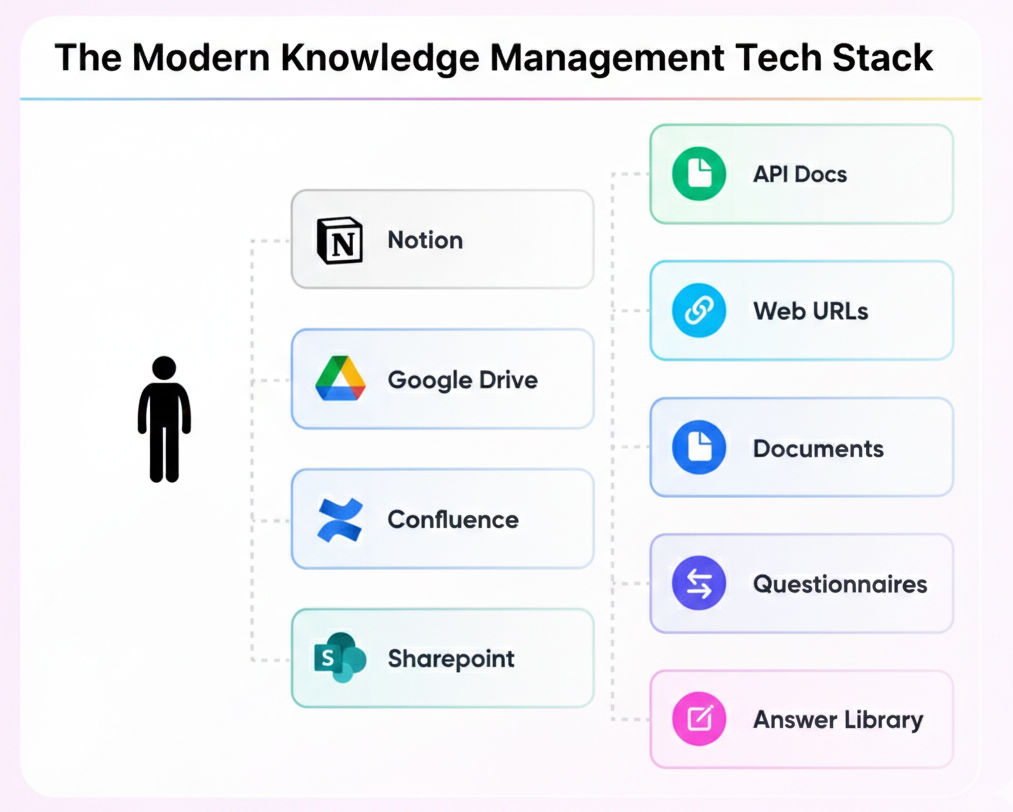
For most organizations, success depends on the quality and structure of the company's knowledge base. When knowledge is fragmented or outdated, AI amplifies problems instead of fixing them.
This report explores how organizations use AI for knowledge management today, how confident employees feel in the answers they receive, and what they expect next. The findings combine survey data with real-world usage patterns to reflect how AI performs under operational pressure.
Methodology
The insights in this report are based on a survey conducted in late 2025 with hundreds of complete responses. Participants came from sales, presales, operations, IT, and other corporate roles where answering internal knowledge questions is part of daily work.
We examined adoption levels, trust in AI-generated answers, editing behavior, governance models, and consolidation intent. Survey findings are paired with anonymized customer usage examples drawn from real enterprise deployments.
How is AI Used in Knowledge Management Today?
AI now plays a role in many knowledge workflows, but its use varies widely across organizations. This section examines where AI is being applied today and how much trust teams place in it.
AI Is Used Mostly in Small Tests and Busy Teams
Most organizations report some level of AI use in knowledge management, with the largest group operating in early experimentation or partial deployment. AI has moved beyond novelty, particularly for teams handling large volumes of internal questions.
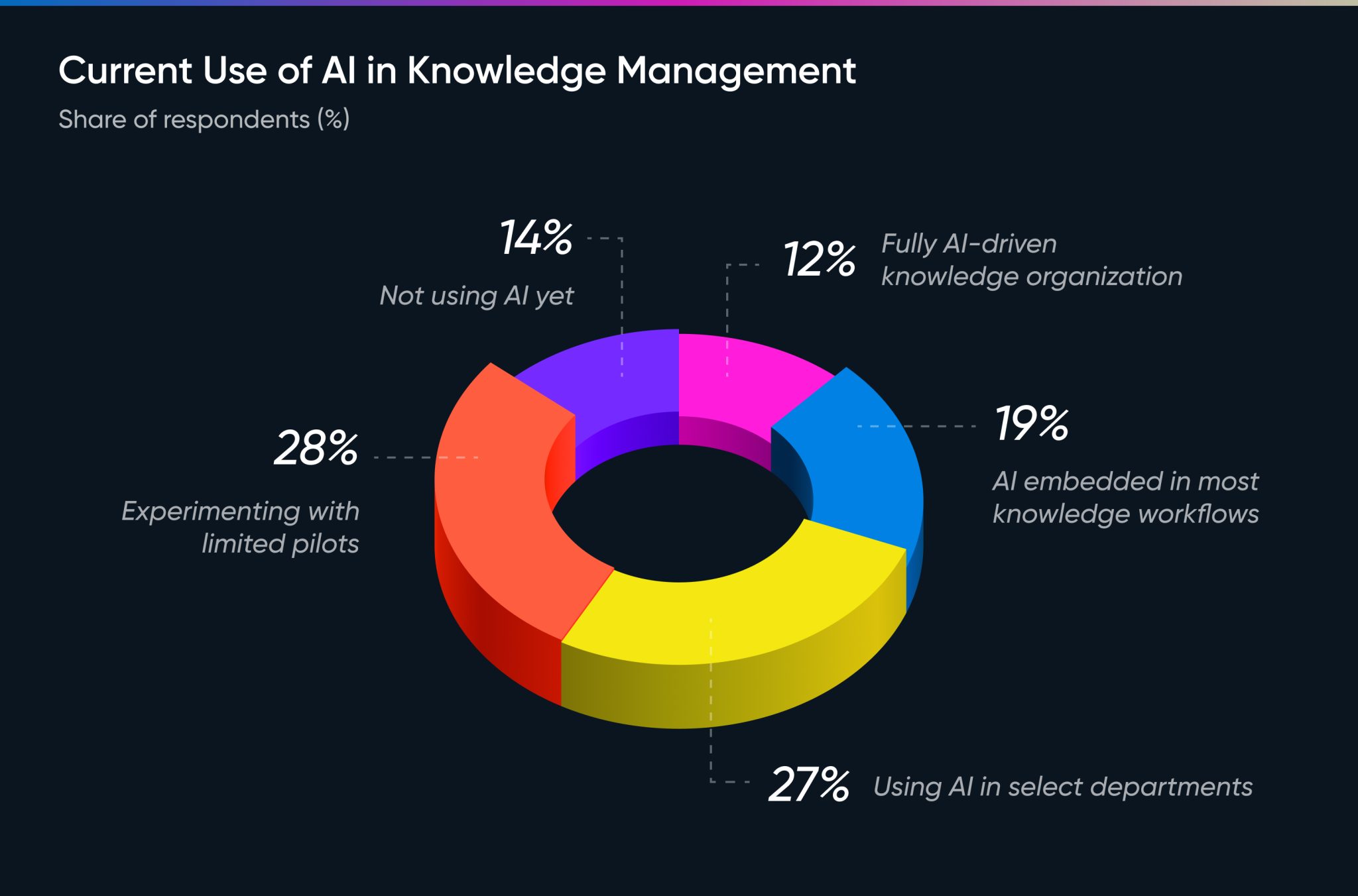
Fully AI-driven knowledge workflows are uncommon. In many organizations, enterprise search is still difficult, which limits how confidently teams rely on AI. As a result, AI is most often used to support human judgment rather than replace it, revealing a clear gap between adoption and confidence.
“AI has completely changed the speed of proposal work, but it has not changed who should be in control. I use AI to accelerate outlines and first drafts, then I step in to add proof points, metrics, and customer-specific insights. That human layer is where proposals are won or lost. The best teams use AI to remove bottlenecks, not to replace judgment, persuasion, or decision-making. In sales, success still depends on understanding people, and that is something AI cannot fully automate.”
— Nick Squires, Proposal Consultant, Fleetio
Most AI Knowledge Deployments Are Still in Early Stages
Adoption of an AI tool by itself doesn’t show real maturity.
What matters most is whether AI gives reliable results for teams in their daily work.
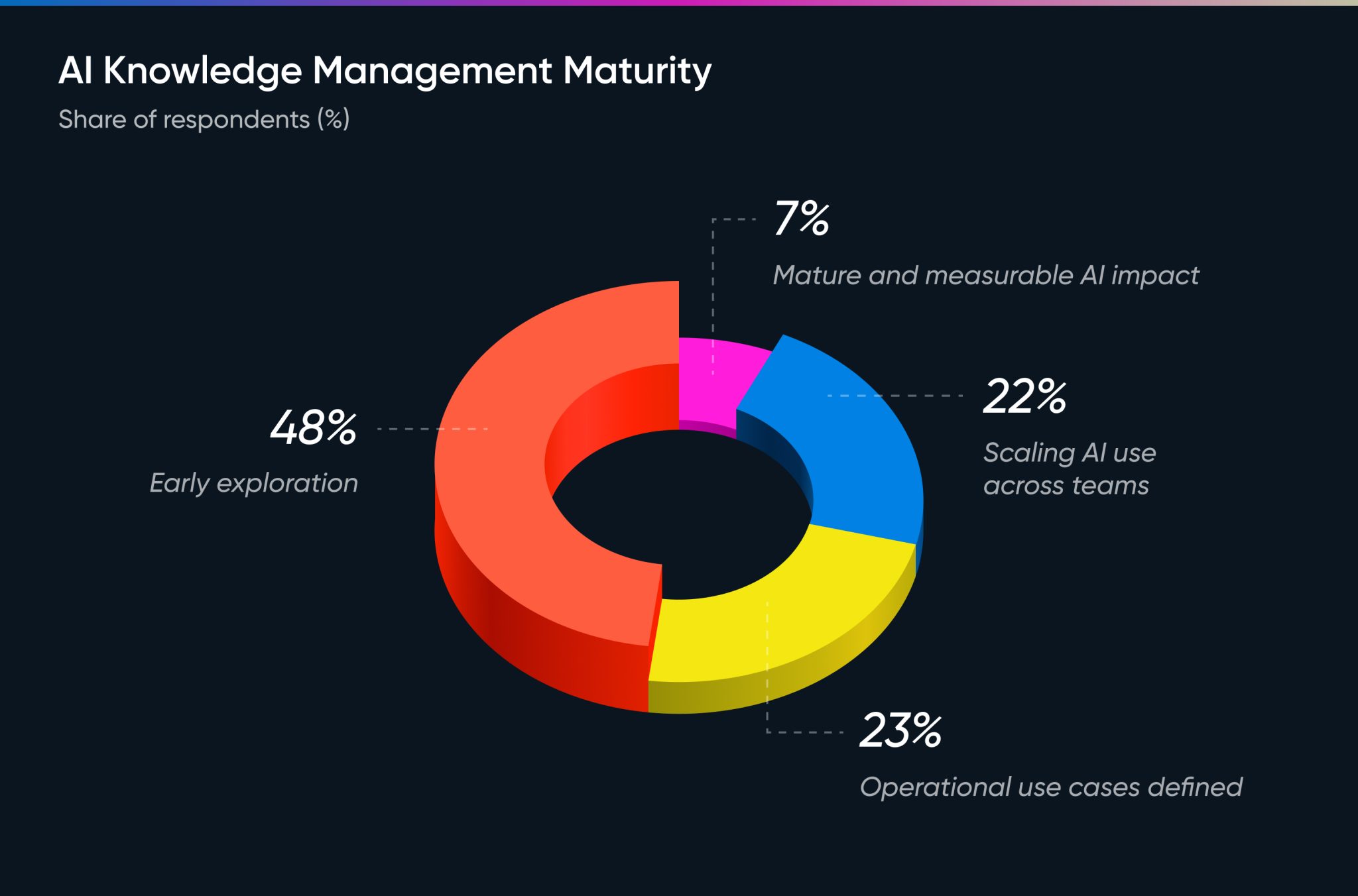
Most organizations remain in early exploration or basic operational use of AI for knowledge management. Few report consistent, measurable impact across the business.
This gap highlights a common challenge with automating enterprise knowledge management. Deploying AI is often easier than building the structure, governance, and ownership needed to trust it at scale.
Why Adoption Is Uneven Across Teams
Even when organizations adopt AI for knowledge management, usage rarely spreads evenly across the business. Some teams fully integrate AI into daily workflows. Others continue to rely on manual processes or informal knowledge sharing.
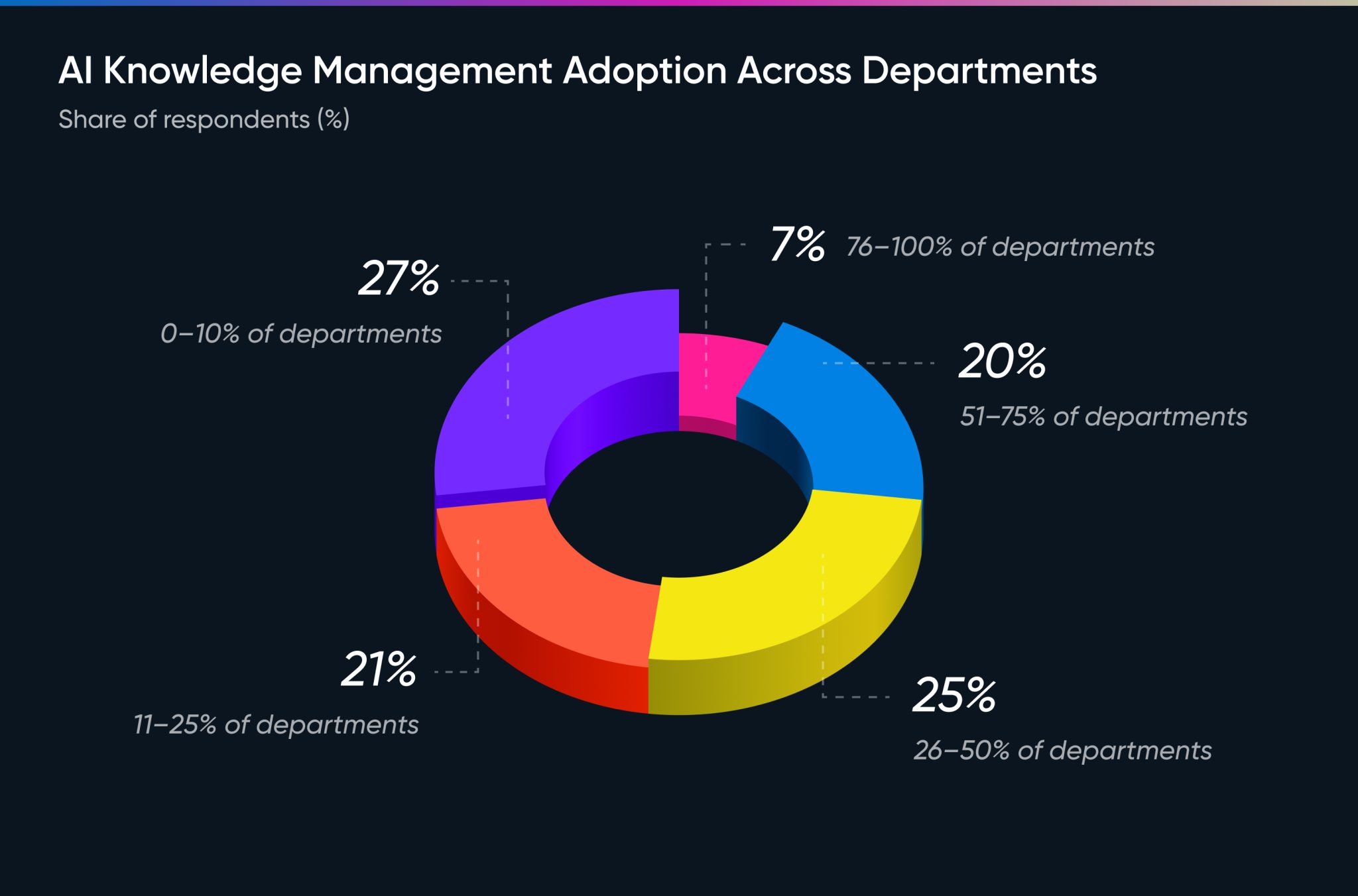
Sales, IT, and customer-facing teams are typically the earliest adopters, driven by immediate workload pressure rather than a coordinated, organization-wide strategy.
Without a shared content strategy, knowledge is created and maintained differently across teams, which limits consistency and increases review cycles.
Glean and Guru Are the Most Well-Known AI Knowledge Tools
As interest in AI-powered knowledge management grows, more tools claim to address the problem. To understand how familiar organizations are with the current landscape, respondents were asked to rate their familiarity with a range of AI knowledge tools.
The results show that many people are aware of these tools, but not deeply familiar with any one of them. The market is crowded and still changing. Organizations that define their requirements before evaluating knowledge management software are more likely to succeed than those driven by brand familiarity.

AI Helps, But Finding Great Answers Remains Painful
Even as more teams use AI, they still struggle with basic knowledge problems. AI can find information faster, but it can’t fix scattered, outdated, or poorly managed content on its own.
These issues limit how much teams are willing to trust AI in high-stakes workflows. They also explain why many deployments stall before seeing value.
Fragmentation and Structure
As teams expand their use of AI in knowledge management, small structural problems get louder. To understand where teams struggle most, we asked users to identify their main challenges.

Knowledge is still spread across documents, tools, and teams. AI can speed up search and draft answers faster, but reliability takes a hit when the underlying content is duplicated, outdated, or inconsistent. When AI pulls from fragmented sources, it produces answers quickly, but not always correctly.
"Most companies are learning this the hard way. They've layered internal company AI on top of broken knowledge structures rather than fixing them. They get fast answers but they don't trust them. Executives are excited to hear about AI adoption, but the boots on the ground are struggling with the outputs."
— George Avetisov, Founder, 1up.ai
AI Integrations Are Growing, but Coverage Is Uneven
Good adoption depends on how well systems are connected behind the scenes. To understand whether AI tools have consistent access to the information they need, we asked users how well their knowledge and AI tools integrate with one another.
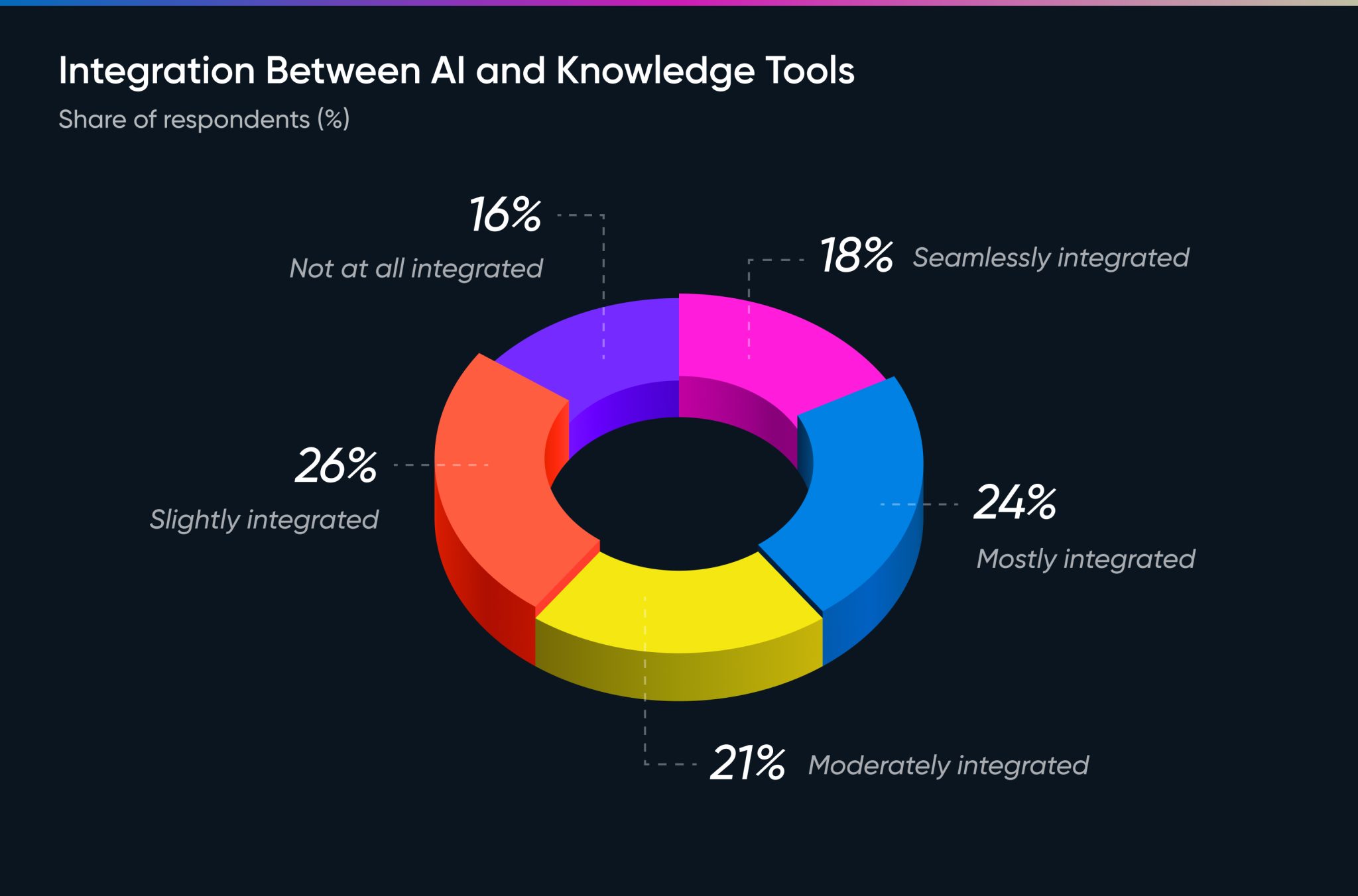
Weak + inconsistent integrations are common. Teams report that AI tools connect to only SOME of the systems where critical information lives. Answers end up incomplete or out of date.
When AI can’t see all the right sources, employees have to double-check answers in different tools. Constant fact-checking lowers trust and makes AI more of a starting point than a final answer.
“When it comes to the documentation that feeds our AI knowledge base, there isn’t a single owner for everything. We rely on a mix of security documentation, which our security team owns and updates regularly, often in collaboration with legal, alongside product and support documentation. At JumpCloud, we’re fortunate to have strong product documentation and technical writers who consistently keep it up to date. That foundation makes a real difference.”
— James Herbert, Sr. Director, Solutions Engineering, Jumpcloud
Confidence in AI Answers is Rising
Accuracy is key to "feeling good" about knowledge management. We asked how confident employees feel about finding correct and up-to-date answers at work.
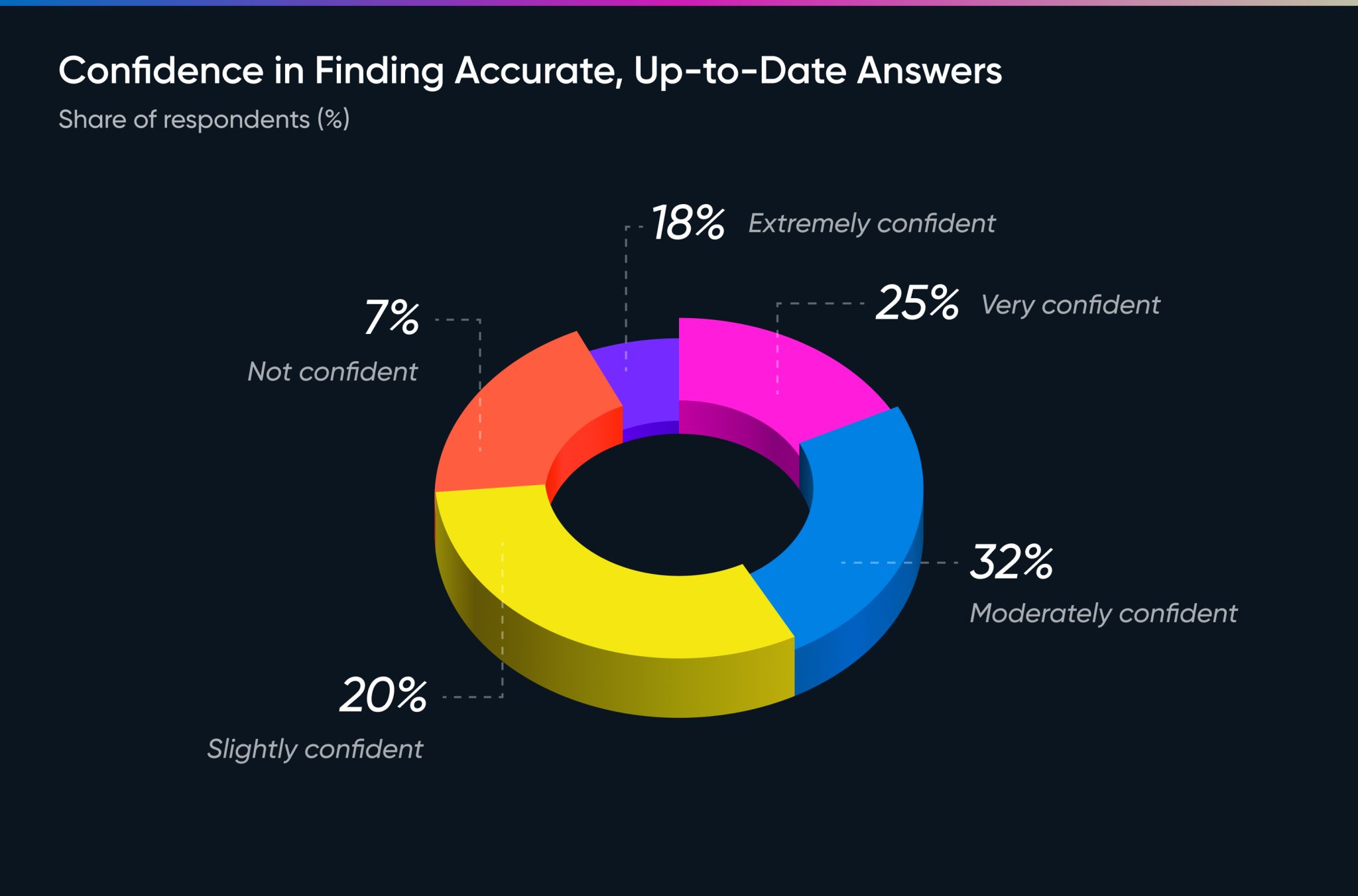
High confidence remains uncommon.
Only a small group report being extremely confident. Most are uncertain, not outright distrustful. Employees often believe answers are generally correct, but not reliable enough to use without verification.
This uncertainty has real consequences.
For example, sales leaders often add extra review cycles, cross-check sources, and redo work before sharing AI-generated answers with customers. Product managers may also second-guess their own documentation when AI responses are incomplete. These fact-checks reinforce the need for workflows that prevent AI hallucinations.
Until confidence improves, AI will remain a productivity aid rather than a trusted source of record. Building trust depends on clear ownership of knowledge inputs, regular updates of those sources, and accountability for what info is considered authoritative.
How Employees Actually Use AI
How employees use AI in knowledge workflows depends less on availability and more on trust. We dug into how teams are using AI-generated answers in practice and how they're judging what is "good."
Trust in AI-Generated Answers
Trust shapes how far employees are willing to rely on AI. To understand this, respondents were asked how much employees trust AI-generated answers in their organization.

Credibility is improving, but full trust remains rare.
Most employees rely on AI in limited contexts rather than consistently, which means answers are often treated as drafts instead of final outputs. In customer-facing workflows such as sales questions, RFP submissions, due diligence and compliance reviews, verification remains common.
This caution comes from a place of uncertainty. It's not necessarily a resistance to AI. Confidence scoring and certainty signals are still unclear. That makes it hard for users to know when an answer can be trusted. As a result, AI is looked at as more of support tool rather than an authority. Building trust will require clear signals around source quality, freshness, and accountability.
Editing and Verification Behavior
Editing behavior refers to how often employees review, modify, or override AI-generated answers before using them in internal or external communication.
It’s a clear signal of how much employees trust AI-generated content. To understand how AI fits into real workflows, we asked how often employees edit or override AI responses before using them.
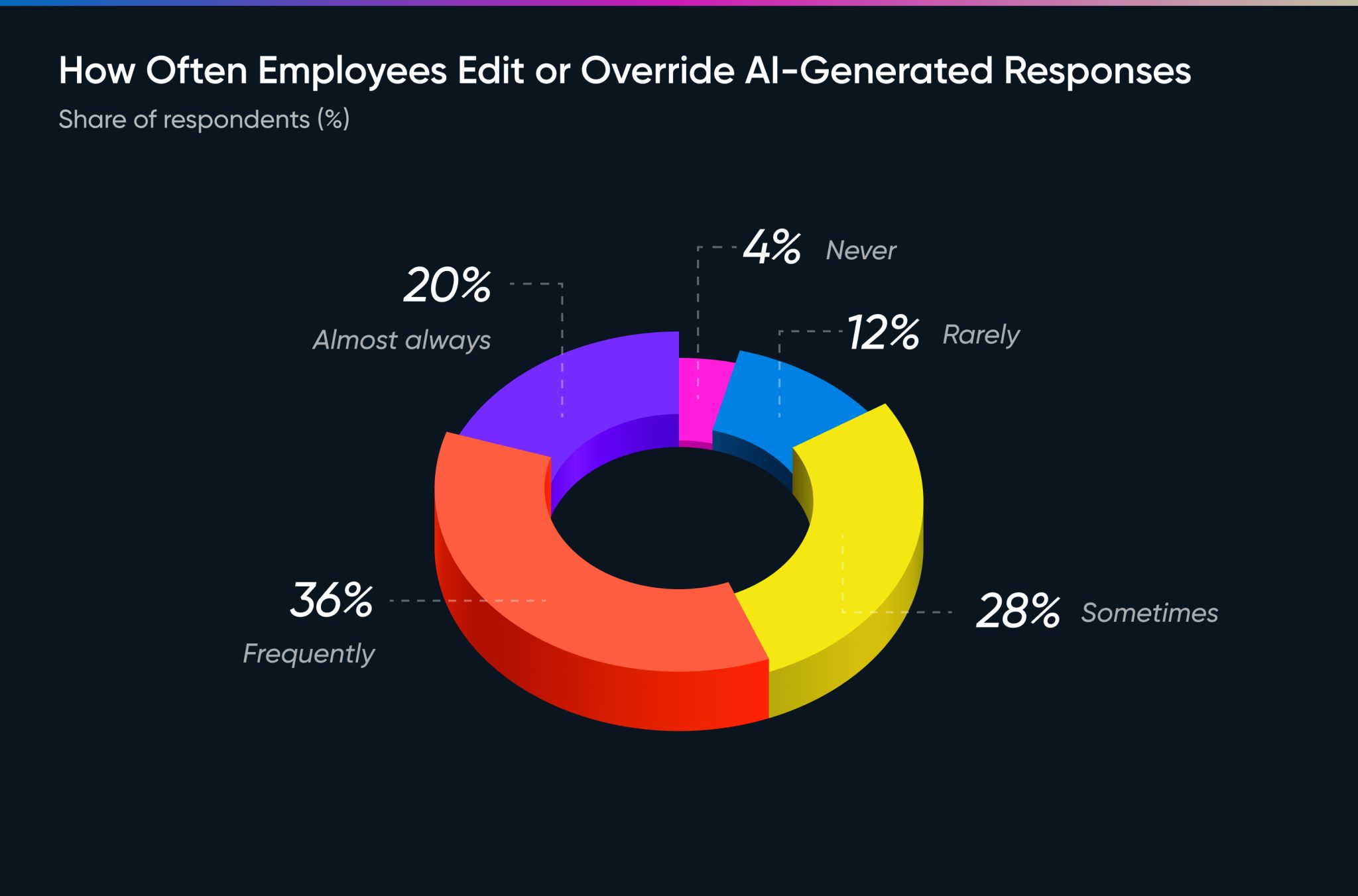
Editing AI output is standard practice. Most employees adjust AI-generated responses before sharing them externally or using them in formal documents, confirming that AI is treated as a drafting tool rather than a final authority.
This behavior shows practical thinking, not doubt. Employees value AI’s speed but still review content carefully in customer-facing work where tone, accuracy, and clarity matter. Workflows designed for human review help prevent low-quality AI output and produce more reliable results.
Editing is a safeguard, not a sign of failure. AI speeds up the first draft, while humans stay responsible for accuracy and context.
"AI gives us speed, but not certainty. We treat AI answers as a strong first draft, then verify them across approved systems and owners before anything goes to a customer. When knowledge is spread across tools, teams are forced to cross-check facts, commitments, and messaging manually. That review discipline is what keeps answers accurate, defensible, and aligned, especially in high-stakes bids."
— Pradeep Nayar, Global Bid Manager, Global Solution Advisory and Presales, WalkMe®
What Employees Value Most in an AI Assistants: Accuracy
What employees value in an AI assistant shapes how it is used day to day. To understand these priorities, respondents were asked which attributes matter most in an AI-powered knowledge assistant.
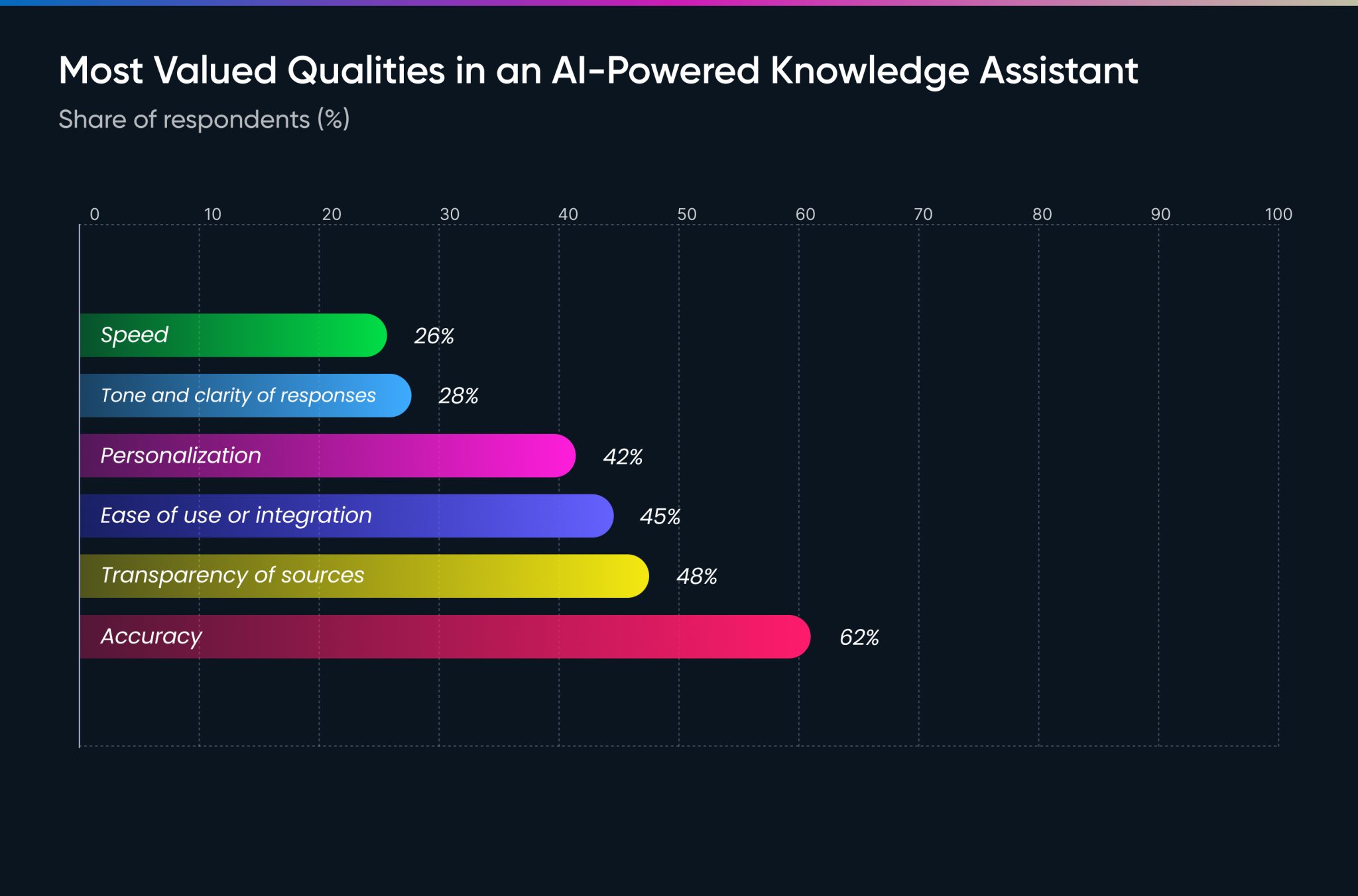
Accuracy matters most, followed by transparency and ease of use. Speed ranks last.
Seriously?! Speed ranked last?
Apparently, people care more about knowing an answer is true and understanding how it was created. This goes against common software design ideas, where speed is often treated as the most important feature.
This challenges the assumption that faster answers = better adoption. Employees are willing to wait longer for reliable responses, especially in customer-facing and high-stakes workflows. AI assistants that prioritize accuracy + clear sourcing are more likely to earn trust and see sustained use.
The Human Layer Behind the LLMs
As AI becomes embedded in knowledge workflows, ownership becomes unavoidable. Reliable knowledge systems depend on people who are accountable for accuracy, maintenance, and ongoing improvement.
This shift is driving the rise of the AI answer engineer, a role focused on governing knowledge so it remains trustworthy at scale.
Most AI Knowledge Systems Lack a Clear Owner
The success of AI knowledge management also depends on clear ownership. Without someone accountable for accuracy and maintenance, even strong systems struggle to deliver consistent results.
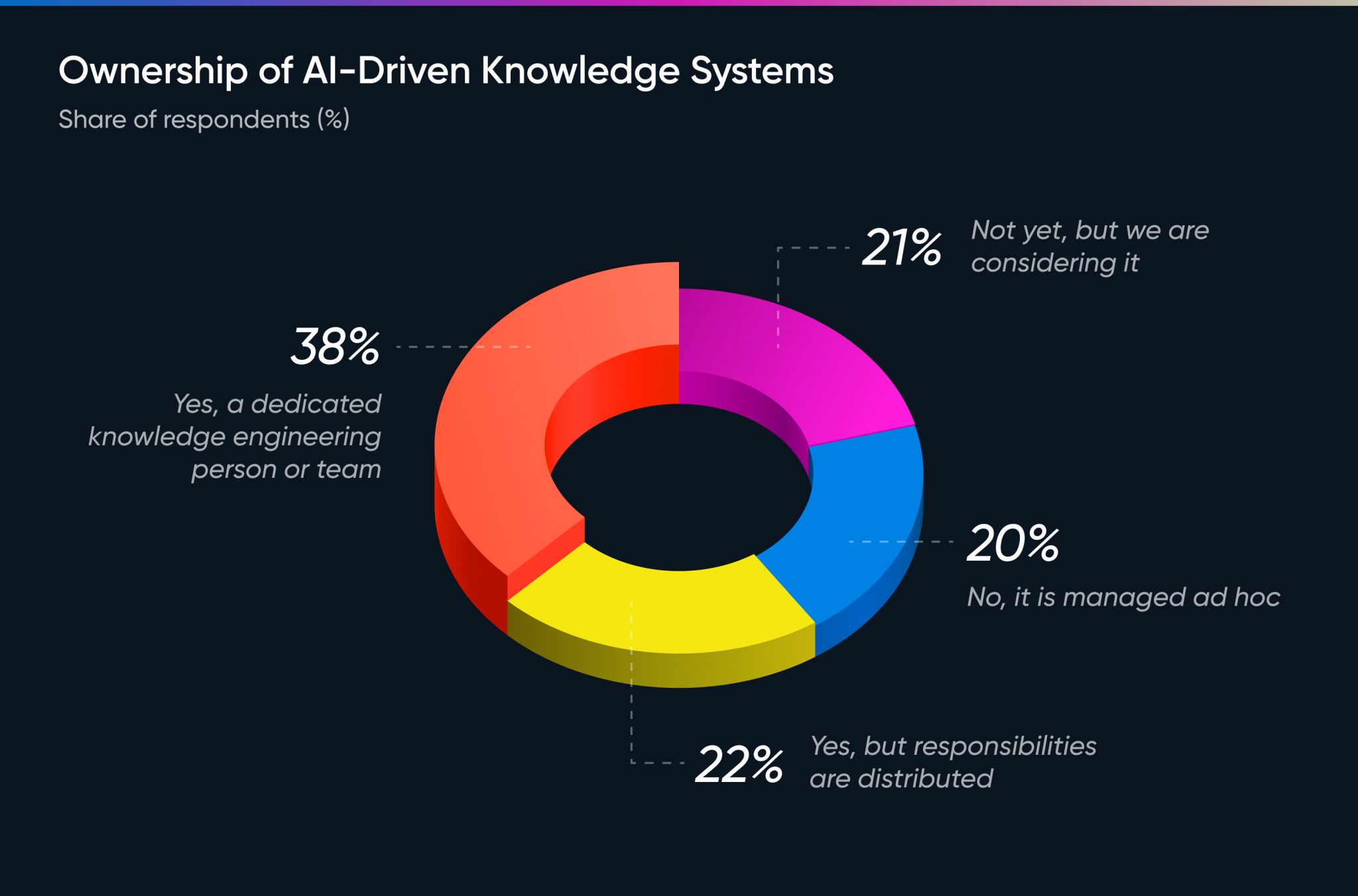
Most organizations still lack formal ownership. Responsibility is often shared across teams or handled informally, which leads to outdated content and conflicting answers.
AI systems cannot easily resolve conflicts on their own. Human oversight is a must.
Teams with defined ownership see better outcomes. Clear responsibility leads to regular review, faster issue resolution, and standards for what information can be trusted. As AI use grows, more teams see the need for dedicated roles to manage the underlying data.
"AI may generate the output, but humans still carry the professional and legal responsibility for the answer. In high-stakes work, that creates a real trust tax. Teams must review every response to avoid hallucinated terms or unintended commitments, which can offset much of the time AI saves. There’s also a confidence loop at play. People often use AI when they lack expertise, but that makes it harder to prompt well or validate the output. The result is second-guessing both the question and the answer."
— Shaun Dolan, Director of Solutions Engineering, Orca Security
97% Say Human Curation Is Still Essential
As AI takes on a larger role in knowledge management, human oversight remains essential. Most respondents rate human curation as very or critically important.

AI alone is not sufficient for high-stakes knowledge. Human curation ensures content stays accurate and aligned with how teams communicate. It also helps resolve conflicts when sources disagree.
The Future of AI in Knowledge Management
As organizations move beyond basic AI-assisted search, expectations for AI are rising. To understand where demand is headed, the survey asked respondents which new capabilities they want AI to support next in knowledge management.
What companies want AI to do next

We're seeing a move away from answering questions only when asked toward systems that predict needs, create documents, and improve over time. Many teams also want role-based help, where AI gives answers based on context instead of generic replies.
Users are frustrated with manual repetitive work. They want AI to surface relevant information earlier and reduce preparation time. This is true of all departments. Here are some use cases we're already seeing in the wild:
Teams want AI to act as an active participant in knowledge workflows, not just a faster search tool.
Tool Consolidation Pressure
As organizations adopt more AI and knowledge tools, complexity has become harder to manage. To understand how teams are responding, the survey asked how likely organizations are to consolidate tools within the next year.

Consolidation is a near-term priority for many teams. Nearly half of respondents expect to reduce the number of knowledge or AI tools they use, driven by the need to simplify fragmented workflows.
Tool sprawl increases search time, verification effort, and inconsistency. Consolidation is less about cost and more about improving integration, ownership, and trust in AI-driven knowledge.
"Start with the business goal, then choose the right tool. AI has not changed this principle, it has amplified it. General-purpose tools can help, but purpose-built solutions deliver far better results for specific workflows. Over the next few years, specialized AI tools that solve real problems will drive market consolidation. The teams that succeed will choose tools designed for their workflows, not ones adapted to them."
— Alexis Gaï, Chief Revenue Officer, Cleeng
Predictions for 2026 and Beyond
What's our take on the next phase of knowledge management?
Reliability> experimentation. As AI becomes part of daily work, businesses will be judged on how dependable their knowledge systems are.
- Knowledge ownership will become formalized. Dedicated roles will emerge with clear responsibility for accuracy, governance, and system performance.
- Data Freshness will become expected. Self-updating and continuously maintained knowledge will shift from a differentiator to a baseline requirement.
- AI will move from reactive to proactive. Systems will surface relevant information earlier. Wether AI can reliably anticipate needs remains to be seen.
- Tool consolidation will accelerate. Teams will favor unified platforms that reduce complexity. No one needs 10 tools that do "kind of" the same thing. This is true of all tech stacks.
- Governance will differentiate outcomes. Accuracy, source verification, and accountability will matter more than speed alone.
The Future Is Unclear, but Fewer Tools Are Coming
No one knows exactly where AI is going next, but one thing is clear. Organizations are moving toward fewer, more connected tools. As AI is added to fragmented knowledge systems, complexity becomes the biggest problem, not the technology itself.
"Accurate, well-maintained documentation directly improves the quality of AI-generated responses. Keeping the knowledge base curated and current is critical to getting value from a tool like 1up. Ultimately, it’s a partnership between Sales Engineering and subject matter experts to ensure the most up-to-date information is always available to power our AI tools and deliver accurate answers."
— James Herbert, Sr. Director, Solutions Engineering, Jumpcloud
AI has made knowledge faster to access, but not more reliable by default. Most teams now use AI in knowledge workflows, yet few trust it enough to act without review. Fragmented content, unclear ownership, and weak integration still shape outcomes, even as expectations for automation grow.
Because of this, organizations are not trying to add more AI tools. They are trying to simplify. Tool consolidation offers a way to reduce rework, improve consistency, and create clearer ownership across knowledge systems.
The teams that move ahead will not win by chasing every new AI feature. They will win by fixing the foundations. Centralized knowledge, clear accountability, and human governance are what turn AI from a drafting tool into something people can trust.
AI will keep changing, but the deciding factor will remain human choice. Organizations that treat knowledge management as a system, not a feature, will be the ones that unlock lasting value.

.png)
AI Made Writing Code Free and Moved the Bottleneck to Code Review

The Payoff of Connecting Questionnaire work to your Sales Pipeline

Shadow AI: What Your Reps Are Pasting Into ChatGPT Right Now

How to Write an RFP Response That Survives AI Scoring

SIG vs CAIQ vs VSA: A Simple Guide to the Big Three