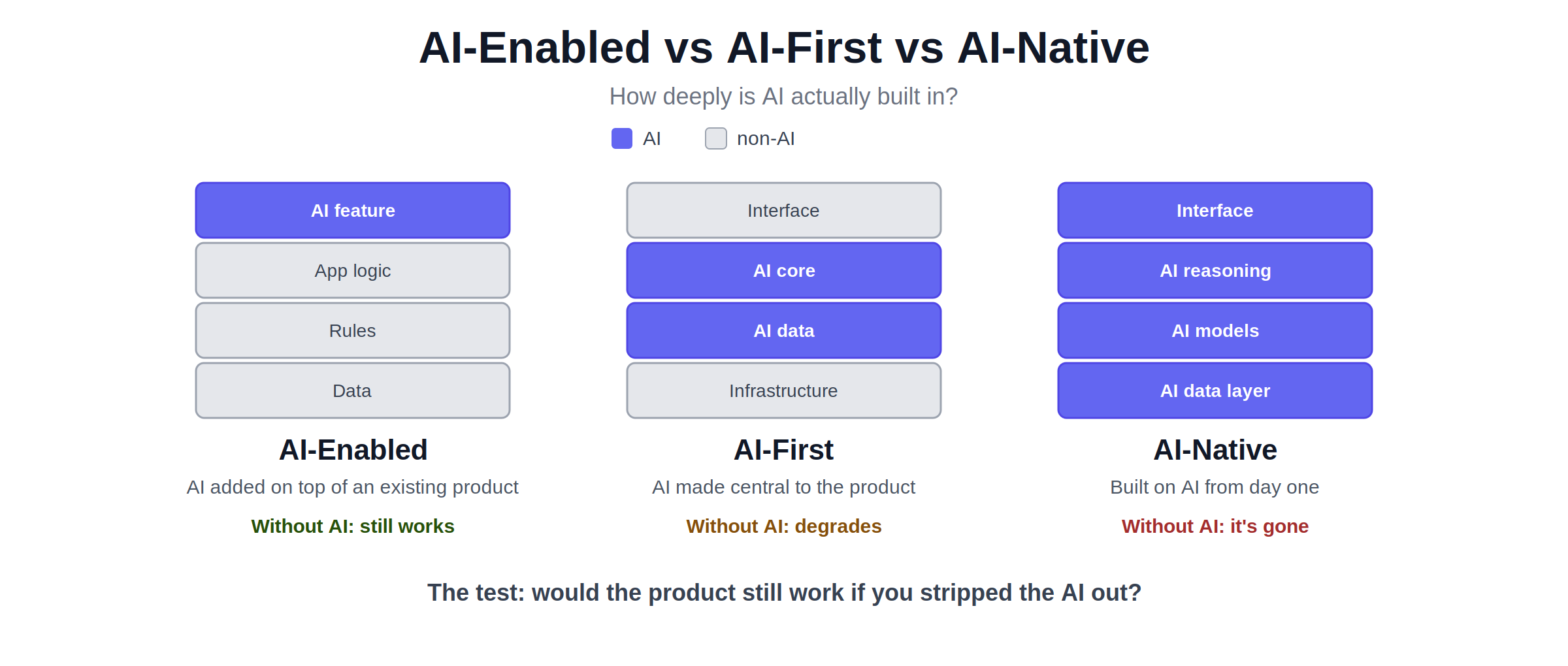
AI-native means the AI was in the plan before anything got built, not stapled on once the product already worked. Easy gut check: rip the AI out. Does it still do the job? Then somebody just bolted AI onto a normal product. Does it turn into a dead shell? Now you have the real thing. With AI-native, the intelligence is not riding on top of the product. It is the product.
Think of it as a slider. Far left, AI-enabled. A regular tool picks up a clever feature, the way Photoshop bolted on an AI eraser. Useful trick. Photoshop was still Photoshop for thirty years without it. Middle of the slider, AI-first, where a company tears itself down and rebuilds around AI despite not starting there. Far right, AI-native, AI baked in from day one. Other tech waves did this exact dance. Years ago "mobile-native" meant an app actually designed for a phone, not a desktop site crammed onto a small screen. "Cloud-native" meant software rewritten for the cloud rather than hauled onto it unchanged. The pattern never really changes. You do not bolt a new motor into the old frame. You draw up the whole car around it.
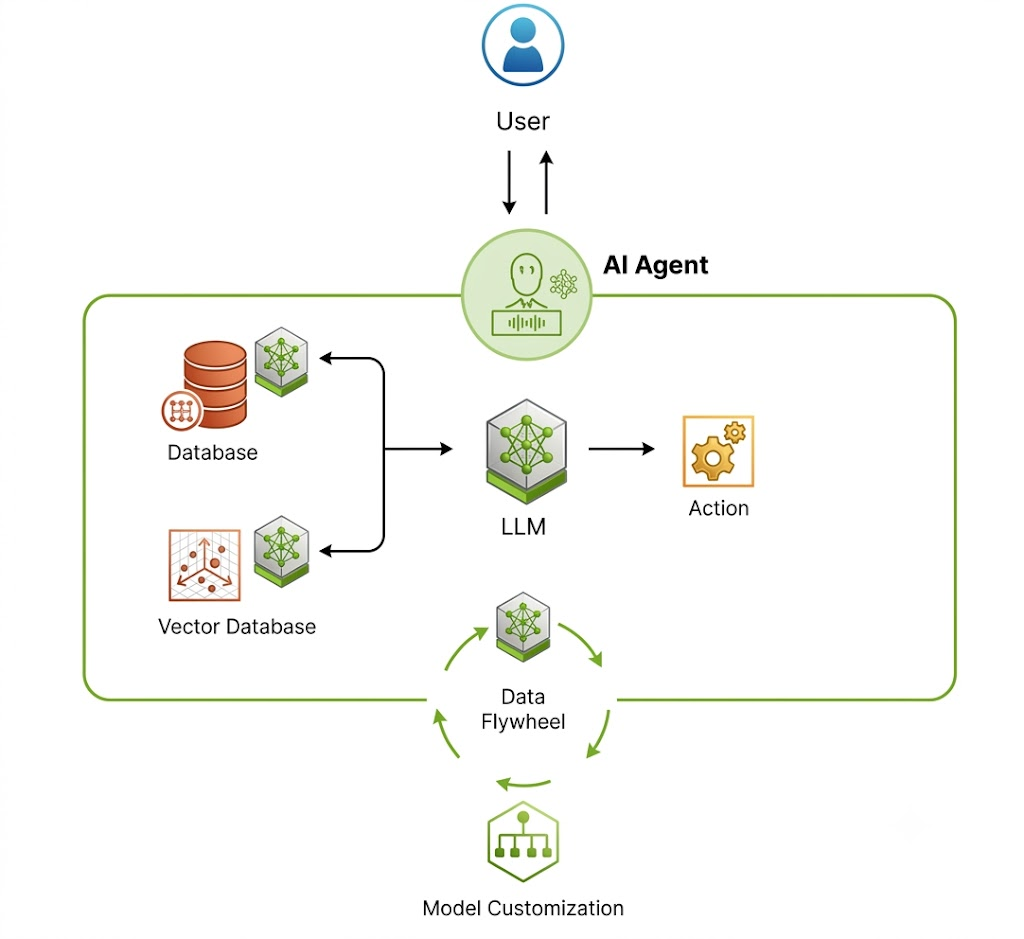
The insides differ too. Classic software runs on fixed rules, so you press a button and get the same result every single time. AI-native systems lean on models that reason and adjust, which means a chore that once took eight clicks can shrink into one request an agent quietly runs end to end. Mostly you just tell it what you want. No digging through menus. Hold Cursor, the code editor built around AI from scratch, up against GitHub Copilot, which showed up first as a plug-in slipped into an editor that already existed. Or set Perplexity's Comet, where the whole act of browsing runs through an assistant, beside a normal browser that tacked on a read-aloud button and called it innovation.
Here is the catch, and it is not a small one. "AI-native" might top the list of most-abused phrases in tech this year. It gets splashed across pitch decks and landing pages, and half the time it is glued to something that just pings another company's model through an API. So stop asking whether a company uses AI. They all do. Ask when AI became the foundation, and what has piled up since then. A team five years into training its own models on its own data holds a lead a latecomer cannot simply purchase. And the punchline writes itself. IBM, a company selling AI-native everything, expects the phrase to quietly die as AI soaks into all of it, the way nobody in 2026 brags about being "internet-native."
Signs something is truly AI-native:
- Remove the AI and it breaks. Pull out the intelligence and nothing useful is left standing.
- Built around AI from day one. Architecture, data, design, the whole thing assumes AI instead of bolting it on after.
- Natural language is the interface. You say what you want rather than clicking through screens.
- It learns and adapts. New data and feedback sharpen it over time, instead of leaving it frozen.
- Outcomes over steps. It folds a long process into a single goal you hand off, usually to an agent.
AI-Native Explained:
Curious what AI-native looks like at the company level, not just the product? In this Y Combinator talk, partner Diana Hu explains how to build a company with AI as its operating system from day one, why old management hierarchies start to break down, and why early founders have the edge.
FAQs
It means a product or company was designed around AI from the ground up, not handed AI as an add-on later. Quick test: picture the AI gone. If what is left is useless, the thing is AI-native. The intelligence is the foundation, and everything else sits on top of it.
AI-enabled is AI dropped into a product that already worked, like a chatbot added to legacy software or a recommendation feature in an old app. Take the AI away and the core still runs. AI-native does not survive that test. It was built on AI from the start, so the intelligence holds the whole thing up. One improves what already exists. The other is shaped around AI from day one.
Cursor, the code editor, was built around AI from the beginning, unlike plug-ins that bolt AI onto an editor that already exists. Perplexity's Comet runs the entire browsing experience through an AI assistant. As a rule, AI-native products lean on natural language as the main way in, get sharper the more you use them, and fall apart the moment you pull the AI out.