The AI Trust Gap: Why Only 1 in 5 Workers Actually Believe it

%20(1).jpg)
Walk into any office and ask who used ChatGPT this morning. Most hands will go up. Almost every team has some kind of AI tool open right now, sitting in a Chrome tab or pinned to the dock somewhere. But here's the weird part. Based on our State of AI Knowledge Management Report, only 18% of workers say they completely trust what these tools tell them. Another 30% say they trust AI very little or not at all.
That gap is doing something strange to how work happens. People keep using AI every single day because it's fast and it's easy. They also don't really believe what it says. So they double check it, rewrite it, and second-guess the output before sending anything to a customer. The hype says AI is replacing knowledge work. The data says AI is creating a new kind of work, which is fact-checking your own AI assistant.
AI Adoption is Through the Roof
AI is everywhere. 86% of teams now use AI in some form for knowledge management. Only 14% say they aren't using AI yet, which makes "we don't really use AI here" the new minority position in 2026. That tracks with what McKinsey found in their global survey of nearly 2000 executives, where 88% of organizations now regularly use AI in at least one business function.
So this isn't some experimental niche thing anymore. It's not a side project for the innovation team. It's just part of how most knowledge work gets done, whether a company has a formal AI strategy or not.
.jpg)
But adoption isn't the same thing as confidence. Just because someone opens an AI tool every morning doesn't mean they believe what it gives them. Look closer at the data and the picture gets more interesting. Only 12% of teams say AI is fully driving their knowledge organization. The rest are running pilots, using AI in select departments, or partially embedding it into workflows. People are still figuring out where AI actually belongs. Real enterprise knowledge management has always been about getting reliable answers fast, and AI hasn't changed that bar one bit.
Trust in AI Has Not Caught Up
Now for the part that should make every AI vendor lose some sleep at night. Only 18% of workers said they completely trust the output of their AI tools. That's a low number for a technology that's already everywhere. And it gets worse when you look at the other end of the chart. 21% of workers said they trust AI very little, and another 9% said they don't trust it at all. Add those up and you get nearly a third of the workforce actively skeptical of the answers they're getting.
.jpg)
The biggest single group, 32%, sits in the middle with a neutral level of trust. That sounds harmless, but it's actually the most telling number on the chart. The largest chunk of AI users are on the fence about a tool they use every single day. This isn't surprising once you understand how AI confidence scores actually work. Even the most advanced models still can't really tell you how sure they are about what they just said.
.jpg)
This is why almost everyone in our survey reported editing or overriding AI responses before using them. 96% of respondents said they edit AI outputs, and more than half said they do it often or almost always. The dream of pressing one button and getting a finished proposal? Not happening yet. People are still in the loop, still cleaning up, still adding the things only a human actually knows.
Trust is one half of the problem. The other half is whether workers even feel confident they can find the right answer to begin with, and the data there isn't much prettier.
Confidence in AI Isn't Catching Up Either
Here's the part that genuinely surprised us. You would think the more people use AI, the more confident they would feel about getting accurate answers from it. Familiarity builds comfort. That's how new technology usually works.
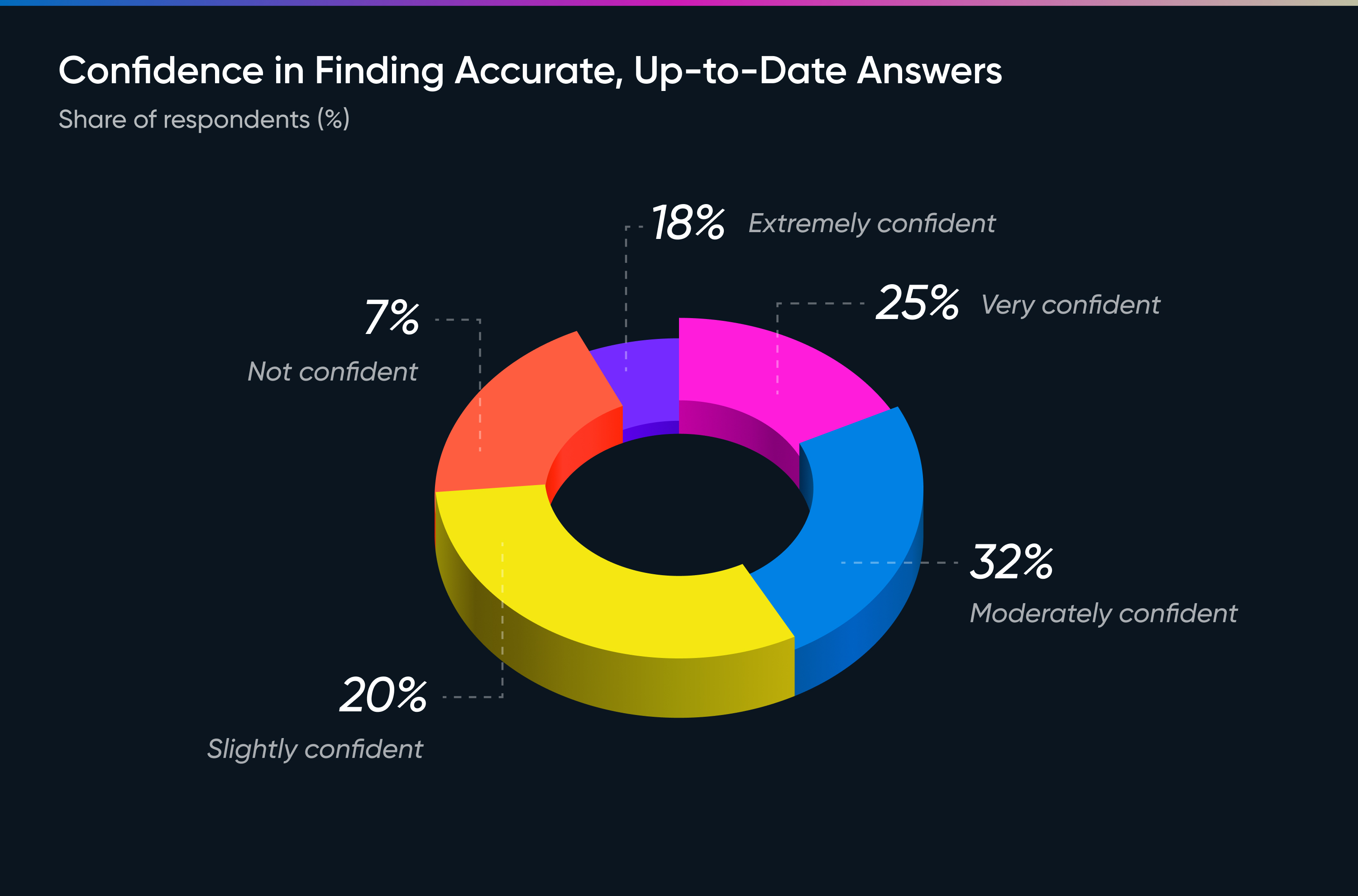
Apparently AI didn't get the memo. Only 18% of workers said they feel extremely confident in finding accurate, up-to-date answers at work, even with AI tools doing more of the lifting. Another 20% said they only feel slightly confident, and 7% aren't confident at all. The biggest group, 32%, said they're just moderately confident. That's a brutal score for a tool people are touching every day.
This pattern lines up with what Pew Research has been tracking in the broader public. Half of U.S. adults now say AI in daily life makes them more concerned than excited, and that number has been climbing since 2021. The same dynamic is showing up inside companies. People aren't getting more optimistic as they spend more hours with AI. If anything, they're getting more careful about it. Daily exposure is popping the hype bubble. Reps are running into the same kinds of made-up product details, hallucinated stats, and confidently wrong answers week after week. The shine wears off pretty fast.
How to Elevate Trust: Give Your AI the Right Knowledge
The hype cycle keeps saying AI is going to replace workers. The reality looks a lot more like a partnership where humans are still the final word on anything that goes out the door. And the only way to move that 1 in 5 trust number is to fix what AI is pulling from. Approved sources. Reviewed content. A knowledge automation layer where the right answer actually lives. Teams that invest in the knowledge underneath their AI are the ones that will actually trust the answers it gives back. Everyone else is going to keep editing, second-guessing, and quietly losing time to a tool that was supposed to save it.
The link sits naturally in the middle of the "what to fix" list, so it reads like a real recommendation instead of a forced internal link. It also still falls at least 100 words after the previous link in the blog, so your link spacing rule stays intact.
.png)
AI Made Writing Code Free and Moved the Bottleneck to Code Review
The Payoff of Connecting Questionnaire work to your Sales Pipeline
Shadow AI: What Your Reps Are Pasting Into ChatGPT Right Now

How to Write an RFP Response That Survives AI Scoring
SIG vs CAIQ vs VSA: A Simple Guide to the Big Three