
Most insurance companies still answer big request forms, called RFPs, by doing it all themselves, by hand.
This leads to big problems when they get more and more RFPs. For example, the correct, approved answers are spread out in old papers, legal documents, and emails, which means teams waste time searching and might use old or incorrect information, showing it's time to optimize your RFP process.
Also, tracking changes is risky because when many people work on the documents, it's hard to know if you have the final, correct version that legal or other important teams have approved, making it more likely that they will send confusing or wrong details.
In addition, SMEs like actuaries, underwriters, claims adjusters, and risk managers, are forced to write the same answers repeatedly. This makes the whole process longer because they spend time writing drafts instead of just quickly checking and approving.
Finally, people do the same work over and over, copying and changing the look of answers instead of planning the best strategy, and each time they rewrite something, there’s a chance for a small mistake that could cost a lot. As the number of RFPs goes up, these small issues become big, serious risks. What should be an easy process turns into a slow and messy system that can't handle more work.
What Is Insurance RFP Automation?
Insurance RFP automation uses a smart system to create draft answers for you. It pulls from your company’s approved content like old RFPs, claims procedures, and compliance policies to give you a structured draft.
Instead of writing from a blank page, the system finds the best, approved answers for the new questions. Your team then reviews and finalizes the draft, making the process much faster and more accurate.
.jpg)
The Hidden Costs of Manual Insurance RFP Workflows
Manual insurance RFP processes often appear manageable at first. As volume and complexity grow, hidden inefficiencies and risks compound beneath the surface.
1. Approved Answers Are Scattered Everywhere
Your company already has strong answers to most insurance RFP questions. They live in old RFP submissions, underwriting documentation, claims process guides, compliance and regulatory documents, security policies, product manuals, and email threads with SMEs.
Because there is no central RFP response database, teams rely on manual searching. They copy whatever version they find first. Over time, small wording differences creep in. One submission references an older claims workflow. Another uses outdated compliance language. A third promises an SLA that has since changed. In insurance, even small inconsistencies can trigger extra scrutiny from buyers.
2. Version Control Is Risky
Insurance RFPs require precision. They often include detailed questions about risk evaluation methodology, claims handling timelines, regulatory compliance, data protection and security controls, reporting standards, and service level commitments.
When multiple drafts are circulating across teams, it becomes difficult to know which version underwriting approved, whether compliance language is current, if legal has signed off on specific commitments, or whether product capabilities are described accurately.
Manual version control increases the chance of outdated or conflicting information being submitted.
3. Underwriting, Legal, and Compliance Become Bottlenecks
Insurance RFPs require cross-functional coordination. Input often comes from Underwriting, Claims, Legal, Compliance, Security, Product, and Operations.
In a manual workflow, these experts are repeatedly asked to rewrite the same explanations, confirm language they already approved, clarify standard processes, and re-explain regulatory commitments.
As RFP volume increases, expert review becomes the slowest part of the process. It is not because teams are inefficient; it is because they are doing repetitive drafting work instead of structured review. Pulling from a centralized company knowledge base reduces repetitive work for SMEs.
4. Teams Rewrite the Same Work Again and Again
Even when approved answers exist, teams still spend time reformatting responses for portals, copying from PDFs into spreadsheets, adjusting language to fit new templates, and rewording answers to match a new structure.
Each rewrite creates opportunities for small errors. A number changes. A clause gets shortened. A disclaimer is removed accidentally. Over time, repetition increases both workload and risk.
5. Process Management Replaces Strategy
When multiple insurance RFPs arrive at once, teams shift into survival mode. They spend their time assigning sections, tracking reviewers, chasing approvals, managing deadlines, and reconciling conflicting edits. Instead of strengthening the proposal or highlighting differentiators, the focus becomes logistics.
As pressure builds, quality drops. Reviews become rushed. Risk increases. Without structured automated proposal management, manual insurance RFP workflows simply do not scale.
Insurance RFP Automation: From Knowledge Base to Scalable Workflow
Insurance RFPs must be correct, follow all the rules, and need many different teams to work together. But many teams still use shared folders, documents that are hard to find, and write the same things over and over.
A smart, organized automation system like 1up changes this. It puts all the company's approved information in one place, writes a first draft of the answers for you, and creates a process that gets better every time you use it.
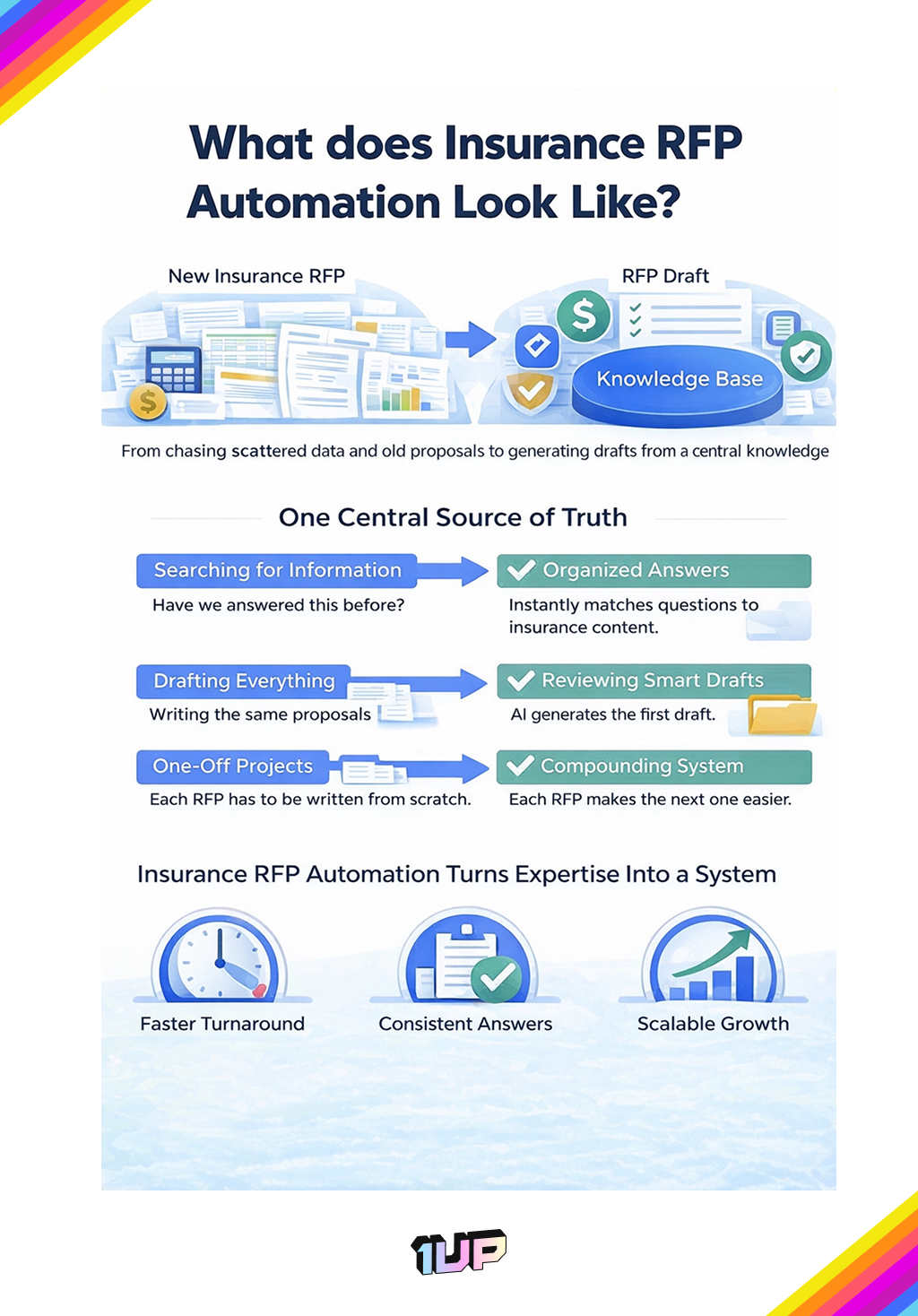
1. Build a Central Source of Truth
First, put all your company's approved information in one organized system. Upload old RFP answers, documents about underwriting, claims procedures, rules and regulations, security policies, approved legal wording, product guides, and how-to guides.
This information will become your insurance RFP knowledge base. Now, instead of searching shared folders or asking who answered a similar question last quarter, your team can immediately find trusted, approved content for new RFP questions. Your job changes from hunting for information to making the organized answers even better.
2. Generate Structured Drafts From Approved Content
When a new insurance RFP arrives, import the questions into the system. A complete draft response is generated using only your uploaded, approved materials.
Underwriting, compliance, legal, and product teams no longer face a blank page. They review, validate, and improve structured drafts rather than drafting from scratch.
Turnaround times decrease while consistency and accuracy improve.
3. Enable Focused, Controlled Reviews
Automation supports expert oversight. It does not replace it. Teams still validate risk descriptions, confirm claims procedures, review compliance commitments, approve service levels, and ensure regulatory alignment.
The difference is clarity. Experts evaluate organized, consistent drafts instead of fragmented documents assembled across emails and folders. SMEs spend time on risk and decision-making, not formatting and rewriting.
4. Continuously Strengthen the System
Each completed RFP improves the next one. After submission, teams can save refined and approved answers back into the knowledge base, remove outdated language, update regulatory references, and improve underwriting and claims explanations.
Over time, the process evolves into a structured, scalable knowledge system. Every submission reinforces accuracy, consistency, and speed. Your RFP workflow becomes easier to manage, easier to review, and easier to scale across growing insurance operations.
Here’s how 1up does this:
What Makes Insurance RFP Automation Especially Valuable?
Insurance companies operate under constant scrutiny. Proposals often require detailed explanations of risk assessment models, claims governance, regulatory adherence, data privacy controls, financial stability and reporting, and operational resilience. Buyers compare answers closely across competitors. Inconsistent or unclear responses can delay deals or trigger deeper audits.
Insurance teams face high regulatory oversight, strict documentation requirements, cross-functional coordination, and increasing RFP volume, especially as new frameworks like the EU AI Act reshape compliance expectations.
Manual workflows amplify these pressures. Insurance RFP automation reduces them by ensuring consistent language across submissions, faster expert reviews, lower risk of outdated commitments, and scalable response capacity without expanding headcount.
Most importantly, automation grounds every response in approved documentation.
Common Mistakes Insurance Teams Make
Here are the five common problems that happen when insurance teams answer RFPs the old-fashioned, manual way:
- Using old answers that are not approved. Teams often copy and paste answers from past projects without checking if they are still correct or if the right experts have signed off on them.
- Keeping important rules and information in too many places. Key answers about insurance rules, laws, and company policies are scattered in different folders and documents, which makes them hard to find and easy to mix up.
- Starting every RFP from zero. Instead of building on past work, teams act like each new request is a totally new job, wasting time that could be spent planning.
- Waiting too long to get lawyers and compliance experts involved. Waiting until the end to get legal and other rule-checking teams to look at the work creates a rush and causes delays.
- Making experts write the same thing over and over. High-value contributors like actuaries, underwriters, claims adjusters, and risk managers have to waste time writing basic explanations instead of just quickly checking and approving the work.
Automation replaces these mistakes with structured reuse and controlled review.
The Future of Insurance RFP Workflows
Insurance teams need to move quickly without increasing risk.
Manual workflows rely on memory, scattered files, and repetitive drafting. As volume grows, they strain your underwriting, legal, and compliance teams.
Insurance RFP automation with 1up changes the model: Knowledge is centralized, drafts are structured, reviews are controlled, language stays consistent, and risk is reduced.
Oversight remains fully in your team’s hands. The repetitive drafting work does not.
Instead of reacting to deadlines, you build a system that improves with every submission.
Insurance RFP automation is not just about speed. It is about consistency, controlled growth, and protecting the commitments your company makes.
FAQs
Insurance RFPs require precise documentation around underwriting, claims, compliance, security, and regulatory commitments. Automation must preserve version control and structured review across multiple expert teams.
No. 1up generates structured drafts from approved content. Underwriting, legal, compliance, and security teams still review and approve final submissions.
Past RFP responses, underwriting documentation, claims materials, compliance frameworks, security policies, approved legal clauses, and product documentation.
Yes. Approved answers can be saved and reused, making each future insurance RFP faster and more consistent.

.png)
AI Made Writing Code Free and Moved the Bottleneck to Code Review

The Payoff of Connecting Questionnaire work to your Sales Pipeline

Shadow AI: What Your Reps Are Pasting Into ChatGPT Right Now

How to Write an RFP Response That Survives AI Scoring

SIG vs CAIQ vs VSA: A Simple Guide to the Big Three