RFPs are like big questionnaires where a potential customer asks about your company's legal, security, and compliance setup before they decide to buy from you.
The typical, manual way to answer them involves searching everywhere for old answers, legal clauses, and approved documents in shared folders and old emails, copying and pasting that language into a new proposal form.
THEN begins the pain of sending parts of the document to many experts, such as the legal team, the security team, and the product team, to check and approve the language, and trying to put all the edits together quickly to meet a deadline.
This process seems simple, but it creates a lot of problems and hidden risks as your business grows and you get more RFPs. And if you work on a Legal team, the stakes are much higher.
What Makes RFP Work So Painful for Legal Teams?
1. Approved Legal Answers Are Scattered
Your company has already written the best answers for many of the questions in a Legal Request for Proposal. However, these important answers are often hidden across many different places, including old RFP or DDQ responses, security questionnaires, standard contracts, privacy policies, government or industry rules, papers from official checks, and email approvals.
Because there is no single, easy-to-find place for all this approved language, teams rely on searching old files and emails. They end up copying and pasting whatever version of a legal clause or security promise they can find.
This creates a serious risk for the company. Over time, different versions of the same important rule start floating around. Small changes in the words appear, and it becomes very hard to know which version the legal team actually approved most recently. Using an outdated or incorrect promise in a legal RFP can create unnecessary legal problems for your business.
2. Version Control Is Difficult and Risky
Legal Request for Proposals need very exact and careful language about important business issues.
They cover technical topics like:
- Data privacy and protection
- Regulatory compliance
- Security controls
- Subprocessors (companies you use to help do the work)
- Indemnification (protecting the customer from loss)
- Service levels (guarantees about service quality)
- Business continuity (plans for emergencies)
When many people on different teams are editing a proposal, a lot of drafts get passed around. This makes it confusing and difficult to know for sure: which version the legal team has officially approved, if the language used for compliance rules is current and up-to-date, and if the promises you are making about the product are actually true.
Even tiny changes in the wording can cause different parts of the proposal to contradict each other. Relying on a manual process makes it very easy for old, wrong, or inconsistent language to be submitted, which creates a big risk for your business.
3. Legal and Compliance Teams Become Bottlenecks
To answer a Legal RFP, many teams, including Legal, Security, Compliance, Product, Engineering, and Leadership, must contribute information.
In the manual process, subject matter experts like lawyers repeatedly perform the same tasks: rewriting basic explanations, confirming previously approved language, restating rules and standards, and clarifying security protections.
As RFP volume grows, this repetitive review work becomes the slowest part of the proposal, diverting legal professionals from new problems. This workflow also wastes time on tedious reformatting and content transfer, such as moving text between different online forms, PDFs, and spreadsheets.
Furthermore, teams get bogged down in simple management tasks like tracking approvals, chasing reviewers, and compiling final edits. This intense pressure compromises answer quality, increases company risk, and prevents the manual process from scaling to meet a growing number of RFPs.
4. Teams Rewrite the Same Work Again and Again
Even when the correct, approved answers are available, team members are forced to spend a lot of time on repetitive, manual work. This is because they have to get the information to fit the buyer's different systems and forms.
For example, teams often have to reformat the approved content to upload it to different online proposal portals, copy text out of PDF files and paste it into spreadsheet templates, adjust the wording manually just to fit the document’s specific layout or section, and rewrite legal promises or clauses slightly to match the specific format of the form they are filling out.
Every single time a person rewrites or copies content, it creates a chance for a small error to be made. Even minor mistakes, like a missing word or an incorrect number, can lead to serious problems in a legal document.
Over time, all these small differences and errors add up. This repetition not only wastes time that experts could spend on higher-value work, but it also increases the chance that the company will submit an answer that is inconsistent, wrong, or creates legal risk.
5. Process Management Replaces Strategy
When law firms get hit with a lot of Legal RFPs at once, the whole team’s focus shifts. Instead of spending time making the company's proposals stronger and more persuasive, they get stuck in basic, repetitive management tasks.
Teams spend most of their time on logistics like assigning sections of the document to different people, tracking who needs to approve each part, constantly chasing reviewers to finish their work on time, managing a long list of deadlines, and trying to combine and fix all the edits from different people. This means the work of simply managing the process takes over.
Law firms are focused on moving the papers, not on the quality of the answers.
As a result, quality changes because everyone is rushing, and the proposal's quality goes down. Review is rushed, meaning legal and security experts don't have enough time to look closely at every word, which is the whole point of their job. Risk increases because when legal SMEs can't review carefully, the company is more likely to submit outdated, inconsistent, or risky language.
A manual process for legal RFPs simply cannot handle a growing business. It forces teams to choose between speed and safety, and it will eventually break under the pressure of scale.

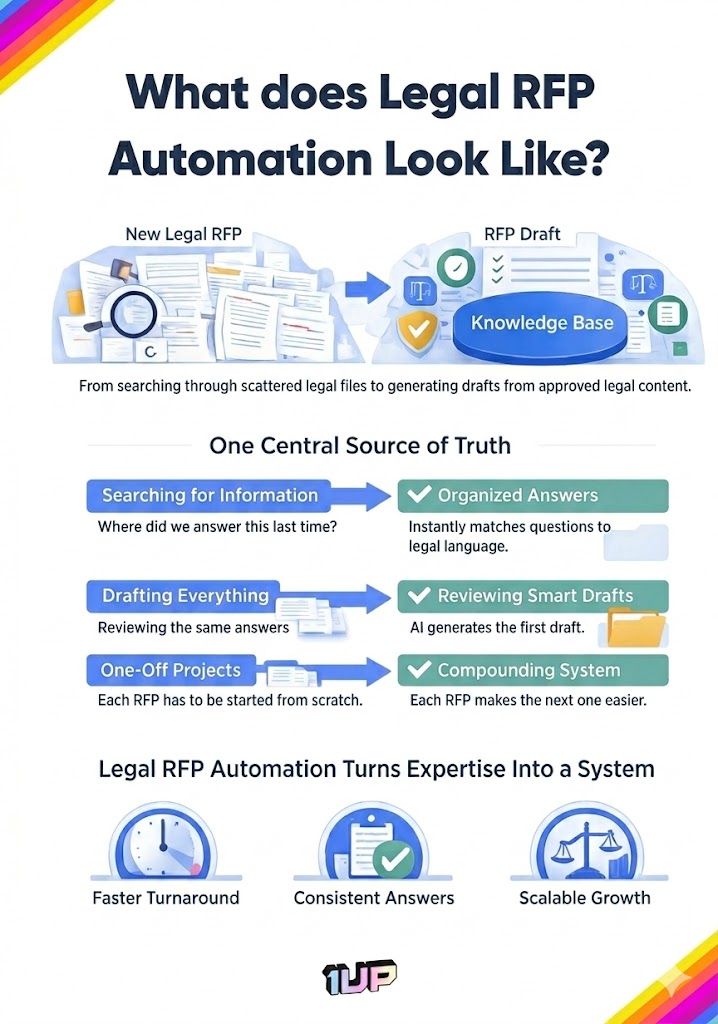
Legal RFP automation uses smart technology, or AI, to create draft answers for you based on information that your team has already checked and officially approved.
Instead of beginning with an empty page and having to research everything, you start with a strong foundation built from approved legal rules and clauses, privacy policies, security documentation, rules from government or industry, proof from official checks, product information, and answers from past proposals.
Any good RFP automation software works by reading the new RFP questions and instantly finds and matches those questions to the correct, approved content stored in a central knowledge base.
This process creates structured drafts that your team simply reviews and finishes. This completely changes how the work gets done. Instead of experts having to write the same language over and over again, they start with a draft that is already grounded in trusted, up-to-date documentation. This makes the whole process faster and more accurate.
How are Law Firms automating RFP and DDQ responses?
Legal teams are automating RFP and DDQ responses by transforming scattered institutional knowledge into a structured, repeatable system powered by AI. Tools like 1up reduce manual drafting while keeping legal, security, and compliance experts fully in control of final approvals.
1. Building a Central Source of Truth
Automation starts with consolidating information into one organized knowledge base. Instead of relying on scattered folders and outdated files, teams gather past finalized RFP and DDQ responses, approved legal language and contract clauses, security and privacy documentation, compliance frameworks and certifications, audit materials, and current product documentation.
Once uploaded into 1up, this centralized library becomes the single source of truth. Every response is grounded in approved, up to date information, which eliminates time spent searching across systems and reduces the risk of inconsistent or outdated language. This knowledge foundation becomes the core infrastructure that supports scalable automation.
2. Generating Structured Drafts From Approved Content
When a new RFP or DDQ arrives, teams import the questions directly into 1up. The platform analyzes each question and automatically generates a structured draft response using only the approved materials stored in the knowledge base.
Instead of starting from a blank page, legal teams begin with a complete draft that aligns with company standards, regulatory requirements, and previously approved language. This significantly accelerates response times while maintaining consistency and accuracy. Here is a short overview of how 1up works in practice:
3. Enabling Faster, More Controlled Reviews
Automation strengthens oversight rather than reducing it. With the drafting process handled by the system, experts shift their focus entirely to validation and decision making. Legal reviews the content for accuracy and risk exposure, compliance ensures regulatory alignment, and security confirms that all technical controls are correctly represented.
By removing repetitive writing from the workflow, high value teams spend their time refining, approving, and managing risk instead of recreating standard answers. The result is faster submissions with tighter control.

4. Continuously Improving the System
The process does not stop once the RFP or DDQ is submitted. Each completed response strengthens the system for future use. Teams save refined, approved answers back into the knowledge base, remove outdated legal clauses, and update policies or compliance language as regulations and company standards evolve.
Over time, the knowledge base becomes more precise, more aligned with current operations, and easier to scale. Legal RFP automation evolves into a long term AI driven knowledge management system that makes every future submission faster, more consistent, and easier to manage. This compounding effect is the real power of automating knowledge management.
Best Practices for Legal Teams Who Want to Automate
Legal Requests for Proposals are high-stakes documents that carry major weight. When your company submits an answer, you are making formal promises about critical business areas: regulatory compliance, data protection, security controls, operational standards, and contractual obligations.
Because legal RFPs often include detailed technical disclosures, teams must also clearly explain their data security in AI policies.
Buyers always look closely at these answers, and they compare what you say to what other companies say. If your wording is inconsistent or unclear between different submissions, it can cause the buyer to question your reliability, which can lead to extra questions, delays, or even losing the deal entirely.
Managing Legal Risk and Growing RFP Demands
Your legal and compliance experts operate in a high pressure environment where precision, alignment, and speed all matter.
Every response must accurately reflect your company’s actual policies. There is no room for error when commitments are tied directly to legal and regulatory risk. At the same time, legal, security, product, and compliance teams must stay fully aligned on what is being promised to customers. As your company grows and wins more deals, RFP volume increases, and manual processes struggle to keep up.
Legal RFP automation with 1up helps teams manage this pressure by reducing risk at every step. It keeps answers consistent across proposals, minimizes contradictory promises that can confuse buyers, and speeds up expert review cycles. It also reduces exposure from outdated legal language and enables teams to handle higher RFP volume without expanding headcount just to manage paperwork.
Most importantly, it lowers risk by ensuring every commitment is built from documentation that has already been approved and vetted by your experts.
Common Mistakes Legal Teams Make
Even well-organized teams often fall into these traps with a manual workflow:
- Reusing Old Answers: Copying and pasting answers from past documents without checking if the legal team has officially approved that language for the current year.
- Scattered Information: Storing important legal and security clauses in different places, which makes it impossible to know where the definitive version is.
- Starting Fresh: Treating every new legal RFP as a brand new project, instead of reusing the excellent work and approved language that already exists.
- Reviewing Too Late: Not bringing in the legal team to review the document until the very last minute, which puts huge stress on them and increases risk.
- Repetitive Work: Asking experts to rewrite or confirm the same basic explanations that they have already approved many times before.
Many companies discover that the problem is not buying more RFP software, but fixing the structure of their approved content.
Automation replaces these mistakes with a structured system for reusing approved legal knowledge.
What's Next for RFP Workflows?
Legal teams need to move faster than ever without increasing their risk of making a mistake.
The old, manual process is broken. It relies on people's memory, files scattered everywhere, and experts rewriting the same things over and over. When the workload gets too big, these manual systems simply fall apart.
But with legal RFP automation software like 1up, everything changes:
Knowledge is Centralized: All approved answers are in one secure place.
Drafts are Structured: The system builds a complete first answer for you, and it is easy to see where every piece of information came from.
Reviews are Faster: Experts can check a finished draft in minutes instead of spending hours writing from scratch.
Language Stays Consistent: Every proposal uses the same, approved wording, which removes contradictions and confusion for the buyer.
Risk is Reduced: By using only pre-approved content, the chance of accidentally submitting old or wrong information drops dramatically.
Legal oversight stays completely in control. The repetitive, boring work does not.That is why more teams are experimenting with RFP agents and copilots, as long as outputs stay grounded in approved content.
Instead of constantly reacting to urgent deadlines, your teams build a smart system that gets better every time you use it. Legal RFP automation is not just about speed. It is about consistency, a strong defense for your company's promises, and controlled growth.
FAQs
Legal RFP automation focuses on precise, approved legal and compliance language. It must preserve version control, maintain auditability, and support structured legal review.
No. Tools like 1up help legal teams automate manual work by generating structured drafts from approved documentation. Legal, compliance, and security teams review and approve every submission.
Past RFP responses, approved clauses, privacy and security documentation, compliance frameworks, audit materials, and product documentation.
Yes. Each refined answer can be saved back into 1up so future legal RFPs become faster and more consistent.


How to Write an RFP Response That Survives AI Scoring

SIG vs CAIQ vs VSA: A Simple Guide to the Big Three

How to Win Government RFPs With AI (Without Getting Disqualified)

ChatGPT vs. Copilot vs. Claude for RFPs: A Side-by-Side Comparison
.png)
Using Claude for RFPs? Add This One Piece