.jpg)
Say a rep pings the company AI for current pricing. Two seconds later, it comes back with a tidy, confident number. Feels good, until you realize that number changed back in March and nobody has touched the doc since. Now it is sitting in an email to a customer. This is how AI usually goes wrong at work. The tool did its job on knowledge nobody bothered to check, and stayed confident the whole way. That is why AI governance for enterprise knowledge matters, and why a solid plan for internal company AI has to start with the knowledge base long before anyone picks a model. This guide walks through how to do it well.
What AI governance for enterprise knowledge really controls
AI governance is the set of rules, roles, and checks that decide how AI uses your company's knowledge.
While this sounds dry, in practice it answers three questions most teams skip:
- What is the AI allowed to read?
- Who gets to see what it says back?
- And when it botches one, how does anyone even find out?
Notice what those questions have in common. None of them are about the model. The model is the easy part now. You can swap one out for a better one next month. The hard part is the knowledge feeding it and the answers coming out the other side. Governance is quality control for both.

Think of your knowledge base like the water supply for a whole building. The faucets are shiny and fast. If the water going in is dirty, every faucet serves dirty water, and nobody can tell by looking. Governance keeps the supply clean.
Three ways AI knowledge goes wrong
Most people picture a big dramatic breach when they hear the word risk. Those happen. But the failures that hurt enterprise knowledge tend to be harder to spot. They build up slowly, and by the time you notice, the bad answer has already gone out a hundred times.
Three show up most often:
- The AI reads something it should not
A rep asks a question, the tool pulls a detail from a legal doc or an unfinished pricing sheet, and shares it with a customer. All it took was an access setting nobody thought to check.
- The AI reads something old
Your pricing changed in March. The doc did not. So the tool keeps quoting the March number with full confidence, and your reps keep repeating it. That one stale number gets passed along across dozens of deals before anyone notices.
- The AI reads two docs that disagree
One says the contract term is 30 days. Another says 60. The tool picks one. It never mentions there was a conflict, and there is no easy way to find out which it chose.
Every one of these traces back to a gap in governance, the kind most companies have without realizing it.
What good AI knowledge governance looks like
The whole aim is answers your team can trust, fast, without leaking stuff to the wrong people. Getting there takes a handful of deliberate moves. Each one comes with a catch.
Decide which version wins
Every team wants a single source of truth. Building one is harder than it sounds, and most teams underestimate the effort.
Inevitably, documents will conflict with each other, and that is exactly where the real difficulty arises. An old proposal says one thing. The latest product sheet says another. Both are sitting in your knowledge base. Someone has to pick a winner, tag it as the trusted version, and send the loser to the archive. That is a judgment call, and no model can make it for you. Governance is what makes sure someone actually does, instead of leaving the AI to pick one at random.
So set up something simple. One home for approved knowledge. A clear label for what counts as current. A habit of archiving old versions before they resurface and confuse the AI. None of it is exciting work. It just prevents most of the wrong answers you would otherwise track down one by one.
Treat access as a real decision
Access control looks like a security topic. It is also a design choice that shapes what your AI can do at all.
There is a catch, though. Every doc you open up to the AI makes it more useful and a bit more dangerous at the same time. Open up the security folder and reps can answer tough questions on the spot. Open up too much and the tool might surface a salary sheet to someone who should never see it. You are always trading reach for risk.
The fix is to tie access to roles. A sales rep sees sales knowledge. A customer filling out a form sees only what you chose to make public. Finance stays with finance. This gets tricky with sensitive material like security and compliance docs, where some of it is fine to share and some is not. It helps to study how the best trust center products split public from gated content. They have already figured out where the lines go, so you can borrow their thinking instead of guessing.
Make the AI show its work
People signal doubt without thinking about it. They hedge. They say things like not totally sure, or let me double-check that. AI does not hedge. It gives a wrong answer in the same calm voice it uses for a right one. So you have to add the doubt back in yourself.
The main tool for this is grounding, which is a fancy word for tying every answer to a real document. When the AI responds, it should point to the source it pulled from. That does two big things. Now your team can verify a fact in seconds rather than taking the tool's word for it. You also build a paper trail, which you will be glad to have the day an auditor or a picky customer asks where an answer came from.

Tools like 1up provide sources for where they find an answer within your knowledge base. An answer you cannot trace is a guess, dressed up to look sure of itself. Make citations the default and your whole knowledge system gets more honest.
Put humans where the stakes are
Human review is the obvious safety net. The mistake is applying it evenly, so either everything gets rubber-stamped or nothing gets checked.
Better to tier it by stakes. An internal answer about which meeting room to book does not need a reviewer. A pricing clause going into a signed proposal absolutely does. Sort your AI outputs by how much a mistake would cost, and spend your review time where the damage would be worst.
This is how smart proposal automation works in practice. The AI drafts the bulk of a long RFP response, which is most of the labor, and a human expert reviews the parts that carry real risk before anything ships. The reviewer skips the retyping. Their job is to catch the stat that got garbled, the number that went stale, the claim that reads smooth and happens to be false. That is the highest-value ten minutes in the whole workflow.
Keep the knowledge alive
Knowledge does not fail all at once. It rots slowly. A product ships, a policy changes, a competitor shifts, and the docs lag behind. Give it a year and half your knowledge base has gone out of date, still feeding answers as if nothing changed.
The fix is boring, but it works. Give each big topic a named owner, an actual human. Then put reviews on a calendar, even a loose one, so docs get a look on schedule and not just when someone trips over an old file. Update the source the same week a thing changes, not the next quarter.
This is why a new role keeps popping up on enablement and knowledge teams. This is why the AI answer engineer has turned into a real job on enablement and knowledge teams. Their entire role is keeping the knowledge base accurate and current, so the answers your AI hands out stay trustworthy. Left alone, a knowledge base grows weeds. Someone has to keep pulling them.
Measure whether it is actually working
You cannot govern what you never look at. A lot of teams track how many questions the AI answered and leave it there. That number tells you people are using the tool. It says nothing about whether the answers were any good.
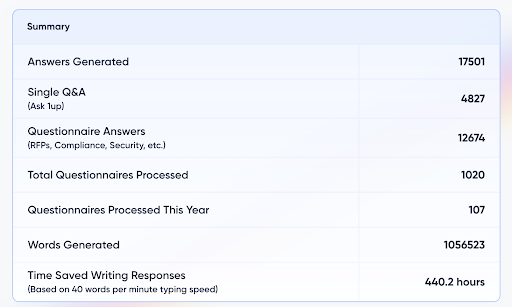
Track quality too. Give people a one-click way to flag a bad answer, and then, this is the part teams skip, act on what they flag. When a thumbs-down vanishes into nowhere, folks learn that flagging is a waste of time and quit doing it. Close the loop instead. Go fix the doc that caused the bad answer, then circle back to whoever flagged it so they know it mattered.

1up tracks not only extensively track metrics, it also provides a simple way for users to upvote or downvote answer quality.
Borrow a framework instead of inventing one
There’s no need to invent this yourself. Two well-known frameworks hand you a running start and a shared vocabulary, and neither costs a dime.
The NIST AI Risk Management Framework is a free one from the U.S. government. It splits the job into four steps: govern, map, measure, manage. NIST put it out on January 26, 2023, and more than 240 organizations had a hand in the drafting, so the thing was tried and tested before it ever shipped. Those four steps map almost one-to-one onto what we just covered. Govern means set your rules. Map means know what knowledge and risk you have. Measure means track quality. Manage means fix and improve. Best part, it hands your legal, security, and sales folks a common language, which saves you from half the circular meetings you would otherwise sit through.
Want something more official? There is ISO/IEC 42001, the first global standard for managing AI, published in December 2023. It walks you through standing up a real AI management system and keeping it healthy over time. You can even get certified, which some buyers in regulated fields will ask about directly. Worth knowing even if certification is years away for you.
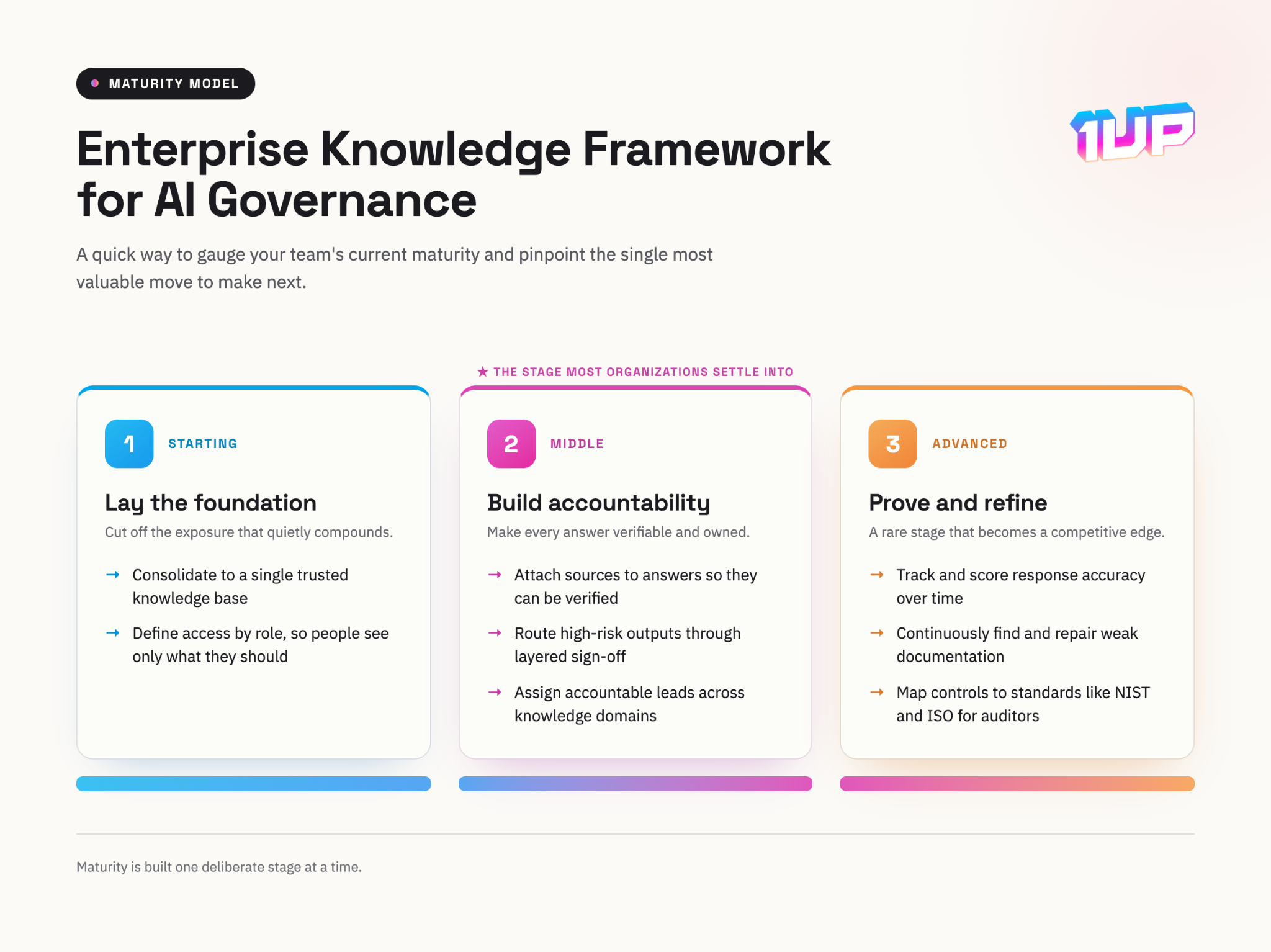
A simple way to know where you stand
No team stands all of this up at once. It comes together in stages, and knowing which stage you are in shows you what to tackle next.
If you are just starting, do two things. Pick one source of truth, and set basic role-based access. That alone kills off a huge share of those slow-building risks.
Once that is steady, add the middle layer. Turn on citations so every answer is traceable. Set up a tiered review process for high-stakes outputs. Name owners for your main knowledge areas. Most teams that take this seriously focus here.
The advanced stage is about feedback and proof. You are measuring answer quality, fixing weak docs on a loop, and lining your practices up with something like NIST or ISO so you can show your work to a customer or an auditor. Few teams are fully here, so getting here early is a real edge.
You do not have to leap to the end. You just need to know which step is next.
Where teams go wrong
A few deeper traps are worth naming.
Governance theater is the big one. A team writes a long policy doc, files it away, and feels covered. The doc changes nothing about how the AI behaves day to day. Rules only count if they show up in the tool.
Over-locking is the opposite trap. Fear of leaks pushes a team to wall off so much that the AI turns useless, so people go back to hunting through wikis by hand. You lose the whole benefit to avoid a risk you could have managed with roles.
No clear owner is the slow killer. A knowledge base owned by everybody ends up owned by nobody, and it slides out of date fast. Name the owner and the drift stops.
Skipping measurement leaves you flying blind. With no feedback, you learn an answer was wrong when a customer tells you, which is the most expensive way to find out.
Governance without the busywork
A platform like 1up is built to handle exactly this. 1up ties your scattered docs into one trusted, connected knowledge base, then automates the answers your team needs, whether that is a full RFP, a security questionnaire, or a quick question from a customer. Every response traces back to a real source instead of a guess. You control who sees what, it pulls from your most recent info, and it learns each time someone makes a correction. 1up is SOC2 certified and built by former security engineers too, so your data stays encrypted and under your control. A lot of the governance work above just comes built in.
Treat your knowledge like the asset it is
Strong AI governance for enterprise knowledge comes down to a shift in how you see your own information. Your docs, your past answers, your policies, all of it is now the raw material your AI runs on. A great tool cannot fix messy, unguarded, out-of-date knowledge. It just spreads the mess faster and with more confidence.
The real payoff runs deeper than dodging a single leak or a bad answer here and there. You wind up trusting your own knowledge base again. The AI starts pulling its weight. And people quit second-guessing every response before they act on it.
Start small. One source of truth, and access rules that make sense. Add citations and review where the stakes are high. From there, keep the docs current, watch how the answers hold up, and let NIST or ISO steer the rest.
Get that right and your customers feel it in every quick, spot-on answer that comes their way. Most of them will never know why. They will just trust you a little more each time, which is the whole game.
FAQs
AI governance is the set of rules, roles, and checks that decide how AI uses your company's information. It covers what the AI is allowed to read, who gets to see what it says back, and how anyone finds out when an answer is wrong. Almost none of it is about the model itself. The work sits in the knowledge feeding the model and the answers coming out the other side.
Pick one home for approved knowledge and label clearly what counts as current. Archive old versions before they resurface and get picked up again. Then give each major topic a named owner and put reviews on a calendar, so docs get checked on a schedule instead of whenever someone trips over an old file. Update the source the same week something changes.
The NIST AI Risk Management Framework is free and splits the job into four steps: govern, map, measure, manage. It is the easier starting point and gives legal, security, and sales teams a shared vocabulary. ISO/IEC 42001 is the more formal option, published in December 2023, and you can get certified against it. Buyers in regulated industries sometimes ask for that directly, so it is worth knowing about even if certification is years away.

.png)
AI Made Writing Code Free and Moved the Bottleneck to Code Review
The Payoff of Connecting Questionnaire work to your Sales Pipeline
Shadow AI: What Your Reps Are Pasting Into ChatGPT Right Now

How to Write an RFP Response That Survives AI Scoring
SIG vs CAIQ vs VSA: A Simple Guide to the Big Three