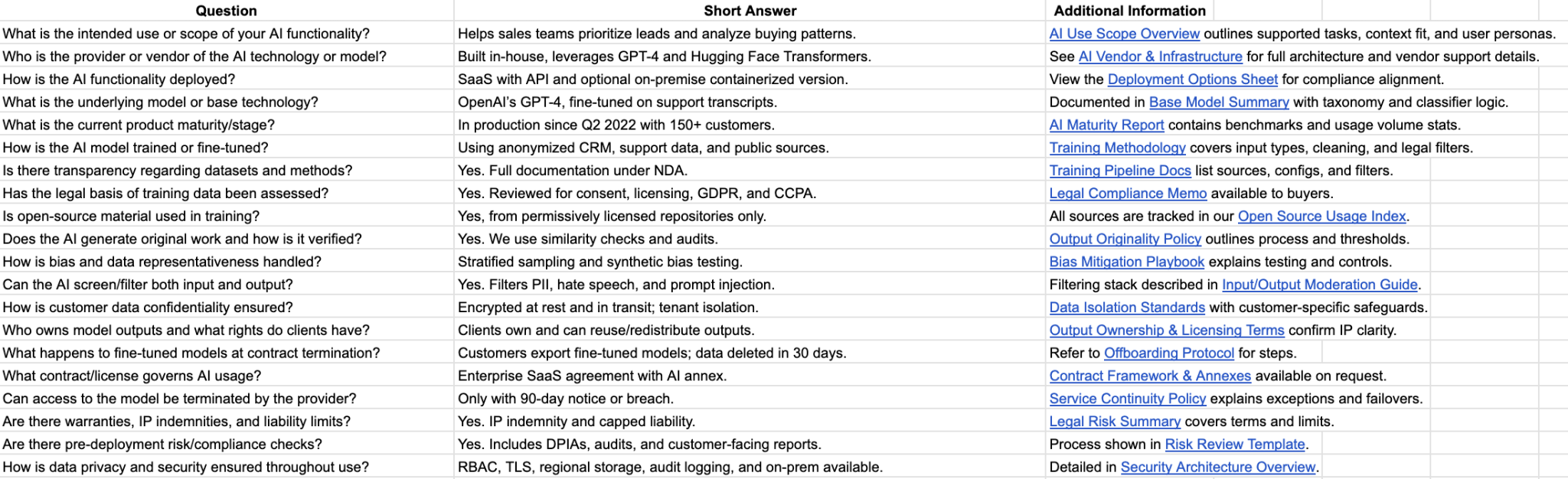
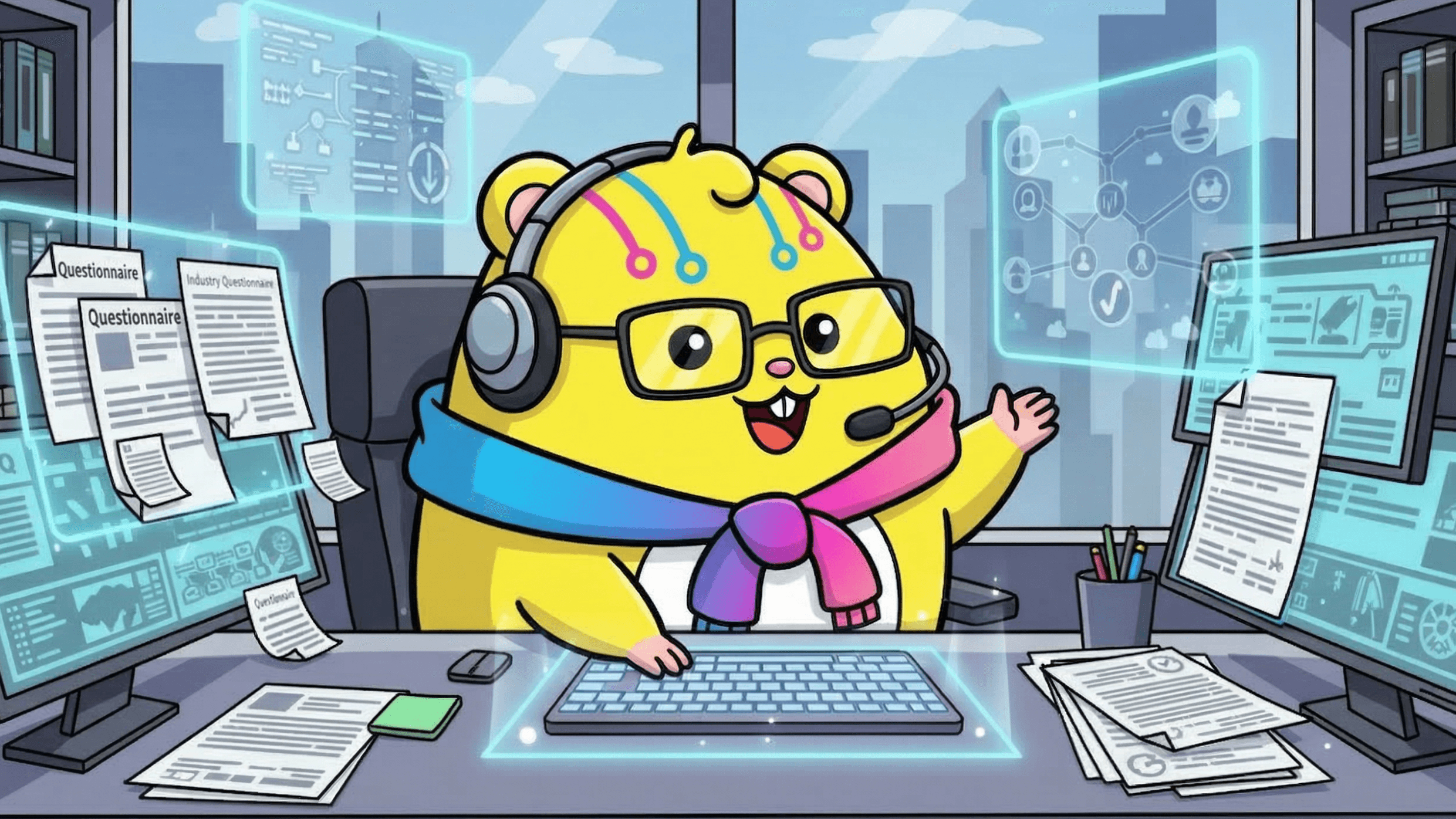
If you've sold AI software in the last year, you already know the drill. The demo goes great. Then the questionnaire shows up. Twenty questions deep into legal, security, and data, and your rep is on Slack pinging product, engineering, and a lawyer who doesn't answer until Tuesday.
Most of these questions repeat across deals. We pulled the 20 we see most often into one place. If you also handle non-AI security and compliance asks, our compliance questionnaire examples post is worth a look.
Need help? Download this template for the most common AI questionnaire responses.
The Five Categories Buyers Care About
Most AI vendor questionnaires touch the same five risk areas. If your rep can name the category behind a question, they can answer the real worry instead of just the wording on the page.

The biggest pile of asks, somewhere around a third, lands in ownership, use, and legal terms. Who owns the outputs. Whether the buyer can use them commercially. Where data sits. What happens when the contract ends. Anything to do with indemnity, licensing, and liability fits in here too.
AI functionality and deployment is about how the system works and where it lives. SaaS, API, on-prem. Which base model. How mature the product really is.
Data and model transparency questions come down to your training data. What you trained on. How representative it is. How you keep bias out. How you check that outputs are clean.
Governance, risk, and compliance is the formal review side. A lot of your bigger buyers now have AI governance teams. They want documented assessments before they sign, often built around the NIST AI Risk Management Framework. You won't get around this step.
Monitoring, security, and controls is the "prove this isn't a black box" category. Logs. Traceability. Prompt injection defenses. Hallucination handling. The list keeps growing every quarter.
Ownership, Use, and Legal Terms
1. Has the legal basis of the training data been documented?
Why they're asking: The fear here is downstream liability. If your training data came from somewhere shady, the buyer inherits that mess the second they deploy you.
How to respond: Lead with yes. Then back it up. Mention your legal review process and offer to share the docs under NDA.
Example response:"Yes. Every training data source goes through legal review. We keep documentation on consent, licensing, GDPR, CCPA, and copyright law. Available under NDA."
2. Who owns the model and outputs generated? What rights do clients have?
Why they're asking: Buyers need to know if they can actually use what your AI produces. Sell it. Modify it. Pass it on to their own customers.
How to respond: Plain English is your friend here. No legalese.
Example response: "You keep full rights to use, modify, and redistribute outputs. No royalty obligations."
3. What happens to custom or fine-tuned versions if the contract is terminated?
Why they're asking: This is exit risk. If a buyer leaves you, what happens to the work they paid for?
How to respond: Spell out what gets exported, what gets deleted, and on what timeline. Buyers want hard numbers, not vague reassurance.
Example response: "When the contract ends, you can export fine-tuned weights and training logs. Customer-specific data is deleted within 30 days per our retention policy."
4. Under what license is the AI functionality provided? Are there deviations from standard terms?

Why they're asking: Legal teams are scanning your contract for anything weird. Surprise clauses can stall a deal for weeks while their team picks through them.
How to respond: State the framework upfront and call out the non-standard parts before they go hunting.
Example response: "Standard enterprise SaaS agreement with an AI-specific annex. No unusual IP or liability clauses."
5. Can the AI provider terminate access to the model or outputs at any time?
Why they're asking: Buyers have been burned before. Tools get yanked, prices get hiked, support disappears. They want guardrails written in.
How to respond: Walk through your SLA, your notice period, and the narrow situations where you can pull access.
Example response: "99.9% uptime SLA. Standard termination requires 90 days of notice. Emergency termination only applies on material contract breach or willful violation of applicable law."
6. Are there warranties, IP indemnities, and limitations of liability under the AI service contract?
Why they're asking: A lawyer question. They want to see how risk is split between the two parties.
How to respond: Summarize the protections and the caps. No need to recite the contract.
Example response: "IP indemnity and performance warranties tied to uptime and security benchmarks. Liability cap matches annual contract value, in line with industry norms."
AI Functionality and Deployment
7. What is the intended use or scope of your AI functionality?
Why they're asking: Buyers want to confirm your AI actually fits their use case, and they want to know what it can't do before they invest.
How to respond: Be honest about what you do and what you don't. Reps who oversell win deals they shouldn't, and those deals turn into churn six months later. Better to lose a bad-fit deal than land one and lose the customer.
Example response: "Our AI scores leads using past CRM activity and engagement signals. The score helps reps focus their time. Outbound automation and pricing decisions are out of scope."
8. Who is the provider or vendor of the AI technology or model?

Why they're asking: Buyers want to know who's behind the model. If a third party is in the mix, they want to know who they're really depending on.
How to respond: Name the model, say where it came from, add a credibility marker or two.
Example response: "Proprietary model trained by our in-house data team. Built on Hugging Face's Transformers library. Hosted on AWS. Some natural language workflows run through OpenAI's GPT-4 API."
9. How is the AI functionality deployed (SaaS, API, OSS, on-premises)?
Why they're asking: Deployment shape can decide whether a buyer can even use you. Some regulated buyers can't touch multi-tenant SaaS, full stop.
How to respond: Cover the options and what comes with each tier.
Example response: "Multi-tenant SaaS by default. Enterprise tier adds API access. Regulated industries can choose containerized on-prem."
10. What is the underlying model name and source?
Why they're asking: A deeper version of question 8. Buyers want the actual model name so they can run their own capability and risk assessment.
How to respond: Be transparent. Base model, fine-tuning, custom layers.
Example response: "Chatbot runs on OpenAI's GPT-4, fine-tuned on anonymized customer support transcripts. Custom classifiers sit on top, trained on our product taxonomy."
11. What is the product maturity or stage (e.g., pilot or production)?
Why they're asking: This one is risk-sniffing. Nobody wants to be the customer who finds the bugs.
How to respond: Be direct about the stage. Share scale numbers. Drop a customer name if you have permission.
Example response: "In production since Q2 2022. Over 150 enterprise customers. More than 10 million interactions a month."
Data and Model Transparency
12. How is the AI model trained or fine-tuned? What data sources are used?
Why they're asking: Buyers are checking that your training inputs are relevant, clean, and legally sound. Sloppy data inputs predict sloppy outputs.
How to respond: Walk through the data types, sources, and method.
Example response: "We train on anonymized CRM data, support tickets, and call transcripts, plus publicly available sales data. Cleaned and labeled to GDPR requirements."
13. Is there transparency in the datasets used for model training?
Why they're asking: The documentation flavor of the question above. Can you actually prove what you trained on if someone asks?
How to respond: Talk about your training pipeline docs, dataset provenance, filtering logic, and version history. NDA is fine here.
Example response: "End-to-end documentation exists for the full training pipeline. Includes dataset provenance, filtering logic, and training configurations. Available under NDA."
14. Is any open-source material included in model training?
Why they're asking: Open-source data is fine, as long as you're tracking the licenses properly. Buyers want assurance you're not in GPL violation.
How to respond: Say whether you do, then explain how you manage it.
Example response: "We use a small amount of open-source content from permissively licensed sources. All documented. GPL is excluded from training."
15. Does the AI generate original work, and are there methods to verify results?

Why they're asking: Two worries layered into one question. Copyright risk on one side, hallucination prevention on the other. Buyers don't want your model regurgitating training data, and they don't want it making things up.
How to respond: Speak to both.
Example response: "Models are tuned to suppress training memorization. We run embedding similarity checks on outputs and do human spot audits to catch issues early."
16. How are lack of bias and fitness for purpose ensured during training?
Why they're asking: Bias is a procurement red line at most large enterprises now. Buyers want fair AI that doesn't fall apart on certain user segments.
How to respond: Walk through validation, audit, and bias mitigation work.
Example response: "Stratified sampling for diverse coverage. Synthetic edge case testing. Bias issues are flagged and reduced before deployment."
Governance, Risk, and Compliance
17. Are there processes for legal, compliance, and risk assessment before using the AI functionality?
Why they're asking: Governance teams want evidence that adopting you won't blow up their risk profile. Many are required to document this internally before approval.
How to respond: Point to your docs and review workflows. Offer to support their procurement evaluation.
Example response: "Yes. We provide compliance documentation, DPIAs, bias assessments, and audit trails on demand. We also support customer-side procurement evaluations end to end."
Monitoring, Security, and Controls
18. Can the AI screen and filter both input and output? What mechanisms are used, and what data is filtered?
How to Respond: Summarize for your client all key contractual protections and any limits you impose therein.
Why they're asking: This is the most-asked security question of 2026. Buyers have to handle harmful content, PII leakage, and prompt injection, which currently sits at the top of the OWASP Top 10 for LLM Applications. Filtering is where safety actually gets enforced.
How to respond: Talk about both sides. Input filtering (what gets blocked before reaching the model) and output filtering (what gets blocked before reaching the user).
Example response: "Regex filters, ML classifiers, and specialized detectors block PII, hate speech, and unsafe content. Inputs are scanned for prompt injection before the model sees them. Outputs are scanned again before they reach the user."
19. How is customer data kept confidential and not reused for other clients or model training?
Why they're asking: Buyers want their proprietary data to stay theirs. They don't want it improving a competitor's model.
How to respond: Cover isolation, encryption, and reuse restrictions.
Example response: "Encryption in transit and at rest. Storage in tenant-specific silos. Customer data is never used for model training unless you explicitly opt in."
20. How do you ensure privacy, confidentiality, and security of inputs, outputs, and processing during use?
Why they're asking: This is the trust question. Buyers want end-to-end protection across the AI lifecycle. For broader context on the wider security review side, our security questionnaire examples post goes a layer deeper.
How to respond: Outline the architecture, access controls, and privacy safeguards.
Example response: "Role-based access controls. TLS encryption. Regional data storage. Audit logging available. On-premises deployment for sensitive use cases."
Turn AI Questions Into a Competitive Edge
How your sales team handles these questions tells the buyer what kind of vendor you really are. Specific, fast, confident answers signal maturity. Hedged or "let me get back to you" answers signal risk.
Your reps don't have to memorize all this. They need fast access to vetted, current answers they can grab in real time. Deals slip through the gap between a question being asked and an answer being delivered.
A central knowledge base, a ready doc packet, and tools like AI DDQ Automation cut that gap to seconds.
FAQs
That's not only okay. It's normal. Make sure you have a centralized AI FAQ knowledge base that can provide fast, accurate answers. You can also include your product and legal teams in enablement sessions, so your people can help educate each other.
First, be honest. Second, be proactive. Let your buyer know what's in development and offer a timeline for completion. Customers place enormous value on transparency and initiative.
Yes. Even if you rely on third-party AI, your organization is accountable for how you integrate, govern, and deploy it. You have to be able to speak to model provenance, usage terms, and safeguards.
You can provide a standard AI readiness packet that includes a model overview, deployment architecture, security controls, IP ownership terms, and a risk/governance summary. You can then create tailored, deeper documents if your client requests them.


Security Questionnaire Examples: Top 20 Questions & How to Respond
How to Build a Questionnaire Knowledge Base

Top 5 Trust Center Products in 2026
24 Depressing Cyber Security Memes

Compliance Questionnaire Examples: Top 5 Questions That Delay Sales
1up your sales team