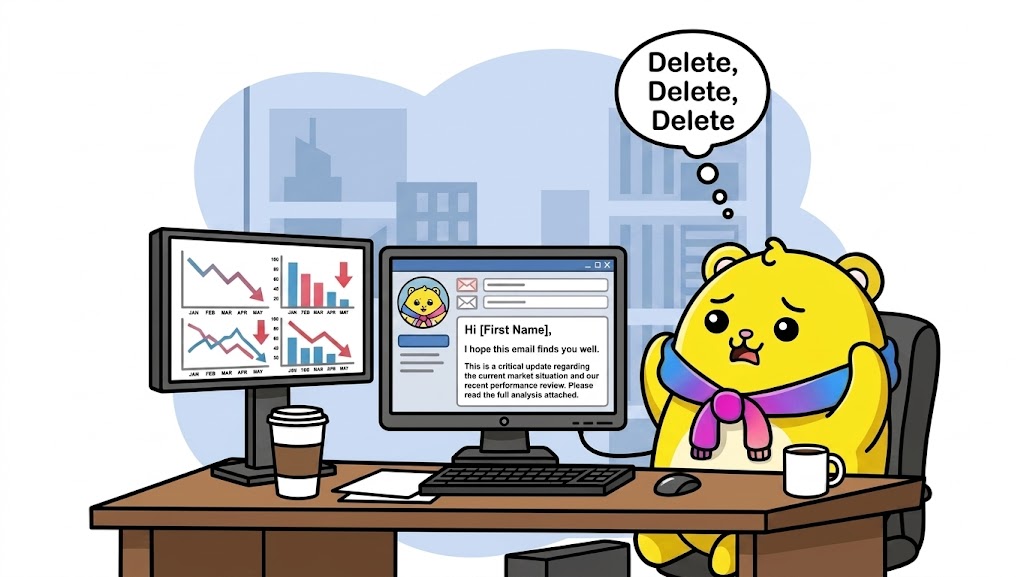
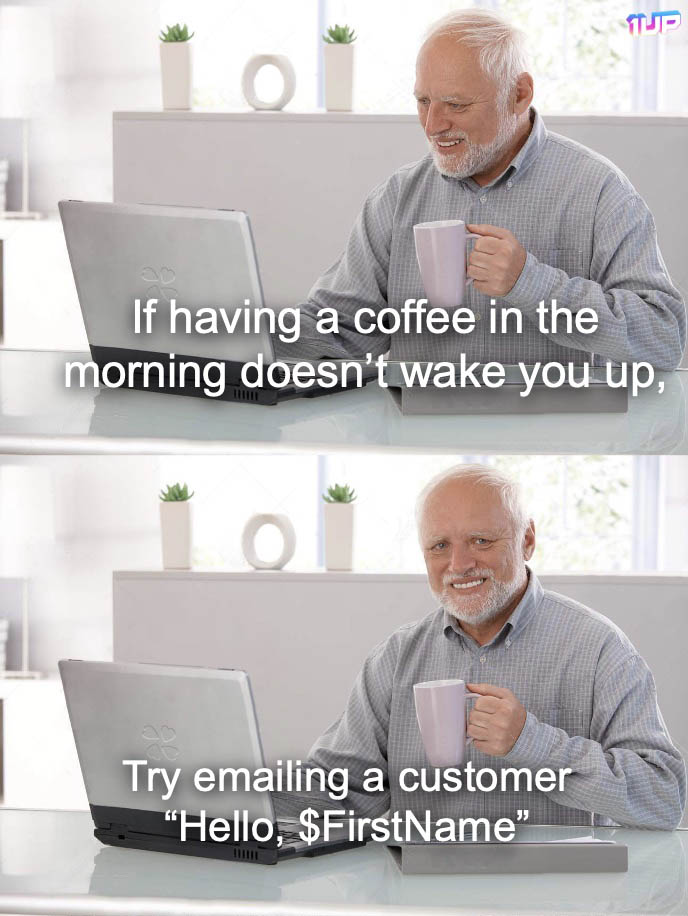
You know the email. "Hi {First_Name}," except it actually says {First_Name}, because nobody checked. Or it opens with "Hope this email finds you well," then drops a line about your company that was obviously scraped off LinkedIn ten seconds earlier.
You delete it. Everybody deletes it. And yet sales teams send these by the thousand every single day.
Here is the part nobody wants to say out loud: it is getting worse, not better.
So the obvious question is WHY.
And almost everyone gets the answer wrong, because most of the AI myths in sales point at the wrong culprit.
The popular theories are that the AI is bad, or the prompt was lazy, or the subject line needs work. All of those treat it like a writing problem. But you can write a clean, well-structured, perfectly grammatical AI sales email and still watch it die in half a second.
The real reason your AI sales emails get deleted is that they are about nothing. They are empty. And no amount of better phrasing fixes an email that has nothing to say.
Why AI sales emails feel hollow: the empty uncanny valley
Back in 1970, robotics professor Masahiro Mori described what he called the uncanny valley. As something artificial gets closer to looking human, we like it more, right up until it gets close enough that the small wrong details start to feel deeply unsettling instead.
People usually apply this to AI sales emails by saying the writing is "too perfect." That is not quite it.
The thing that makes a prospect recoil is not polish. It is the hollowness, the lack of substance. The email has the shape of a message from someone who knows them, but there is nothing actually inside it. It name-drops their company but says nothing true about their business. It claims to have a solution but never names a real problem. It performs familiarity it has not earned.
That is the uncanny valley for sales emails. Not "a robot wrote this." More like "this looks like it should mean something, and it means nothing."
Which points straight at the actual problem. Your AI did not fail because it is a bad writer. It failed because you asked it to write a personal, specific, credible email without giving it anything personal, specific, or credible to work with. So it did what models do when they have a gap to fill. It guessed, padded, and performed.
Buyers can feel that instantly. It is also why buyers now say they care more about accuracy than speed. A fast email that is empty is worth less than no email at all.
Everything below follows from this one idea. Each mistake is a different flavor of the same thing: an AI with nothing real to say, trying to cover for it.
AI sales email mistakes that get your emails deleted
1. Generic email openers that signal AI writing
- "Hope this email finds you well."
- "I came across your company and was impressed."
- "I wanted to reach out because..."
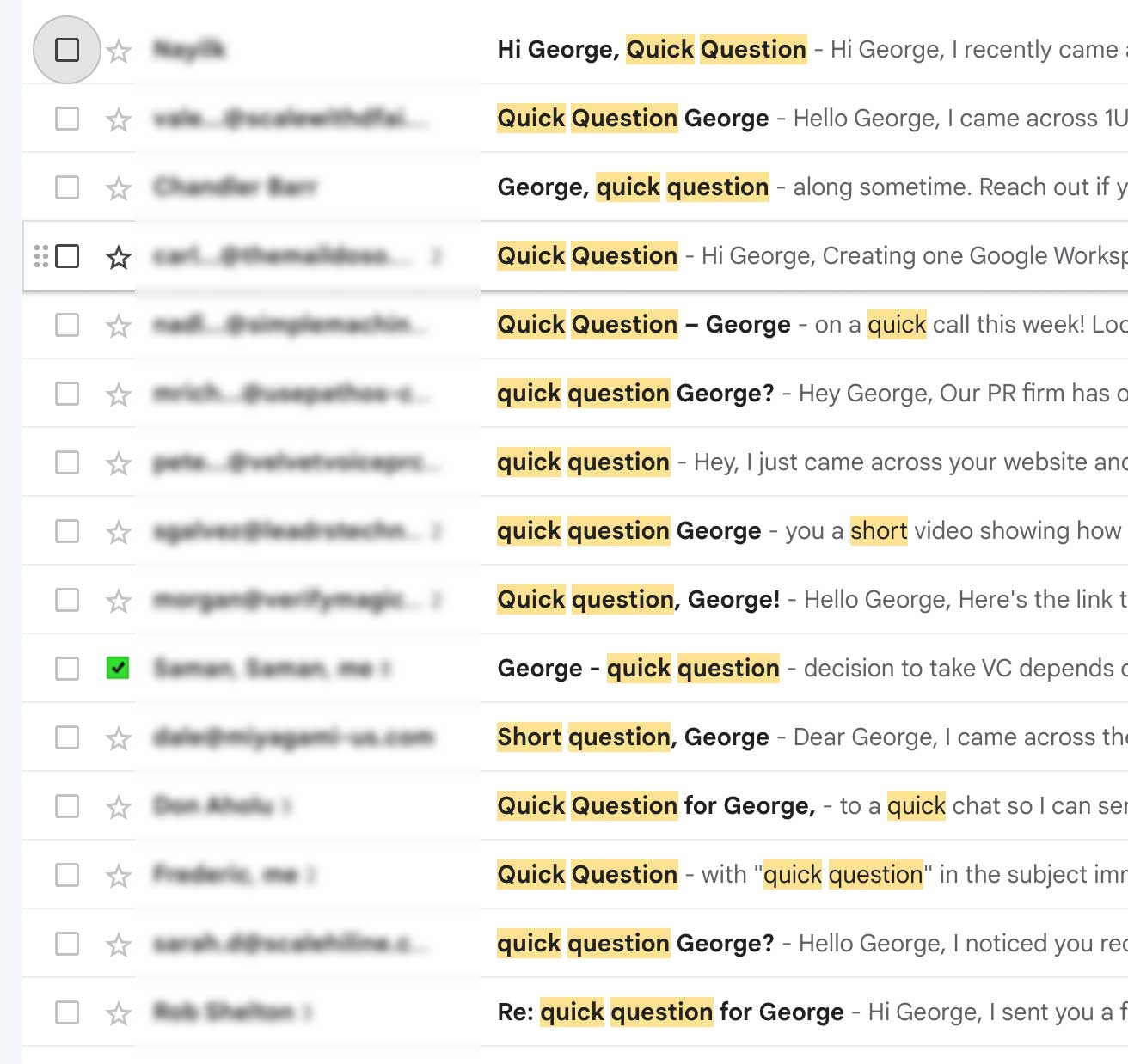
- “Curious…”
- “Noticed XYZ”
These are not openers. They are throat-clearing. They tell the prospect exactly one thing: this email was not written for them specifically, and they can stop reading.
This is the email version of AI slop, content generated to fill space rather than to say something. The opener is the first place emptiness shows, because a real opener requires you to actually know something. A specific trigger event. A real detail about their role. A problem you have genuine reason to believe they have.
If your first line could be pasted into a thousand other emails without changing a word, it is not an opener. It is a placeholder.
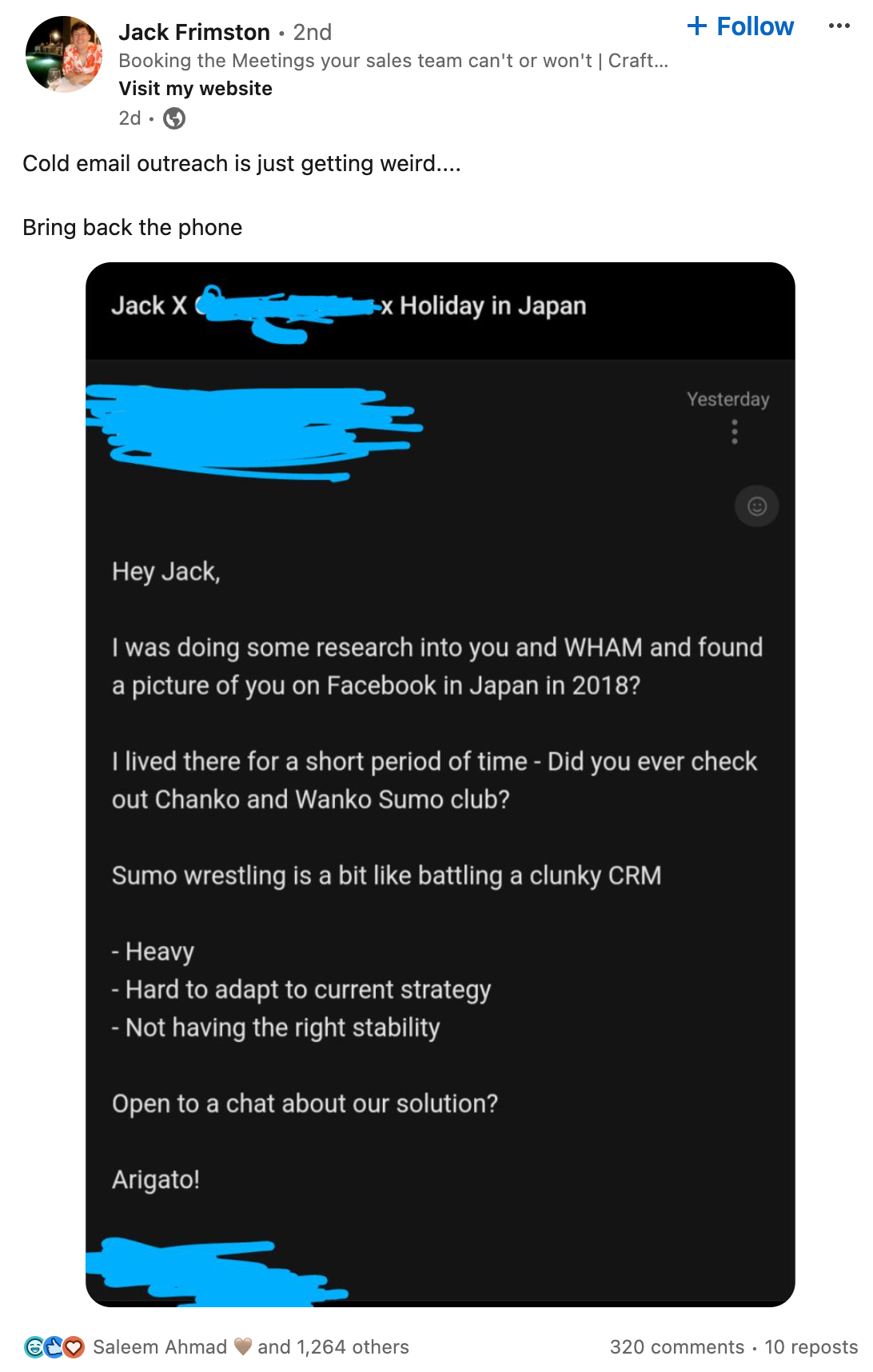
2. Fake personalization in AI sales emails
There is a special kind of bad email that tries to fix a generic opener by inventing a personal one.
"Loved your recent post on LinkedIn!" when there is no recent post. "Great to see your team's growth this quarter!" based on nothing. "I noticed you are focused on scaling..." because the model needed something to type.
Faked personalization is just guessing with confidence. And it is worse than a generic opener, because now you are not only empty, you are also wrong, and the prospect knows you are wrong. You have proven you will say things that are not true to win a reply. That is not a great first impression for a sales relationship.
Real personalization requires real input. If you do not have it, do not fake it. Say something true and useful instead.
3. AI overpromising and hallucinated product claims
Ask an AI to write a sales email and it will happily tell your prospect that you "revolutionize the entire sales process" or "10x productivity overnight."
It says this because it does not actually know what your product does. So it reaches for the most impressive-sounding claim that fits the shape of a sales email. That is the same mechanism behind AI hallucinations: when the model lacks a fact, it produces a confident-sounding substitute.
The problem is that your prospects have read a thousand of those claims and believe none of them. Overpromising does not just fail to land. It actively signals that the rest of the email cannot be trusted either.
The AI is not lying on purpose. It just has no way to know the true, specific, credible version of what you do. Unless you give it one.
4. Human-sounding AI emails with nothing to say
This is the one almost nobody catches, and it is the most important.
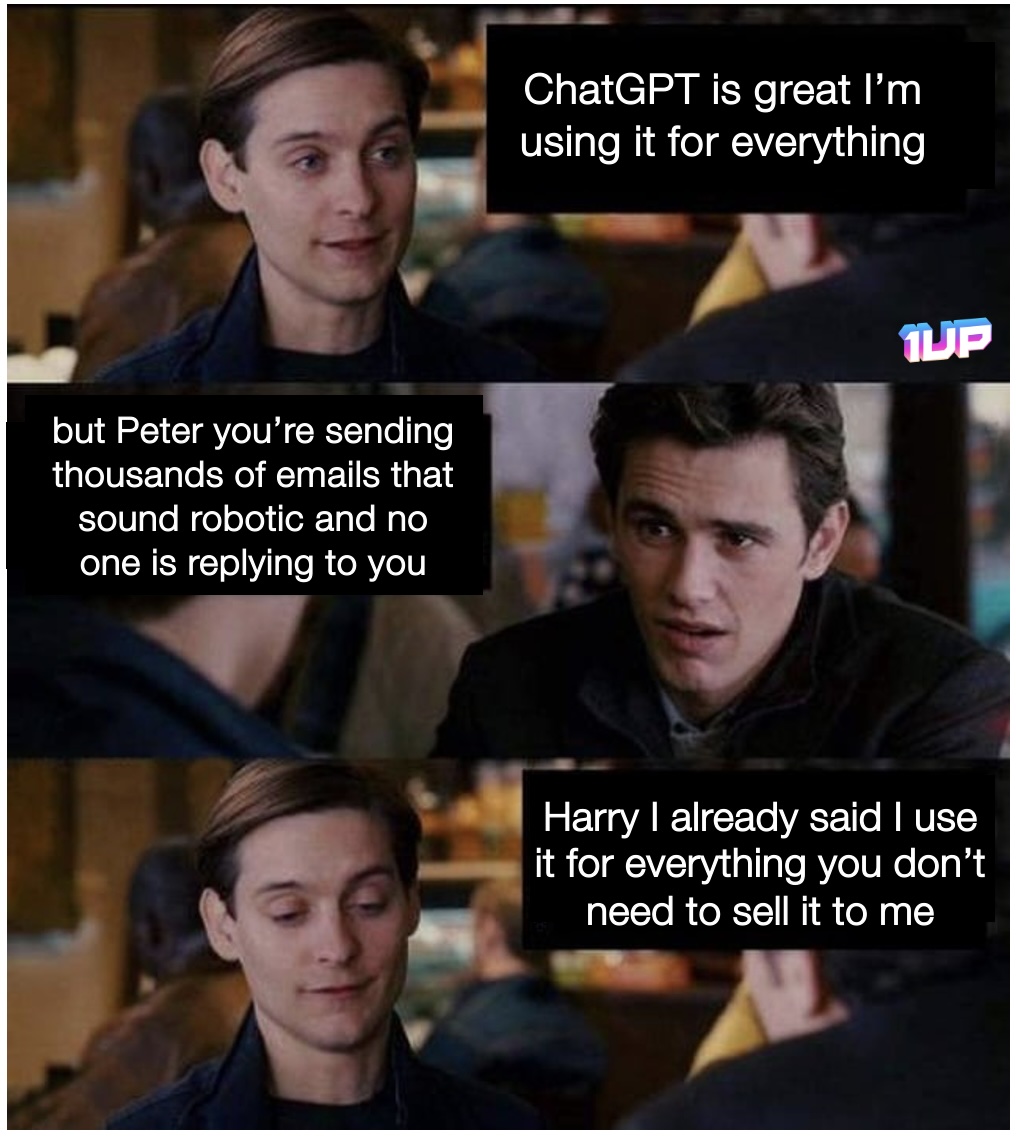
Modern AI is very good at sounding human. Natural rhythm, casual phrasing, a friendly sign-off. It is easy to read an AI draft, notice that it sounds like a person, and hit send.
But sounding human and having a point are two completely different things. An email can be warm, fluent, well-paced, and still give the prospect zero reason to care. "Sounds human" is a style check. "Has a point" is a substance check. Most people only run the first one.
Before any email goes out, the real question is not "does this sound like me?" It is "if I were the person receiving this, is there a single concrete reason to reply?" If you cannot point to it, the email is empty no matter how natural it sounds.
5. Why sending more cold emails makes deliverability worse
When the emails are not working, the tempting fix is volume. Send more. Send wider. Something will land.
It will not. The math used to support this thinking. Send enough, hit enough, get enough replies, and for a while it actually worked. It does not anymore. Open rates keep sliding, and not by a little. Cold email reply rates have dropped from around 8.5% in 2019 to under 4% this year, and the curve is not flattening.
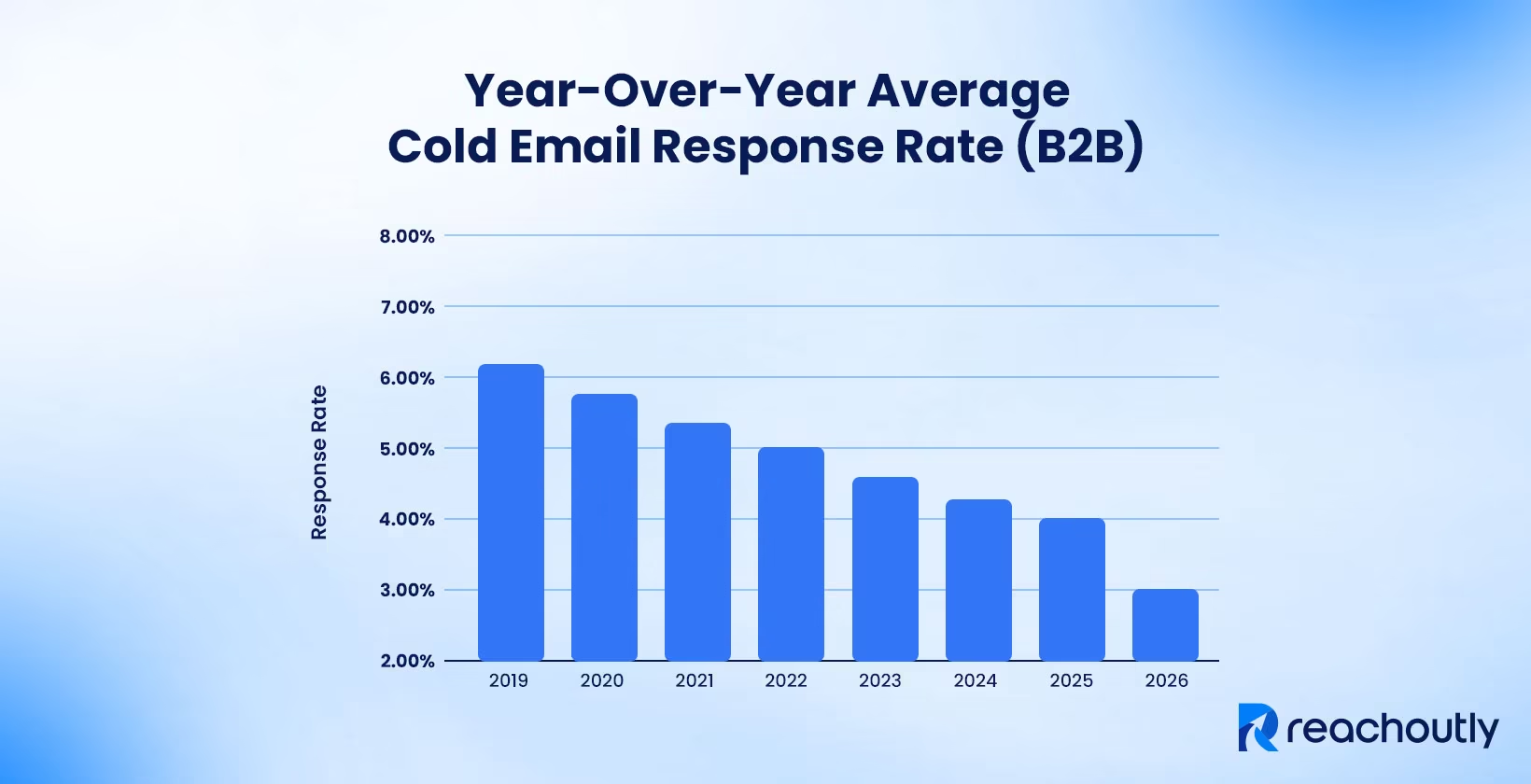
The tools got faster and the emails got worse at the same time, and prospects adjusted faster than the senders did.
Spam complaints keep climbing on the other side of that curve. Every empty email a prospect receives makes the next one a little more likely to get reported, and reported emails do not just disappear quietly. They teach the filter. The filter learns your domain. The filter learns your patterns. The filter starts making decisions about your whole company's mail before a human ever sees it.
And the filter has gotten dramatically smarter. Inbox providers keep tightening their filters, and Gmail and Yahoo's 2024 bulk-sender rules made that explicit. Authentication is now mandatory. Spam complaint thresholds are enforced. One-click unsubscribe is required. None of this was true a few years ago, and the direction of travel is only one way: stricter. The era where you could quietly carpet-bomb an inbox provider and hope to slip through is over.
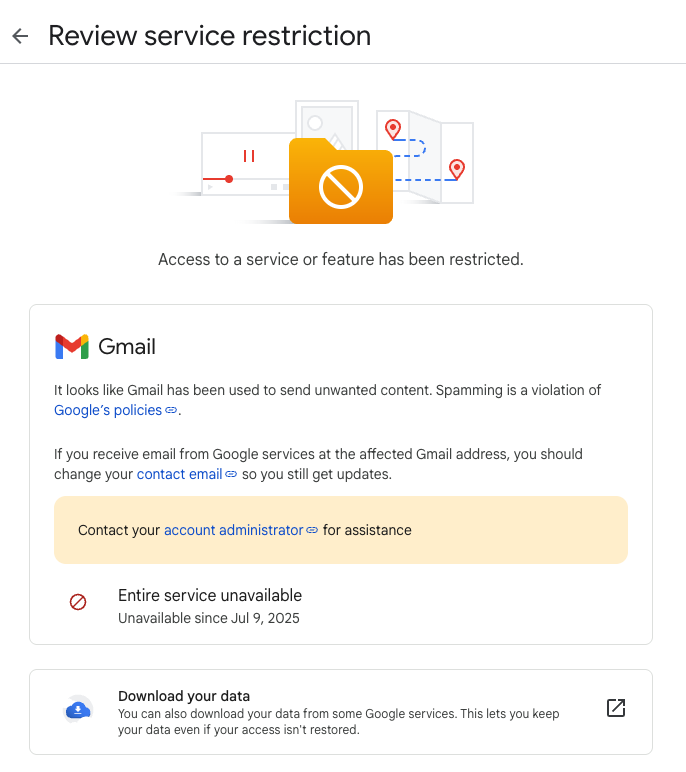
So a flood of low-engagement sends is the fastest way to wreck your domain reputation and put your whole team in spam, not just the rep doing the blasting. Domain reputation is shared. One rep grinding through 500 empty AI drafts a week can drag down deliverability for everyone sending from the same domain, including the reps who are actually doing the work properly. This is part of why sales automation can quietly hurt the teams that lean on it hardest. The teams with the most volume have the most surface area for things to go wrong.
Volume does not fix empty. It just scales it, and then gets it filtered.
How to write better AI sales emails: give it real input
Here is the good news. Every mistake above has the same root cause, which means they share the same fix. Give the AI real input and it stops guessing.
How to write an AI sales email prompt that works
"Write a cold sales email" is a wish. The AI will grant it with something generic, because that is all the request supports.
A brief is specific. Is this lead warm or cold? What do they do, and what problem do they likely have? How long should the email be? What is the one thing you want them to do? What are you offering in return?
Instead of: "Write a sales email to a RevOps leader."
Try: "Write a 4-sentence cold email to a VP of RevOps at a mid-market SaaS company. Their likely pain is messy pipeline data spread across tools. They downloaded our forecasting guide last week. The ask is a 20-minute call. Keep it casual and direct."
Same tool. Completely different output. The difference is entirely in what you gave it.
Personalize AI sales emails with real facts, not adjectives
"Make it personal" is an adjective. The AI cannot do anything with it except perform personalization, which is how you get faked LinkedIn references.
Facts are different. The actual notes from the last call. The real trigger event. The specific case study from a similar customer. The genuine reason this prospect, today, has this problem.
The best version of this is not pasting facts in one email at a time. It is letting the AI pull directly from your company knowledge: your real product details, your verified customer stories, your actual positioning. When the AI is drawing from true, approved information instead of filling gaps, the output stops being empty, because it finally has something in it.
Match your sales voice in AI-generated emails
Generic "professional tone" instructions produce generic professional emails, because everyone gives that exact instruction.
Give the AI your actual voice as raw material. Paste in two or three emails you have written yourself, the ones that got replies, and tell it to match that. You are not asking it to invent a voice. You are asking it to use yours.
One clear CTA per cold email
Empty emails often try to compensate by doing everything at once. Three links, two questions, a calendar invite, and a PDF.
A good email does one job. Make the ask clear, make it singular, and make the next step frictionless. If the prospect has to figure out what you want, they will not.
Always edit AI sales email drafts before sending
This is the rule that catches everything else. The AI does maybe 80 percent of the work. The last 20 percent, the part where you confirm it is true, that it sounds like you, that it actually has a point, is not optional. It is the part that is literally your job.
Never send raw output. Not because it will read like a robot, but because you are the only one in the loop who knows what is actually true.
Scaling AI sales emails across a sales team
Here is the real catch.
Everything above works beautifully for one carefully built email. You can write a tight brief, pull the real facts, paste your voice, and check the draft. For one email, that is very doable.
Now multiply it by a rep sending fifty emails a week. Nobody hand-assembles context fifty times. They will do it for the first few, then the deadline hits, and they quietly slide back to "write a cold sales email." The emails go empty again, not because anyone got lazy, but because the good process did not scale.
So the real question is not "how do I write one good AI email?" It is "how does my whole team get real knowledge into every email without it becoming a second job?"
That is the gap 1up closes. Instead of every rep manually feeding context into a prompt, 1up acts as an answer engine connected to your real company knowledge: your product information, your customer proof, your positioning, your past answers. The AI drafts from verified, approved information by default, so "feed it facts" stops being a step a busy rep has to remember and becomes how the system works.
It is the difference between hoping every rep does the knowledge work every time and building the knowledge in from the beginning so AI knowledge management does it for everyone from a single source of truth.
AI did not lower the bar for sales emails. It exposed it
It is easy to think AI lowered the bar for sales emails. It did not. It exposed it.
AI made it instant and obvious who actually knows their customer and their product, and who was getting by on vibes. The reps who know their stuff use AI to move faster. The reps who do not use AI to scale the fact that they do not, and their prospects can tell.
So the fix was never "sound less like a robot." Plenty of empty emails sound perfectly human. The fix is to have something real to say, and then let AI help you say it faster, to more people, without losing what made it real.
That is also why AI is not coming for good salespeople. It is coming for empty ones.
FAQs
Because reading well and having a point are different things. Most AI drafts pass the "sounds human" check but fail the "gives the prospect a real reason to reply" check. If the email is not built on a specific, true detail about the prospect or a real problem they have, polish will not save it.
Usually not. The model is rarely the bottleneck. The bottleneck is input. A strong model with no real context still produces empty, generic emails. A good process feeds the model true, specific information about your product and your prospect, and that is what changes the output.
Only personalize with real, verifiable information: an actual trigger event, a real detail about their role, a genuine problem you have reason to believe they face. Faked personalization ("loved your recent post" when there is none) is worse than no personalization, because it proves you will say untrue things to get a reply.
Manual context-gathering does not scale past a handful of emails. Teams that do this well connect their AI to a single source of verified company knowledge, so every draft pulls from true, approved information automatically instead of relying on each rep to assemble context by hand every time.


Your Buyer Is in the Room and You're Not: 5 AI-Native Sales Rooms
How to NOT Use AI for Sales: 7 Mistakes That Lose Deals

Top 11 RevOps Tools in 2026
How to Build an AI Sales Agent in 5 Minutes
How to Build a Questionnaire Knowledge Base