Human-in-the-loop theater is fake oversight. The setup looks supervised. A person sits in the AI process, a policy says a human reviews the work, everyone relaxes. The problem is that this person cannot meaningfully change what the AI does. Real human-in-the-loop is a safety net, where someone can catch a bad call and stop it before it ships. Strip out the stopping part, keep the person, and what is left is theater. They are in the room. They are not at the wheel.
Why is it so common? Oversight is basically required now. The EU AI Act, in Article 14, tells companies that high-risk systems need real human oversight. The NIST AI Risk Management Framework pushes the same line. And every board wants a name attached in case the thing detonates. So the fast fix is to bolt a reviewer onto the tail end of the workflow and declare victory. Faking a checkpoint is easy, though. The output lands on the reviewer's desk after the AI has already decided, and that reviewer usually has no time, no authority, and half the picture. Human wiring does the rest. We trust a machine that sounds sure of itself, a reflex with a name, automation bias. Stack three hundred of these reviews into one shift and nobody is really reading. Click. Approved. Click.
In April 2026, MIT Technology Review ran a piece by neuroscientist Uri Maoz that made this concrete with military AI. A drone system flags a target and reports a 92 percent chance of success. The operator approves it. A human made the call, technically. But he could not see what the system was aiming at, or how it landed on that number, so the approval was a rubber stamp with extra steps. Trade the drone for a mortgage model, an ER triage tool, a resume filter. Same problem, lower stakes. If you cannot trace the reasoning, your signature buys no safety. It just makes you the one who answers when it fails. Researcher Madeleine Clare Elish gave that role a name. The moral crumple zone, the human who soaks up blame a machine cannot.
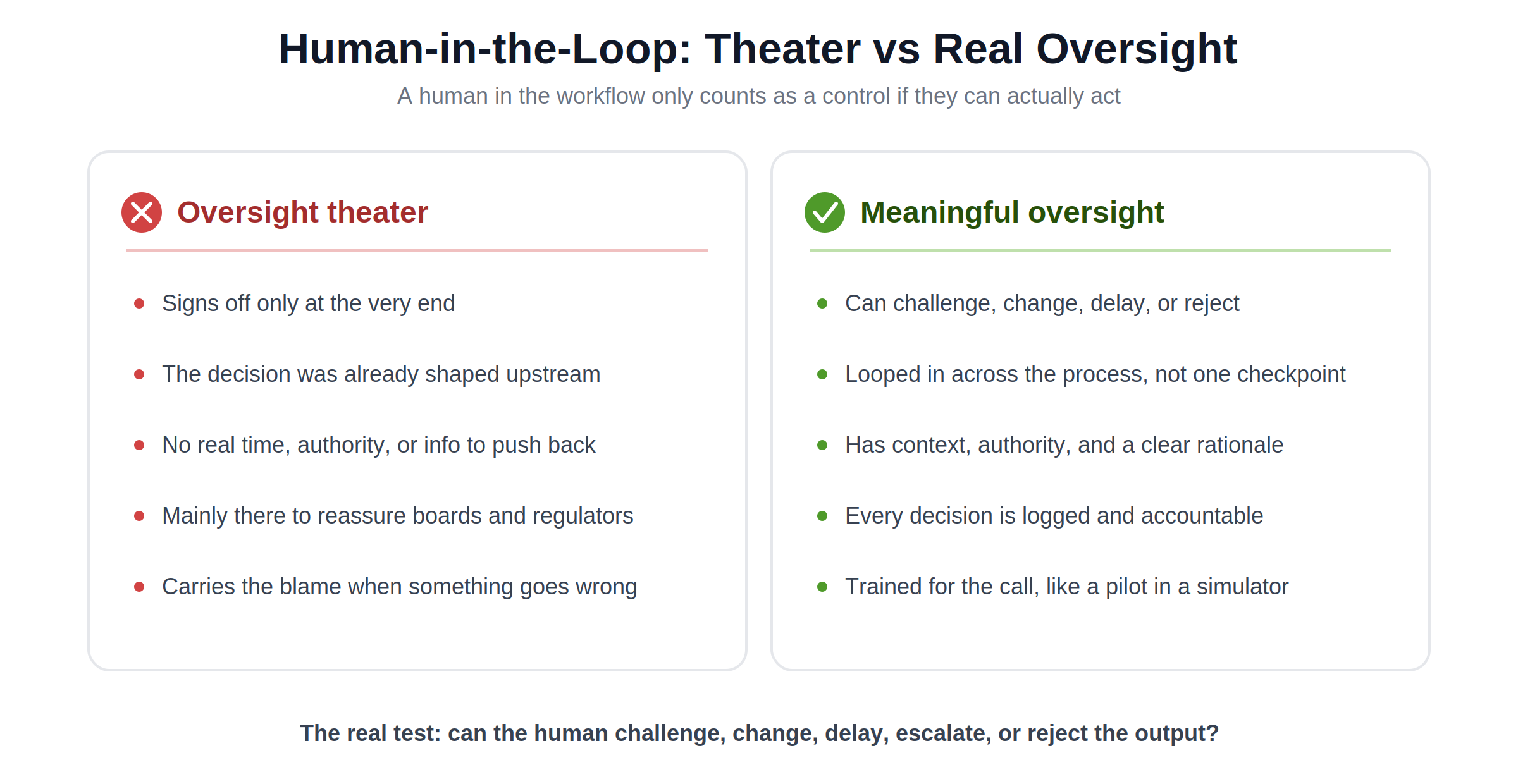
Here is the real dividing line. Not whether a human is in the loop. Whether the human can do something once they are. Question it, change it, stall it, kick it upstairs, or pull the plug. That takes genuine authority, not an approve button that has never once said no. It takes the reasoning behind the decision and a minute to think it over. Aviation sorted this out decades ago with Crew Resource Management, drilling crews on failures in simulators until taking the controls from the autopilot is reflex instead of panic.
Signs of human-in-the-loop theater:
- Sign-off at the buzzer. The reviewer arrives after the AI has all but decided.
- No teeth. No time, no authority, no real path to refuse.
- Rubber-stamping. Almost everything sails through. Rejections round to zero.
- A sealed box. Nobody can see the AI's reasoning, so nobody can grade it.
- Blame, no steering wheel. It breaks, and the human takes the hit for a system they never controlled.
Human-in-the-Loop Theater Explained:
Before you can spot the fake version, it helps to see how human-in-the-loop is meant to run. IBM's Martin Keen walks through HITL here, how people train, tune, and watch over AI, and where human judgment really belongs as these systems get more independent.
FAQs
Oversight in name only. A person sits inside the AI workflow so the system looks watched over, but they cannot truly question, change, or stop its decisions. They are there for the audit and the boardroom, not to catch the mistake before it goes out.
Because sitting in the loop is not the same as running it. Maybe the reviewer is slammed. Maybe they cannot overrule the system. Maybe they have no idea how it reached its answer. People also defer to confident machines on instinct, which is automation bias, and a few hundred reviews a day grinds anyone down to reflexive approvals. No real ability to push back means no real oversight.
Hand the person genuine power to reject or rewrite the output, not just a yes button. Give them the AI's reasoning and the time to weigh it. Put human judgment across the whole pipeline instead of one rushed stop at the end. And train reviewers for the ugly calls, the way pilots rehearse emergencies long before one shows up.