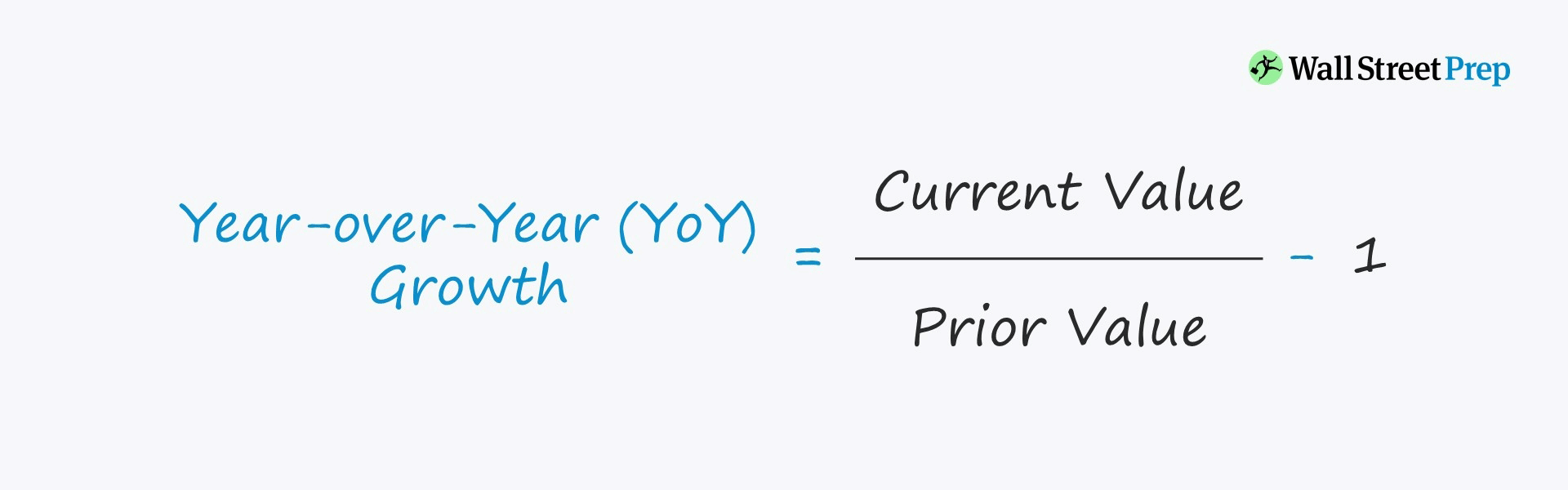
Year-over-Year (YoY) growth is a measure of the change in revenue over a period of time when compared against the same period in a previous year. We often use this metric to assess business performance and look at long-term trends.
What Is YoY and Why It Matters
Okay, so what are we talking about here?
YoY is commonly used by financial analysts and revenue teams to compare how a company is growing. Accelerated growth or a slowdown in the YoY measure can be a strong predictor of future business performance.
YoY, at its core, compares one specific period (like a month or a quarter) to the same period from the previous year.
For example: a business might look at revenues from January 2025 as it compares to the revenues from January 2024. They’ll use this to determine how much the business has grown or declined.
Unlike the Month-over-Month or Quarter-over-Quarter outlook, the YoY indicator is not affected by short-term fluctuations in a business. It’s generally considered a more complete and stable picture of a business’s performance.
For example: a retailer might see a huge spike in sales in December thanks to holiday shopping. But they can only really understand improvements or decline by comparing this spike to previous Decembers.
Strategic Applications of YoY Growth
When you understand YoY, you can make better business plans.
A strong YoY growth rate often leads to higher confidence from investors, which means you can gain more access to funding. It’s also a contributor to internal momentum, which can lead to your ability to scale your entire operation.
On the flip side, a decline in YoY can signal the need to reevaluate your:
- Marketing strategies
- Product offerings
- Customer retention efforts
YoY growth can be used to generate financial models, resource allocation, and predict sales forecasts.
For example: if your company has grown its revenue by 20% YoY over the last three years, you might be able to justify investing in a new product line. You might even decide to open a new location. Conversely, if you’ve seen a drop in YoY performance, or even stagnation, you might start thinking about cutting costs or making improvements to your marketing and sales processes.
Basically, when answering the questions, “What Is YoY?” remember that it’s more than just a formula. Instead, it’s a fundamental tool for making a smart, strategic decision for your business.
How to Calculate YoY Growth
FAQs About Year-over-Year (YoY) Growth
FAQs
YoY, or Year-over-Year, is a way to compare a business metric (like revenue, profit, or customer count) from one year to the same period the previous year. It helps show long-term trends while eliminating the noise of seasonal or short-term changes.
YoY growth is calculated using the formula: [(This Year's Value – Last Year's Value) / Last Year's Value] × 100 For example, if revenue was $1.2M this year and $1M last year, the YoY growth is [(1.2 - 1.0) / 1.0] × 100 = 20%.
YoY growth is important because it provides a clear and consistent measure of performance over time. It allows businesses to track progress, identify trends, and make strategic decisions based on data that reflects real growth or decline.
Each metric serves a purpose, but YoY is typically more reliable for identifying long-term trends. MoM and QoQ metrics can be useful for short-term analysis but are often influenced by seasonality, one-off events, or short-term volatility.