A wrapper, often called an AI wrapper or GPT wrapper, is an app built on top of someone else's AI model instead of a model trained from scratch. It talks to a foundation model like GPT, Claude, or Gemini through an API and adds its own layer on top, usually some mix of interface, prompts, data, and workflow. Picture the model as a powerful engine and the wrapper as the kitchen appliance built around it. The engine does the heavy lifting. The appliance is what makes it usable for one specific job. People also throw the word around as an insult. Call something "just a wrapper" and you are saying it is a thin skin over ChatGPT that anyone could rebuild in an afternoon.
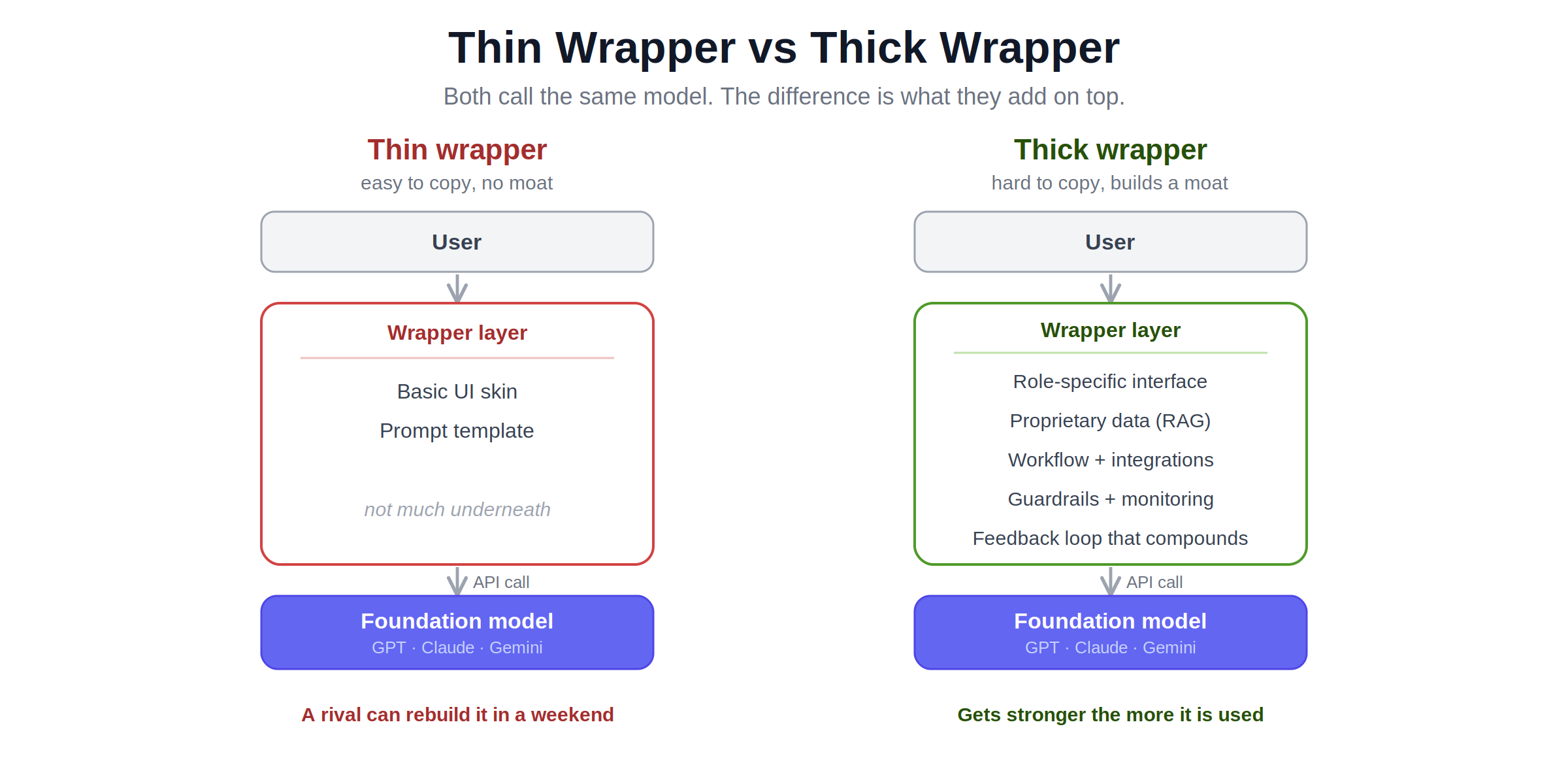
That insult points at a real risk. Wrappers sit on a spectrum from thin to thick. A thin wrapper is barely more than a prompt template and a logo, and it lives or dies by the model underneath. The danger even has a nickname, getting Sherlocked, which is when the model provider ships a feature that wipes out your whole product overnight. It has already happened. When ChatGPT added native PDF reading in late 2023, the wave of startups built around chatting with PDFs suddenly watched their core feature become free. Jasper is the cautionary tale people point to most. It hit a billion-dollar-plus valuation as a polished layer over OpenAI, then reportedly lost more than half its revenue once ChatGPT got good enough to do the same writing on its own.
Here is the other side, though, because the "just a wrapper" crowd misses something. By that logic, most software is a wrapper. The entire SaaS industry was basically a wrapper on databases. Salesforce wrapped one in a sales workflow. Shopify wrapped one in a storefront. Nobody calls them thin. Cursor started life as a wrapper around GPT-4 and Claude and grew into a code editor worth billions, because it kept piling on real value above the model. Even small ones can work. The writing tool Jenni AI reportedly went from a couple thousand dollars a month to over three hundred thousand in about a year and a half. As one Hacker News commenter put it, if you provide value and someone pays you, you are a company. The model is just infrastructure. Your product is everything you build on top of it.
So the useful question is not whether something is a wrapper. Almost everything is. The question is how thick it is, and whether a rival or the model maker could clone it in a weekend. A thin wrapper has no answer to that. A thick one does, because it has built things the base model cannot copy easily, like proprietary data that improves with every use, deep workflow integration, and a real distribution advantage. That is the whole ballgame. Anyone can call an API. The moat is what you wrap around it.
What turns a thin wrapper into a thick one:
- A data flywheel. The product gets smarter from your own usage data, which a generic model never sees.
- Workflow integration. It lives inside the tools people already use, so leaving would be a pain.
- Domain depth. Specialized data, guardrails, and logic tuned for one industry or job.
- Distribution and brand. Reaching and keeping users before a big provider bundles the same feature.
Wrapper Explained:
So are wrappers a real opportunity or just hype waiting to pop? This episode of Pragmatic Talks digs into the AI wrapper gold rush, weighing why these apps are so easy to launch against what it actually takes for one to survive.
FAQs
An AI wrapper is an application built on top of an existing AI model, like GPT or Claude, through its API rather than by training a model from scratch. It adds a layer of value such as a user interface, prompt engineering, proprietary data, or workflow logic that makes the raw model useful for a specific task. The term ranges from simple chatbot skins to deep, vertical products.
Usually, yes. It implies the product is a thin skin over a model with little of its own, easy to copy and likely to be wiped out when the model provider adds the same feature. But the label gets overused. Plenty of valuable software is technically a wrapper, so the real issue is not whether it wraps a model, but how much defensible value it adds on top.
Thin ones usually do not. They depend entirely on the underlying model and can be replicated quickly or made obsolete by the provider. Thick wrappers can build durable moats through proprietary data that improves with use, deep integration into a user's workflow, domain expertise, and strong distribution. The model is a commodity anyone can access, so the moat has to come from everything built around it.