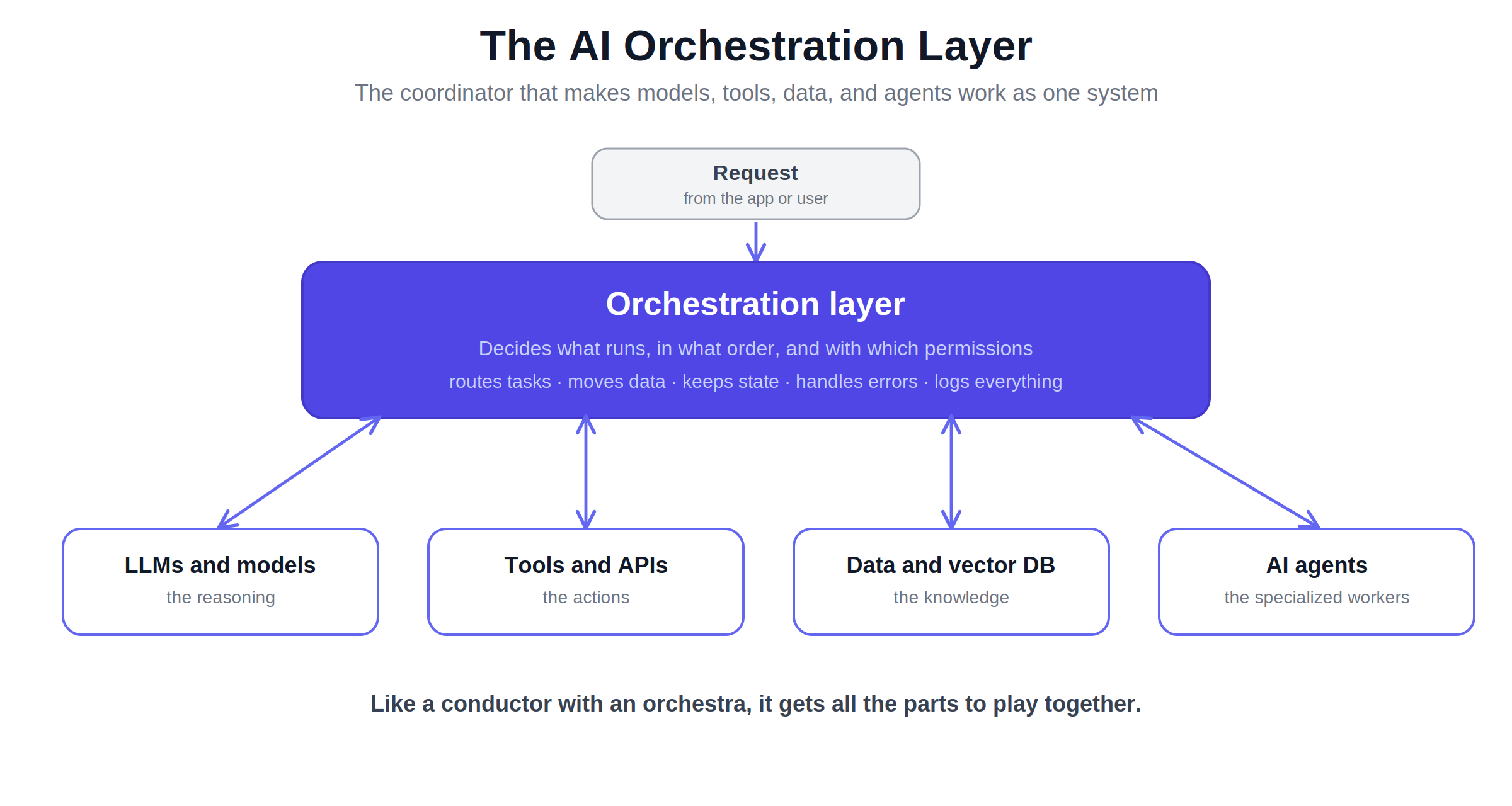
An orchestration layer is the software that gets a pile of AI pieces to act like one system. Almost no real AI app runs on one model these days. You usually have a language model in there, a handful of tools and APIs, maybe a couple of databases, and on the bigger builds, entire crews of agents. The orchestration layer is the bit wedged in the middle of all that, sending each request where it belongs, figuring out the next move, and carrying data from one step to the one after it. Want the quick mental image? A conductor, baton up, in front of an orchestra. The musicians can all play. Someone still has to set the pace and cue each section. That someone is the orchestration layer.
So what is it doing back there? Honestly, a lot. It picks the model or tool that should take each task. Then it feeds the result of that step straight into the next one, so a long job moves like a tidy chain rather than a snarl of one-off calls. It hangs onto state too, which just means it keeps track of what has gone on so far. A model chokes or hands back something shaky, and it quietly swaps in a backup. It also keeps the whole thing honest, checking who is allowed to do what and writing down a record as it goes. One clean way to think about it. Capability versus control. Models and agents bring the capability. The orchestration layer brings the control.
And this is the quiet thing that splits a flashy demo from something a company can really ship. You have probably watched it play out. A single sharp prompt wows the room, then folds the moment real traffic and odd edge cases and compliance rules pile on. With no coordination, each part starts guessing what the others are up to, and the whole contraption collapses into prompt spaghetti. That shortcut has a price tag. In one survey of 600 enterprise tech leaders, most owned up to regretting at least one big AI buy, usually after grabbing a tool that nailed one corner of the problem and left wide coordination and governance gaps that stall any real launch. Plugging those gaps is the orchestration layer's entire reason to exist.
Where do you bump into this most? Agentic AI and multi-agent systems, the ones where a handful of agents carve up the work and then have to trade information without elbowing each other. That kind of teamwork never just happens by itself. It gets wired up in the orchestration layer. Builders usually pull in a framework to do it, and the same few names keep circling, LangChain, LangGraph, CrewAI, AutoGen. Customer support is the example that makes it land. Say a question comes in. The layer routes it to the right agent, digs the real answer out of a company database, opens a ticket, and slides the messy cases over to a human, all in one unbroken handoff.
What an orchestration layer does:
- Routing. Sends each task to the model, tool, or agent best suited to it.
- Sequencing. Chains steps together so the output of one feeds the next.
- State and memory. Keeps track of what has happened so far in a task.
- Error handling. Falls back to another option when something fails or looks wrong.
- Governance. Checks permissions, controls cost, and logs everything for later.
Orchestration Layer Explained:
Want to see the orchestration layer in action on real workflows? In this IBM talk, Terzo's Eric Pritchett walks through how AI agents and LLMs coordinate complex automation, and how that changes the old way of stringing tasks together.
FAQs
It is the software that gets different AI models, tools, data sources, and agents cooperating inside one app. The layer parks itself in the middle and keeps everything moving, sending each task to the right place and carrying data along from one step to the next. Picture that conductor again, pulling all the separate parts into a single performance.
It runs the flow of work across every AI piece in the system. So it decides which model or tool grabs a task, links the steps so one feeds the next, tracks state, catches errors with fallbacks, and enforces the rules around permissions and logging. Short version, the models and agents supply the raw ability, and the orchestration layer supplies the control that keeps them in line.
Because most real AI products lean on more than one model or tool, and those parts have to cooperate or the whole thing starts to wobble. Skip the coordination and the workflow turns fragile, hard to scale, and quick to crack the second real traffic and edge cases show up. The orchestration layer adds the routing, error handling, and governance that carry a one-off demo all the way to production.