GPT-ese, also called AI voice, is the giveaway writing style of a chatbot. Smooth sentences. Perfect grammar. A cheery tone that never dips. And underneath all that polish, surprisingly little actually gets said. The effect is a bit like a sharp intern padding out a topic they only sort of grasped. Most people cannot quite name what is off, but they feel it, and once you learn the pattern you catch it everywhere, in cover letters, LinkedIn posts, even your uncle's Facebook captions.
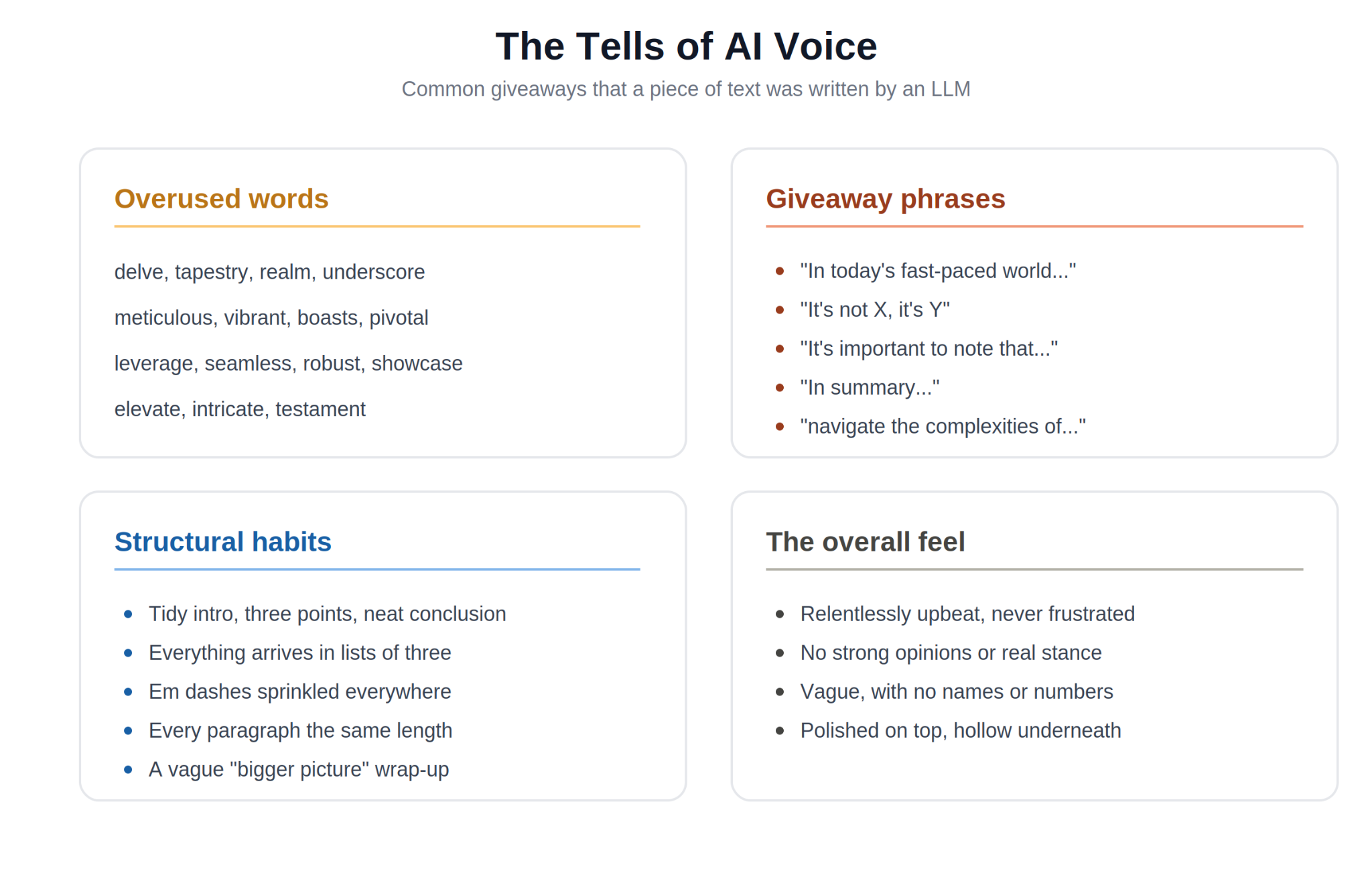
The most obvious tell is word choice. Models reach for the same fancy vocabulary far more than people do. "Delve" is the poster child. Back in 2022, it turned up in roughly one out of every 10,000 scientific abstracts. Two years later, once researchers were quietly running drafts through ChatGPT, that rate had climbed by about 2,700 percent. "Tapestry" got so radioactive that one editor said they no longer believe anyone uses it innocently. Same story for "realm," "underscore," "meticulous," and "vibrant." There are even giveaway names. Ask an AI for a sci-fi story and the hero is suspiciously often called Elara Voss.
But the words are only the surface. Here is the thing though. Strip out every last "delve" and the text can still feel off, because the shape underneath gives it away. There is a rhythm to it. A warm-up intro, three balanced points, and a closing line that pulls back to some lofty takeaway no reader asked for. The "It's not X, it's Y" move keeps showing up. Em dashes land in spots that do not need them. Paragraph after paragraph runs the same neat length, like train cars.
That hollowness is the real fingerprint. Human writing has specifics, brand names, real numbers, a story, a bit of an edge. AI writing tends to float above all that in a haze of "leading industry experts" and "ever-changing landscapes." Worth saying, none of these tells are proof on their own. Plenty of good writers use em dashes and the word "crucial," and the investor Paul Graham once wrongly accused a cold-emailer of using AI just for writing "delve." The signs point a direction. They do not convict.
What gives AI voice away:
- Overused words. Delve, tapestry, realm, underscore, meticulous, vibrant, boasts, pivotal, leverage.
- Stock phrases. The usual suspects: "In today's fast-paced world," "it's not X, it's Y," "it's important to note," "in summary."
- Predictable structure. A clean intro, exactly three points, lists of three, and a big-picture wrap-up.
- The vibe. Sunny no matter what, dodges any real opinion, thin on specifics, slick up top with nothing much beneath.
GPT-ese Explained:
Want to get faster at catching AI voice in the wild? In this video, YouTuber Evan Edinger walks through the tells he uses to spot AI writing almost instantly, with plenty of real examples to train your eye.
FAQs
GPT-ese, or AI voice, is the house style large language models fall into on their own. Think smooth, formal, and a little too cheerful, heavy on words like "delve" and "tapestry," laid out in a predictable shape, and short on the specifics and personality you get from a real writer. People say it as shorthand for "this reads like a chatbot made it."
It learns from enormous amounts of text, then gravitates to the words and patterns that show up most often, so the output settles into a kind of smoothed-out average. On top of that, being trained to stay helpful and inoffensive nudges it toward that even, upbeat register. What you get reads as competent and steady, but also generic, because it is built from what is most likely rather than what is yours.
Cut the buzzwords and pick plain ones. Vary your sentence and paragraph lengths instead of marching along in even beats. Add real specifics, names, numbers, and things only you would know. Take an actual position. And read it out loud. If it sounds like a press release giving a TED talk, rework it.