If you lead a sales team, you probably have a sales playbook you’re proud of.
You put a lot of time into it. It explains how your team sells, what to say to customers, how to handle objections, and what you’ve learned from real deals. On paper, it should be one of the most useful things your team has.
In reality, most reps don’t really use it. Some barely open it. Others don’t even know where it lives.
That’s not because the playbook is bad. It’s because sales move fast. When a rep needs an answer during a live deal or while replying to an email, they’re not going to stop and dig through a long document. They’re going to ask a quick question in Slack or Teams and keep going.
Over time, this turns into a mess. The same questions get asked over and over. People get interrupted all day. Answers change depending on who replies, which leads to mixed messages going out to customers.
This is exactly what an AI-powered Sales Playbook can help with.
By connecting your sales playbook to AI, reps can get answers right away, inside the tools they already use. No searching. No guessing. Just quick, clear answers when they need them. This is part of a bigger shift toward AI knowledge management, where teams stop hunting for information and just ask for it.
In this post, we’ll walk through a simple way to use AI for sales playbooks so all that work you put in actually shows up in day-to-day sales.

What's Wrong With Traditional Sales Playbooks?
Most sales teams don’t have a documentation problem. They have a problem searching for relevant information.
The information exists, but it’s hard to get to when it actually matters. Sales playbooks usually sit in shared drives, Notion pages, or some internal wiki. Even when reps know where the playbook is, finding the exact answer they need takes way too long.
The issue isn’t just opening the document. It’s getting through it. Long pages, lots of sections, and information spread all over the place mean reps have to stop what they’re doing and go searching. In a fast sales cycle, that kind of slowdown can kill momentum.
So reps stop trying because enterprise search is so difficult. Instead of searching, they ask. Slack or Microsoft Teams becomes the go-to place for answers. People get interrupted all day. The same questions pop up again and again, and the answers change depending on who replies. Over time, even a really good sales playbook barely gets used.
This kind of scattered knowledge isn’t just annoying. It’s expensive. Research from Harvard Business Review shows that companies that do a better job organizing and using their knowledge see real results, like:
- 47% higher success in hitting objectives and key results (OKRs)
- 39% better team speed and efficiency
- A 23% boost in productivity, measured by revenue per employee
Sales Playbooks help fix this by changing how people get information. Instead of digging through documents, reps can get clear answers instantly, pulled straight from the playbook and other sales content, right inside the tools they already use.
Don't want to read? Here's a how-to video:
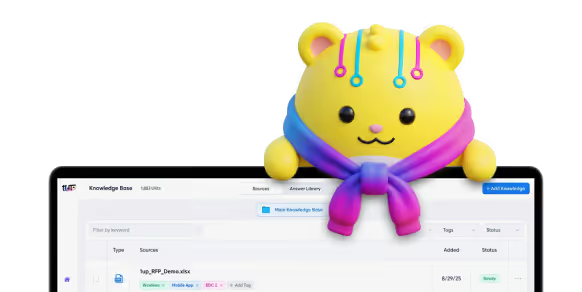
Step 1: Connect Your Sales Playbooks to an AI Knowledge Base
This part is pretty simple. All your sales info needs to live in a place where AI can actually read it and pull answers fast.
That means thinking bigger than just one playbook document. Instead of a single file, you want a shared company knowledge base with everything your sales team uses, like:
- Your main sales playbooks
- Case studies and real customer examples
- Competitor battle cards
- Product and feature docs
- Pricing rules and deal guidelines
- Onboarding and process docs
Most AI tools can connect right to where this stuff already lives, like Google Drive, Notion, SharePoint, or your internal website. Once it’s connected, everything stays up to date on its own. When you change a doc, the AI picks it up automatically. No re-uploading. No version mess.
This step matters because AI doesn’t magically know your business. It can only work with the info you give it. When all your sales content is in one place and kept in sync, your team gets answers from a single source of truth instead of guessing or using outdated info.
Step 2: Automate Knowledge Retrieval With Natural Questions
Once everything is connected, this is where Playbooks really start to matter.
Instead of digging through folders or bugging teammates all day, reps can just ask questions and get answers right away. Stuff that used to take searching or Slack messages can now be handled instantly, like:
- How do I respond if a customer says we’re too expensive?
- The prospect said they’re looking at Competitors A and B. What are our differentiators?
- What’s the implementation timeframe for a customer in the EU running Oracle DB?
This is how teams turn into a knowledge sharing AI workplace. The AI pulls the right info straight from the sales playbook and other sales content and gives it back in a clear, simple way. When it makes sense, it even shows where the answer came from, so reps can trust it during real deals.
When knowledge retrieval is automated, two big problems disappear. Firstly, reps don’t have to remember where things live anymore, and secondly, they don’t have to scroll through long documents just to find one line. The end result is faster answers and more consistent messages across the whole sales team.
Step 3: Put Answers Where Reps Already Work
If reps have to change how they work, they probably won’t use it. That’s just how it goes.
Even the best AI-Generated Sales Playbooks won’t stick if they live in some separate tool no one wants to open. This is where internal company AI really helps.Instead of asking reps to learn a new tool or change how they work, the AI fits directly into the tools they already use every day. Answers show up right where work is already happening.
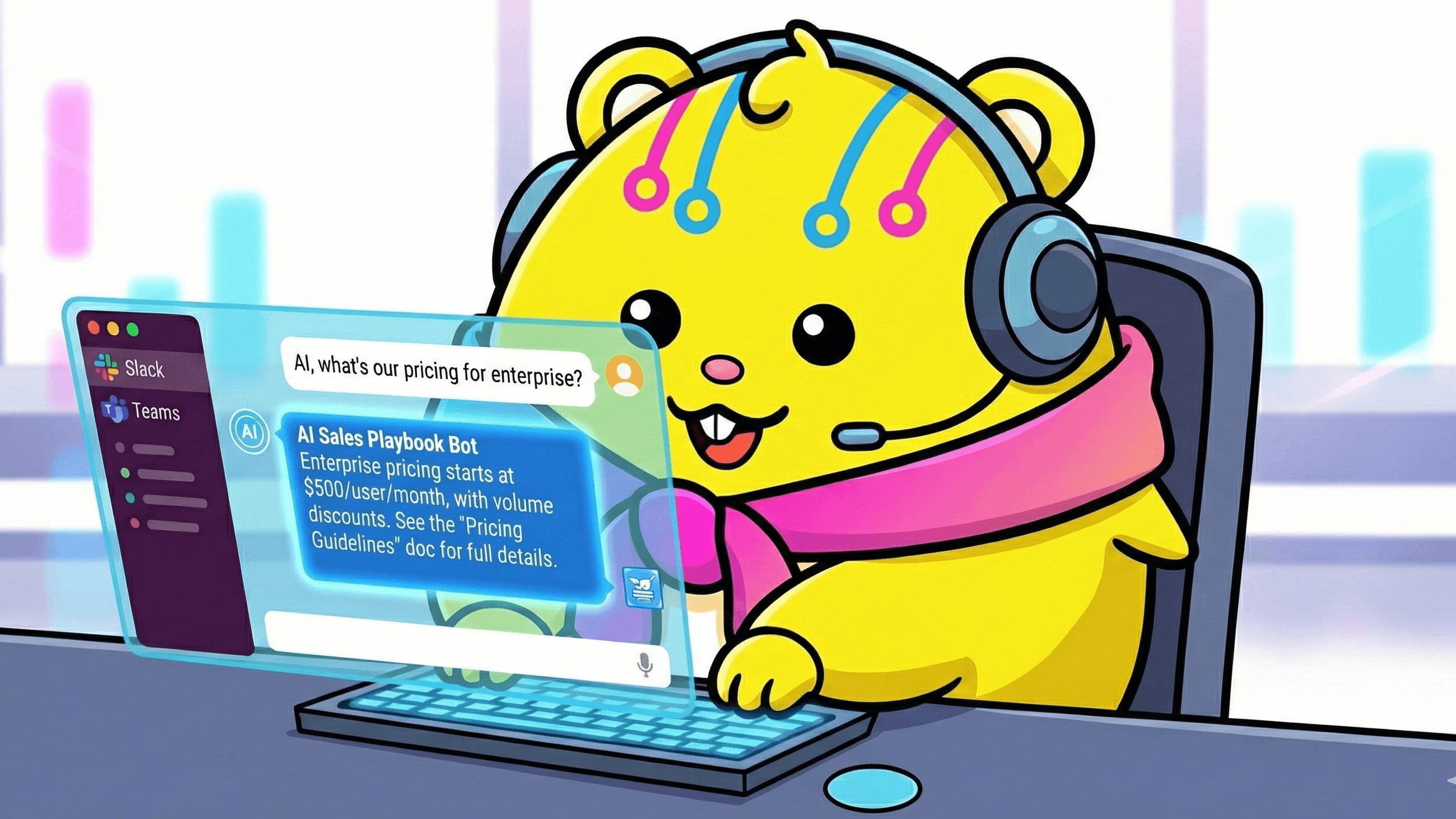
Here’s what that looks like inside Slack:
The same experience is available via other tools reps already live in, including Microsoft Teams and Google Chat.
The impact is immediate. A rep can ask a question in Slack instead of interrupting a teammate. While drafting an email, they can highlight text and get guidance using the browser extension without leaving their inbox. No tab switching. No extra steps. Just answers where they already work.
The difference is immediate. A rep can ask a question in Slack instead of pinging a teammate. While writing an email, they can highlight text and use the browser extension to get help without leaving their inbox. No switching tabs. No extra steps.
When the playbook is built into everyday tools, reps don’t have to remember where anything lives anymore. They don’t need to search folders or hunt down the right doc. The answers are just there when they need them. That’s how playbooks go from being ignored to actually getting used every day.
How AI Reduces Interruptions and Scales Enablement
One of the biggest wins with a Sales Playbook powered by AI is that they stop people from getting interrupted all day.
In a lot of sales teams, managers and top reps spend a huge part of their day answering the same questions over and over. Questions about products, pricing, process, or how to handle a deal pop up constantly. One question by itself doesn’t seem like a big deal, but when it keeps happening all day long, it really slows everyone down.
Here’s a quick look at how reps can get answers on their own using the browser extension, without interrupting anyone:
AI helps break the constant question-and-interrupt cycle by handling common questions automatically. Instead of pinging a teammate, reps can ask the AI and get a clear answer right away. The answers stay consistent because they’re pulled from approved sales content. Over time, reps get more confident, managers get their time back, and the team can grow without needing more people just to answer questions.
It also makes the whole support setup way more organized. By seeing what questions reps ask the most, leaders can spot gaps in onboarding or areas where the playbook needs work. What used to be messy and reactive starts to feel more like a living sales enablement checklist that keeps getting better based on real use.
The end result is fewer interruptions and a smarter, more scalable way to support the sales team as it grows.
How Great Sales Playbooks Actually Get Used
Sales leaders often wonder why past enablement efforts didn’t stick. In most cases, the issue wasn’t the quality of the content or a lack of effort from the team. The real problem was how hard the content was to use.
Traditional enablement expects reps to stop what they’re doing, track down the right document, read through it, and figure out how to apply it on their own. That approach doesn’t hold up in real sales situations, where things move fast and attention is limited.
AI Sales Playbooks remove much of that friction. Instead of behaving like static documents, they function as living sales enablement assets that support reps in real time. The experience looks very different from traditional playbooks:
- No digging through folders
- No switching between tools
- No waiting for teammates to respond
- No second-guessing whether the information is current
Reps ask questions and get clear answers right away, pulled from approved sales content. It feels closer to asking a knowledgeable teammate than reading through a manual.
This shift also changes how enablement teams add value. As Stephanie White, GTM Enablement Leader, puts it, strong teams move the conversation from “So what?” to “Now what?” AI helps surface insights, while people use those insights to make better decisions and improve how the team sells.
With answers built into daily workflows, the playbook stops feeling like background documentation. It becomes something reps rely on to move deals forward. Over time, that’s what turns a dusty playbook into a tool the team actually uses.
FAQs
An AI Sales Playbook is a system that connects your existing sales playbook and enablement content to AI, allowing reps to ask questions in plain language and get instant, sourced answers inside the tools they already use, like Slack, Teams, or email.
Traditional sales playbooks are static documents that require reps to search for information manually. AI Sales Playbooks automate knowledge retrieval by delivering precise answers in real time, removing the need to hunt through documents or interrupt teammates.
AI Sales Playbooks fit directly into existing workflows and remove friction. Because reps can access answers instantly without changing how they work, playbooks become a daily resource instead of something used only during onboarding.

Your Buyer Is in the Room and You're Not: 5 AI-Native Sales Rooms

How to NOT Use AI for Sales: 7 Mistakes That Lose Deals

Top 11 RevOps Tools in 2026
How to Build an AI Sales Agent in 5 Minutes
How to Build a Questionnaire Knowledge Base