If you are a Sales Engineer, you answer the same technical questions over and over.
- Does your product support SSO?
- What are your SLAs?
- How do you handle data residency?
- Can you share your SOC 2 report?
- What does implementation look like?
- Can you outline a POC plan?
These questions show up in RFPs, DDQs, security reviews, Slack threads, and live deal cycles. And most of the time, the answers already exist in your API docs, security documentation, and internal knowledge base.
The real challenge is delivering accurate answers quickly and consistently during live deals.
An AI Sales Engineer uses your approved documentation to automatically generate accurate, source based answers. That means faster RFP turnaround, fewer repetitive Slack questions, and more time for human SEs to focus on discovery, demos, and closing complex deals.
In this guide, we’ll show you how to deploy an AI solutions engineer using 1up and start automating technical sales answers today.
Is AI replacing Sales Engineers?
No. AI is not replacing Sales Jobs any time soon. Instead, it serves as a powerful partner. AI is helping Solutions teams automate repetitive technical answers, speed up responses to RFPs and DDQs, and reduce manual documentation work.

If you've worked with a great SE, you know how critical they are to closing the deal. Sales Engineers remain essential for complex B2B sales. AI simply gives them leverage by handling the repeatable tasks, allowing them to scale their impact.
So what is an AI Solutions Engineer?
Sales cycles today are packed with technical validation, which creates repetitive work. You're constantly facing a barrage of requirements like Security questionnaire reviews, RFP analysis, DDQs, Vendor questionnaires, product questions in Slack, and compliance follow-ups.
Your SE team likely spends hours every week rewriting answers that already exist somewhere in your documentation.
An virtual Sales Engineer isn't really an SE. It does not replace the SE you know and trust.
Instead, it's a proxy for their knowledge. It supports the team when they are busy, offline, or focused on higher value work. It delivers the same approved technical answers your SE would give, just without pulling them into every repetitive question.
After all, that's what makes SE and Solutions teams so valuable – their deep knowledge of your products and services. So the real value of an AI Solutions Engineer would be to augment your human team so they can spend more time on strategy, discovery, and building relationships instead of rewriting the same answers all day.
An AI Sales Engineer pulls from your API docs, product docs, compliance materials, and sales content to generate accurate, source-based responses in seconds. That leads to:
- Faster RFP turnaround
- More consistent answers
- Shorter deal cycles
- Less burnout for Sales Engineers
This is how companies are scaling pre-sales abilities without dramatically increasing headcount.
What makes a great human SE team?
Before automating anything, it is worth remembering what makes human Sales Engineers great.
Strong SEs have:
- Deep knowledge about the problem space
- The ability to work closely with sales teams
- A reputation for being easy to work with
The true measure of a Sales Engineer is not their product knowledge, but their empathy for the client's problem.
Jake Lehmann, Customer Engineer at Google
That kind of awareness only comes from real conversations and experience. AI can surface information, but it can’t replace human judgment or relationship-building.

Does AI really make a Solutions team more productive?
AI tools are now embedded in sales and presales workflows. RFP drafting, security questionnaires, internal knowledge questions. Most teams are using something.
But usage does not equal effectiveness.
Our 2026 State of AI in Knowledge Management Report shows that most organizations are still in early stage adoption. Fully AI driven knowledge workflows are rare. Many teams are experimenting. Few have built systems they trust at scale.
That gap shows up most clearly in customer facing work.
In sales, RFPs, and compliance reviews, AI generated answers are usually treated as a starting point. Employees regularly edit, verify, and cross check responses before anything goes to a customer. Review cycles are still standard practice.
That tells you something important.
AI is accelerating drafting and search. Human judgment is still responsible for accuracy.
Accuracy matters more than speed
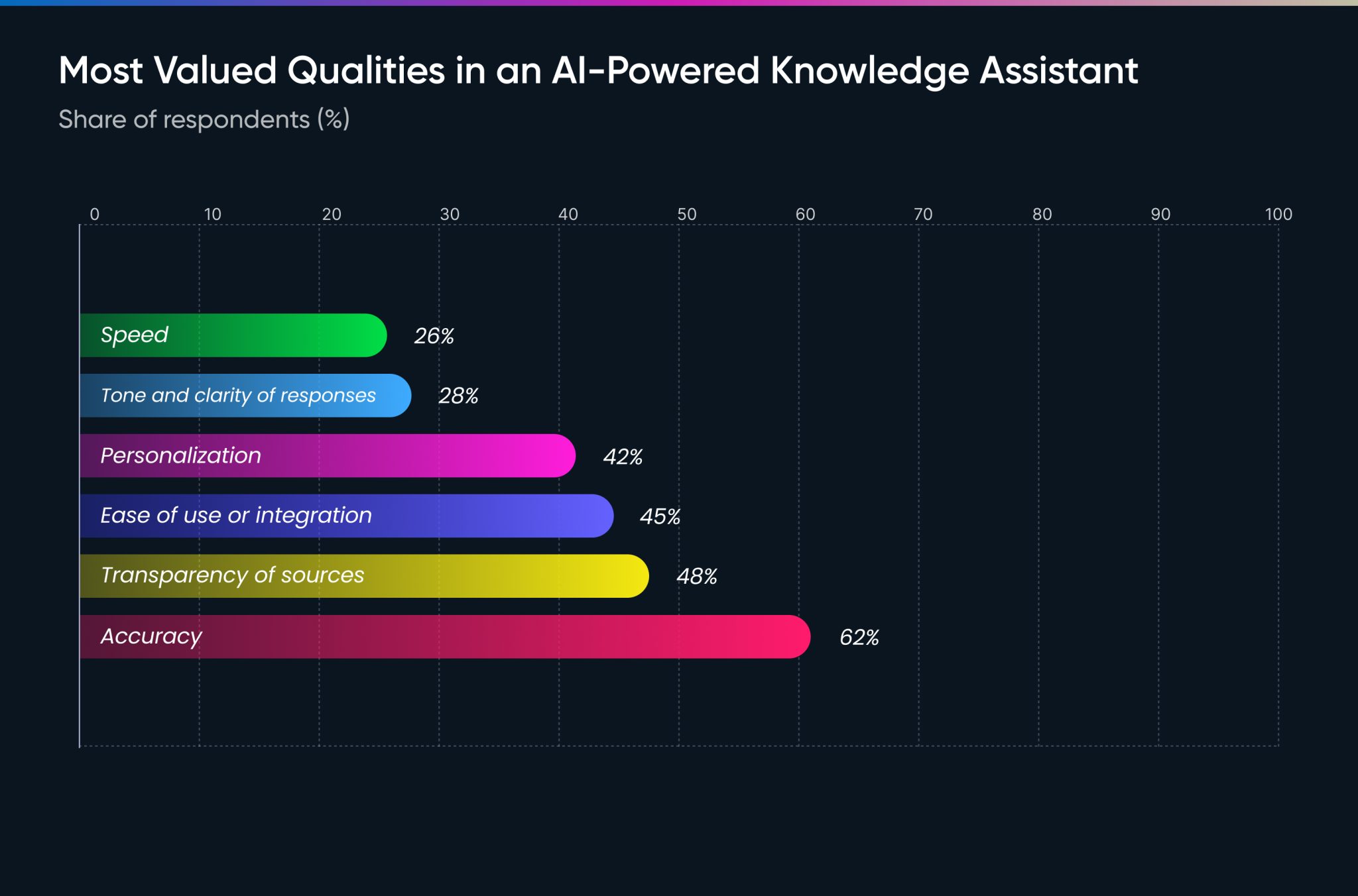
When we asked professionals what they value most in an AI powered knowledge assistant, speed ranked last. Accuracy ranked first with 62% saying it was the most valued quality. Transparency at 48% and ease of use followed with 45% .
That aligns perfectly with how Sales Engineers operate.
An SE answering questions about SLAs, SOC 2, data residency, or implementation timelines carries real responsibility. A vague or incorrect answer can delay a deal or create risk.
AI can assemble the information quickly. The SE makes sure it is correct, contextual, and aligned to the specific buyer.
Human curation is non negotiable
Nearly all (97%) of respondents in our research said human oversight remains critical in AI driven knowledge systems. Only 3% said that human curation was unimportant. Teams want AI to surface information faster. However, they still expect people to own the final answer.
This is especially true in high stakes technical sales.

AI handles repetitive documentation work. Sales Engineers own the commitments made to customers.
The strongest Solutions teams use AI to remove bottlenecks in RFPs, DDQs, and internal process questions. They reduce time spent searching scattered tools. They improve consistency across answers.
At the same time, they keep clear ownership of what gets shared externally.
That is where an AI Solutions Architect creates real leverage.
- It makes the team faster.
- It reduces repetitive work.
- It centralizes knowledge.
And it keeps human expertise at the center of the deal.
How to deploy an LLM-powered Solutions Consultant
So how do you actually "AI-ify" your Solutions team? Setting up an AI Solutions Engineer is straightforward. The most important step is connecting the right knowledge sources.
1. Connect Your Knowledge to 1up
Start with the core systems where your information already lives:
- API documentation
- Product documentation
- Security and compliance docs
- Sales collateral and battlecards
You can also connect third-party systems such as:
- Google Drive
- OneDrive
- SharePoint
- Confluence
- Notion
- Egnyte
- Gated web documentation
Now your AI Solutions Architect has access to the same approved content your team uses every day.
2. Embed It in Your Workflows
For adoption to stick, your AI Sales Engineer should live where your team already works.
Connect 1up to:
This allows reps and SEs to get instant technical answers during active deals.
Once deployed, your AI Solutions Engineer can automate some of the most time consuming tasks in technical sales. Here's what these use cases look like in practice:
Automating RFPs and DDQ Responses
It can draft accurate responses using approved documentation, saving hours on every questionnaire and making RFP automation one of its biggest use cases.
Auto-filling web based security forms
Using a browser plugin, your AI can complete security questionnaires and procurement portals directly from your knowledge base.
Giving Customers self-service Answers
An answer hub creates a centralized place where prospects and partners can ask technical questions and receive reliable, source-based answers, significantly reducing inbound sales load on your SE team.
Generating responses for internal teams
During live deals, speed is critical. Your Virtual Sales Engineer can respond in seconds to internal questions about topics like SOC 2, API rate limits, or data storage.
What can an AI SE team NOT do?
An AI Sales Engineer team cannot run your discovery calls, build executive trust, or read the room during a high stakes demo.
It cannot navigate deal politics or tailor a solution based on subtle signals from a buyer. It also cannot replace the judgment that comes from years of experience in complex B2B sales.
An AI SE handles documentation, RFP automation, and repetitive technical questions. Your human SE handles the relationships and closes the deal.
The Future of Sales Engineering is… Augmented
You know what's better than replacing people wit AI?
Augmenting them.
Technical sales is not getting simpler. Security reviews are deeper. RFPs are longer. Buyers expect fast, precise answers about SLAs, compliance, integrations, and implementation plans. Your Sales Engineers cannot afford to spend half their day digging through API docs and responding to repetitive customer questions.
A Virtual Sales Engineer gives your team leverage. It centralizes your approved documentation, automates responses, handles repetitive technical questions, and delivers consistent answers across Slack, security portals, and deal cycles.
That frees up your human SEs to do what actually wins deals. Running discovery. Designing solutions. Leading demos. Building trust with the buyer.
The teams that move faster will not be the ones with more documentation. They will be the ones that can turn their knowledge into instant, reliable answers.
That is what an AI Sales Engineer unlocks.
FAQs
No. AI Sales Engineers automate repetitive answers and RFP responses, while human SEs handle strategy, relationships, and complex deal conversations.
It connects to API docs, product documentation, security and compliance materials, sales collateral, and systems like Google Drive, OneDrive, and SharePoint.
It generates accurate, source based responses using your approved documentation, speeding up RFP turnaround and reducing manual copy and paste work.

.png)
AI Made Writing Code Free and Moved the Bottleneck to Code Review
The Payoff of Connecting Questionnaire work to your Sales Pipeline
Shadow AI: What Your Reps Are Pasting Into ChatGPT Right Now

How to Write an RFP Response That Survives AI Scoring
SIG vs CAIQ vs VSA: A Simple Guide to the Big Three