Monthly Recurring Revenue (MRR)

Share this post

Monthly recurring revenue (MRR) is the lifeblood of any SaaS company. It’s the income that is expected to be received on a monthly basis, and it acts as a critical revenue metric that enables subscription model companies to understand their overall business profitability, carry out financial forecasting and planning, and measure growth. MRR is usually normalized into a single figure that can be used as a way to identify trends and track performance over time.

Calculating monthly recurring revenue is simple. All that you need to do is multiply your average revenue per account by the total number of customers for that month:

MRR = number of customers * average billed amount

For example, if 30 customers paid you an average of $74.99 per month, your MRR would be $2,249.70.

As you grow, you’ll want to track not only your MRR but also any changes over previous months. This can be done by using three figures:

  • New MRR: Any additional MRR from new customers in a given month.
  • Expansion MRR: Any additional MRR from customer upgrades.
  • Churned MRR: MRR lost from cancellations and downgrades.

Plug all three of these into the following formula to calculate MRR change:

MRR change = New MRR + Expansion MRR = Churned MRR
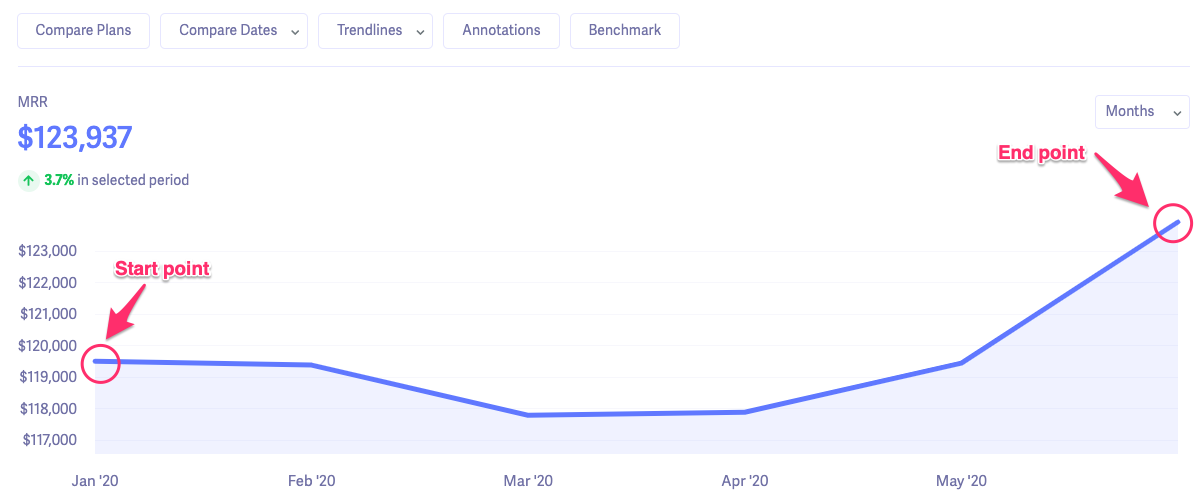
What is Monthly Recurring Revenue (MRR)?
Source: Baremetrics

Monthly Recurring Revenue (MRR) Explained:

FAQs

MRR offers a clear, consistent view into the financial health of a SaaS business. It's like your financial heartbeat because it's based on your recurring income. So you can track how it's accelerating, if it's steady, or if it's slowing down. Tracking like this helps you make smarter decisions about scaling, product investments, and customer acquisition strategies. Also, when you monitor MRR alongside your new, expansion, and churned revenue, you can anticipate cash flow and set solid growth targets. You can also react more quickly to shifts in customer behavior.

Technically, MRR can't go below zero. After all, it's recurring revenue. However, your MRR change reflects the net gain or loss in monthly revenue. So this can definitely be negative. Negative MRR change would mean you're bringing in less than you were. This could happen when your churned MRR outweighs the combined total of new and expansion MRR. A negative MRR change is a contraction in recurring revenue. Pay attention, because it could point to deeper issues like a product that fits poorly in its market. It could also reflect customer dissatisfaction or rising competition. When you spot negative MRR early, you can address those issues before they impact your long-term growth.

No. MRR reflects only predictable, recurring revenue. These can include subscription fees or ongoing service charges. Make sure to exclude one-time payments like implementation fees, setup charges, or training costs from your MRR calculation. This is because they don't repeat on a monthly basis. If you were to include them you would inflate your MRR and end up with misleading forecasts. That could throw off everything from hiring decisions to budget allocations.

MRR (Monthly Recurring Revenue) and ARR (Annual Recurring Revenue) are both metrics that reflect predictable, subscription-based income. The difference has to do with the timeframes. MRR is perfect when you're dealing with short-term tracking and you want to quickly identify month-over-month growth. In contrast, ARR is better for long-term forecasting. This is especially true when you have to report to investors or you've got to set annual revenue goals. It's helpful to realize that if you know your MRR, you can multiply it by 12 to calculate your ARR. Just note that ARR is more sensitive to annual billing cycles while MRR is better for real-time analysis of how healthy your revenue is.
Related Articles

Previous Article
No previous post!
Check out our Directory
Next Article
No next post!
Check out our Directory
Account-based Marketing (ABM)

Account-based Marketing (ABM)

August 15, 2022
Annual Recurring Revenue (ARR)

Annual Recurring Revenue (ARR)

August 15, 2022
Average Contract Value (ACV)

Average Contract Value (ACV)

August 15, 2022
Bottom of the Funnel (BOFU)

Bottom of the Funnel (BOFU)

August 15, 2022
Top of the Funnel (TOFU)

Top of the Funnel (TOFU)

August 15, 2022
Sales Development Representative (SDR)

Sales Development Representative (SDR)

August 15, 2022
Business Development Representative (BDR)

Business Development Representative (BDR)

August 15, 2022
Closed Lost

Closed Lost

August 15, 2022
Closed Won

Closed Won

August 15, 2022
Inbound Marketing

Inbound Marketing

August 15, 2022
Sales Enablement

Sales Enablement

August 15, 2022
Demand-Generation

Demand-Generation

August 15, 2022
Drip Campaign

Drip Campaign

August 15, 2022
Inbound Sales

Inbound Sales

August 15, 2022
Sales Qualified Lead

Sales Qualified Lead

August 15, 2022
On Target Earnings (OTE)

On Target Earnings (OTE)

August 15, 2022
Outbound Sales

Outbound Sales

August 15, 2022
Sales Automation

Sales Automation

August 15, 2022
Sales Kickoff (SKO)

Sales Kickoff (SKO)

August 15, 2022
Sales Productivity

Sales Productivity

August 15, 2022
SalesForce Admin

SalesForce Admin

August 15, 2022
Spiff (Sales Program Incentive Funds)

Spiff (Sales Program Incentive Funds)

August 15, 2022
Statement of Work (SOW)

Statement of Work (SOW)

August 15, 2022
Total Addressable Market (TAM)

Total Addressable Market (TAM)

August 15, 2022
Unique Selling Point (USP)

Unique Selling Point (USP)

August 15, 2022
MEDDIC Sales Methodology

MEDDIC Sales Methodology

August 15, 2022
Objection Handling

Objection Handling

August 15, 2022
Smarketing

Smarketing

August 15, 2022
Social Selling

Social Selling

August 15, 2022
GTM Strategy

GTM Strategy

August 15, 2022
Bad Leads

Bad Leads

August 15, 2022
Monthly Recurring Revenue (MRR)

Monthly Recurring Revenue (MRR)

August 15, 2022
Weighted Pipeline

Weighted Pipeline

August 15, 2022
Call to Action (CTA)

Call to Action (CTA)

August 15, 2022
Audience Segmentation

Audience Segmentation

August 15, 2022
Conversational Marketing

Conversational Marketing

August 15, 2022
Marketing Operations (MarkOps)

Marketing Operations (MarkOps)

August 15, 2022
Marketing Technology (MarTech)

Marketing Technology (MarTech)

August 15, 2022
Conversion Rate Optimization (CRO)

Conversion Rate Optimization (CRO)

August 15, 2022
Chief Revenue Officer

Chief Revenue Officer

August 15, 2022
Retargeting

Retargeting

August 15, 2022
Sales Funnel

Sales Funnel

August 15, 2022
Channel Partners

Channel Partners

August 15, 2022
Sales Hit Rate

Sales Hit Rate

August 23, 2022
Sales Quota

Sales Quota

August 23, 2022
Value Proposition

Value Proposition

August 23, 2022
What is Zoho?

What is Zoho?

August 23, 2022
What is Jira?

What is Jira?

August 23, 2022
Year-over-Year (YoY) Growth

Year-over-Year (YoY) Growth

August 23, 2022
Expansion ARR

Expansion ARR

August 24, 2022
Sales Forecast

Sales Forecast

September 1, 2022
Lead Scoring

Lead Scoring

September 1, 2022
Revenue Operations (RevOps)

Revenue Operations (RevOps)

September 1, 2022
Marketing Automation

Marketing Automation

September 1, 2022
Market Intelligence

Market Intelligence

September 1, 2022
Product-Market Fit (PMF)

Product-Market Fit (PMF)

December 5, 2022
Lifetime Value (LTV)

Lifetime Value (LTV)

December 5, 2022
Net Promoter Score (NPS)

Net Promoter Score (NPS)

December 5, 2022
Service Level Agreement (SLA)

Service Level Agreement (SLA)

December 5, 2022
Startup Runway

Startup Runway

December 5, 2022
Total Contract Value (TCV)

Total Contract Value (TCV)

December 5, 2022
Compound Annual Growth Rate (CAGR)

Compound Annual Growth Rate (CAGR)

December 5, 2022
Deferred Revenue

Deferred Revenue

December 5, 2022
Remaining Performance Obligation (RPO)

Remaining Performance Obligation (RPO)

December 5, 2022
Sales Pipeline Coverage

Sales Pipeline Coverage

December 5, 2022
Sales Engineer

Sales Engineer

December 5, 2022
Time to Value (TTV)

Time to Value (TTV)

December 5, 2022
Daily Active User DAU

Daily Active User DAU

December 5, 2022
Monthly Active User MAU

Monthly Active User MAU

December 5, 2022
Sales Decision Maker

Sales Decision Maker

December 5, 2022
What is a Competitor?

What is a Competitor?

January 9, 2023
BANT

BANT

January 12, 2023
GPCTBA/C&I

GPCTBA/C&I

January 12, 2023
Loss Leader

Loss Leader

January 12, 2023
Product-led Growth (PLG)

Product-led Growth (PLG)

January 12, 2023
Revenue Marketing

Revenue Marketing

January 12, 2023
Net Dollar Retention (NDR)

Net Dollar Retention (NDR)

January 12, 2023
Revenue Per Employee (RPE)

Revenue Per Employee (RPE)

January 12, 2023
Reduction in Workforce (RIF)

Reduction in Workforce (RIF)

January 12, 2023
Top Down Sales Strategy

Top Down Sales Strategy

January 12, 2023
Value Based Pricing

Value Based Pricing

January 12, 2023
Sales-Led GTM

Sales-Led GTM

January 12, 2023
Customer Relationship Management (CRM)

Customer Relationship Management (CRM)

February 2, 2023
Nurture Stream

Nurture Stream

February 2, 2023
Customer Churn

Customer Churn

February 2, 2023
Customer Success Manager

Customer Success Manager

February 2, 2023
Marketing Qualified Lead (MQL)

Marketing Qualified Lead (MQL)

February 2, 2023
Ideal Customer Profile

Ideal Customer Profile

February 14, 2023
What is a BAFO

What is a BAFO

November 28, 2023
Lead Generation

Lead Generation

December 18, 2023
Upselling

Upselling

December 18, 2023
Cross-Selling

Cross-Selling

December 18, 2023
SPIN Selling

SPIN Selling

December 18, 2023
Objection Prevention

Objection Prevention

December 18, 2023
Renewal Rate

Renewal Rate

December 18, 2023
Customer Journey Mapping

Customer Journey Mapping

December 18, 2023
Revenue Attribution

Revenue Attribution

December 18, 2023
Revenue Retention

Revenue Retention

December 18, 2023
Sales Velocity

Sales Velocity

December 28, 2023
Win/Loss Analysis

Win/Loss Analysis

December 28, 2023