Anyone who has dealt with RFPs knows they are a massive headache. You spend hours or days bothering teammates, scavenging for just the right document, and triple-checking answers, only to realize the deadline is creeping up way too fast.
And if your process is not airtight, mistakes slip through, and suddenly your proposal is not as competitive as it should be.
Now you do not need to drown in questionnaires, because you can automate your RFPs with the right AI. This saves you a ton of time.
When you go searching for RFP software, Responsive (previously known as RFPio) is one of the big names in the space. It is not the strongest option out there, though, since it still has problems with accuracy, a complex interface, and pricing you cannot see without a sales call.
So we rounded up the top Responsive alternatives that handle RFP automation, but better. Every one of them has added real generative AI since this list first went up, so we refreshed the details below.
Responsive Alternatives at a Glance
The Downsides of Responsive
Before we get to the Responsive competitors, it is worth remembering why people look for one in the first place. Responsive (RFPio) is a leading automated response platform with some real benefits, but customers keep reporting the same issues:
- Maintaining a large library of Q&A: This is the hardest part of these RFP tools. Once you have built a big knowledge base, you have to spend meaningful time keeping it current.
- Inaccurate AI-generated answers: One of the biggest selling points of automated response software is accurate answers that win deals. When Responsive misses even some of the time, that gets hard to get behind.
- Complex interface: The whole point is to save time and money. If your team spends weeks learning the interface, uploading docs, and figuring out how to ask questions, the math stops working.
- No free trial: Responsive offers a demo if you hand over your contact information, but there is no free trial. There is also no price list on the site, just a section describing the plans. Either way, you are booking a sales call and hoping you do not get upsold into oblivion.
1. Loopio
Loopio is a content library platform like Responsive, so you will spend real time keeping responses clean and current. It is one of the most popular RFP response tools out there, and in 2026 it leans hard on AI. Loopio rebranded its AI engine from Magic AI to Response Intelligence, which it says is trained on more than a decade of response data and over 500,000 past projects. It drafts first responses with trust scores that cite the source, so your team can check each answer before it ships.
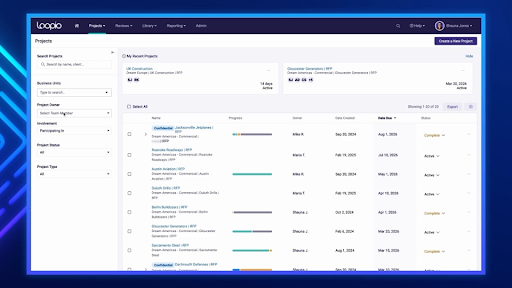
From deciding whether to accept an RFP to tracking prospects as they view your docs, Loopio covers the full cycle. It now handles RFPs, DDQs, and security questionnaires, and pulls in Salesforce for opportunity context.
The structured content library is still the core of the product, which keeps responses organized and reusable. The catch has not changed. That library only helps if someone keeps it fresh, and old answers turn into wrong answers before anyone notices. Loopio supports Word, Excel, PDF, and web portals and includes reporting to track content performance, but manual oversight is still needed for formatting and upkeep.
Top Features of Loopio
- Governed Content Library
- Response Intelligence AI with Source Citations
- Project Agent for One-Click Redrafting
- Analytics that Track Win Rates and Content Usage
Loopio Pricing
Loopio does not publish pricing and does not offer a free trial. Third-party estimates in 2026 put entry pricing at more than $10,000 per year, scaling by seats and add-ons from there. You will need to contact sales for a quote.
- Foundations and higher tiers: Contact Sales
2. Ombud
Ombud has grown past being a straight RFP tool. It now positions itself as an enterprise RevOps and knowledge platform, handling RFPs, RFIs, security questionnaires, proactive proposals, SOWs, and POC frameworks in one place, with content management, collaboration, and real-time doc signing built in.
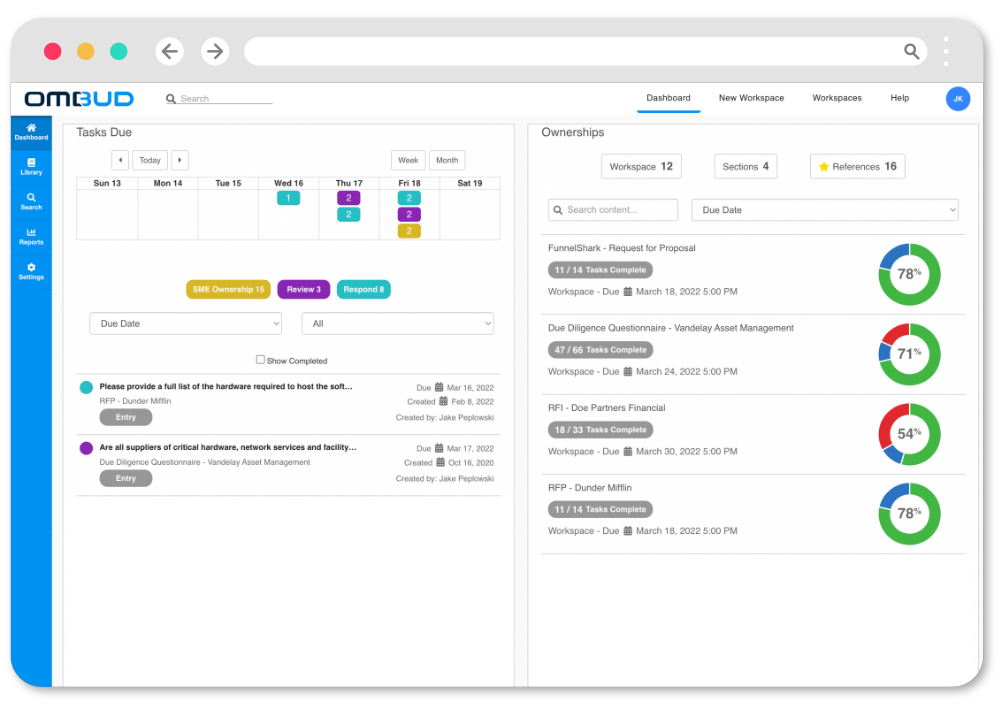
The AI side runs on two named features. OmMatch is a content-matching engine that suggests answers, and reviewers credit it with cutting response time by more than half. Ombuddies are context-aware assistants that help draft and autofill. Teams collaborate on RFPs, summarize documents, and generate new content from stored data. Ombud also carries FedRAMP High authorization, which matters if you sell to US federal agencies.
Top Features of Ombud
- OmMatch AI content matching: Surfaces approved answers and cuts response time.
- Ombuddies assistants: Context-aware AI that helps draft and autofill.
- Easy document sharing: Share docs and close deals faster with e-signatures.
- Collaboration: Comments and task assignments without switching to email.
Ombud Pricing
- Ombud does not publish pricing and does not offer a free trial. You will need to get on a call with sales for a custom quote.
3. 1up
Of course, we had to include our own platform, not just to self-promote, but because we truly believe we offer the fastest, most accurate responses to RFPs, fully automated.
Organizations such as FusionAuth, WalkMe, and Deliveroo utilize 1up to automate their sales questionnaires.
1up has built a reputation for having a single source of truth, which is you. We connect directly to your source material, and 1up pulls answers in record time. It even includes links back to the source, so accuracy is easy to verify.
Your team can ask single questions right inside Slack, MS Teams, or Google Chat. Or you can have a Word doc or Excel sheet filled out automatically, no matter how long it runs. We also have a browser extension that answers questions on the web when you do not have a doc to upload. Beyond RFPs, 1up now handles security questionnaires and DDQs, and our customer-facing Answer Hub gives buyers a self-serve place to get answers from your approved sources, looping in a human when needed.
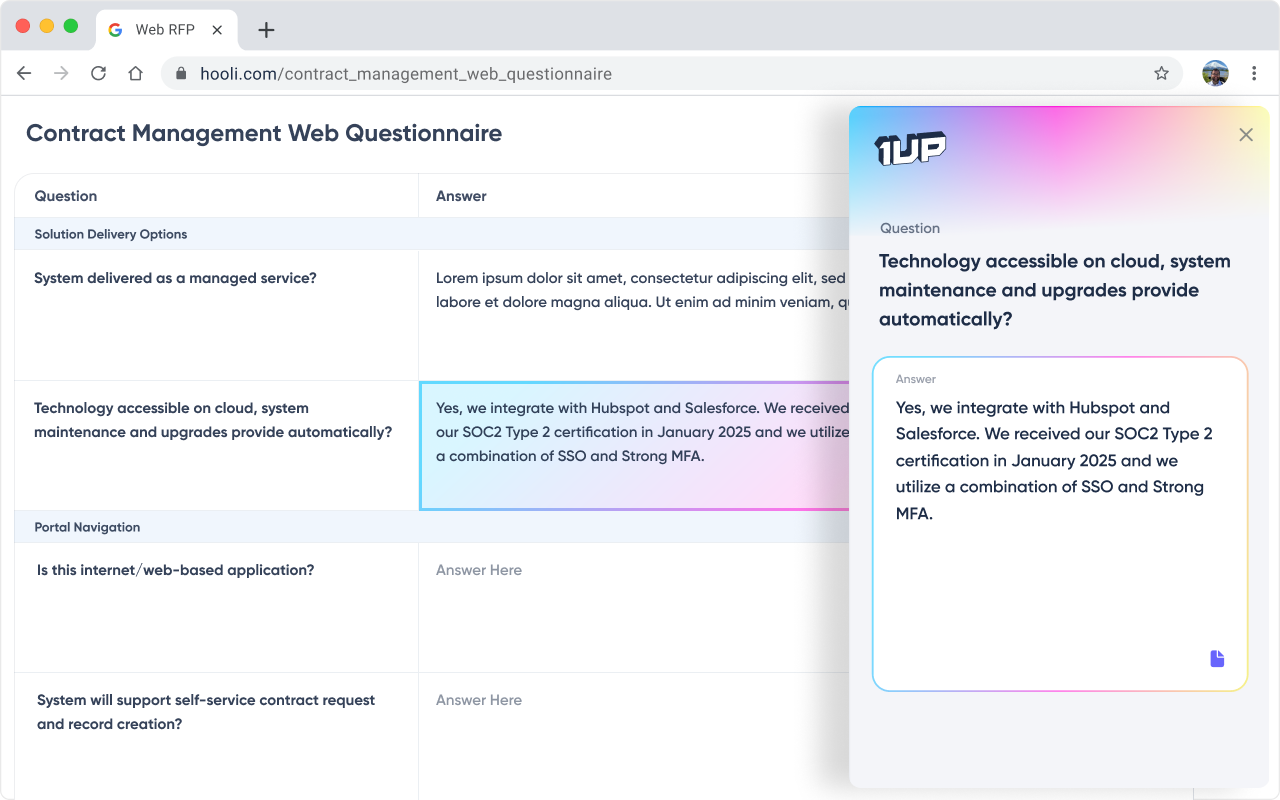
Top Features of 1up
- Automated Question Answering from Your Own Sources
- Multi-Question RFP, DDQ, and Security Questionnaire Autofill
- Browser Extension for Web Portals
- Slack, MS Teams, and Google Chat Answers
- Answer Hub for Customer-Facing Questions
- Source-Linked Answers for Easy Verification
1up Pricing
1up offers a free plan and a 14-day free trial, and we publish our rates, which is rare in this category.
- Free: $0, with 50 answers per month
- MCP: $50 per month plus automation usage
- Starter: $300 per month, for one questionnaire type
- Plus: $900 per month, for six questionnaires
- Enterprise: Contact sales for a custom plan
There is also a customer-facing Answer Hub at $1,000 per month, and annual billing saves 15 percent.
4. Qvidian
Qvidian is a proposal management software widely used in financial services. It helps regulated companies create strong proposals while making compliance easier to manage.
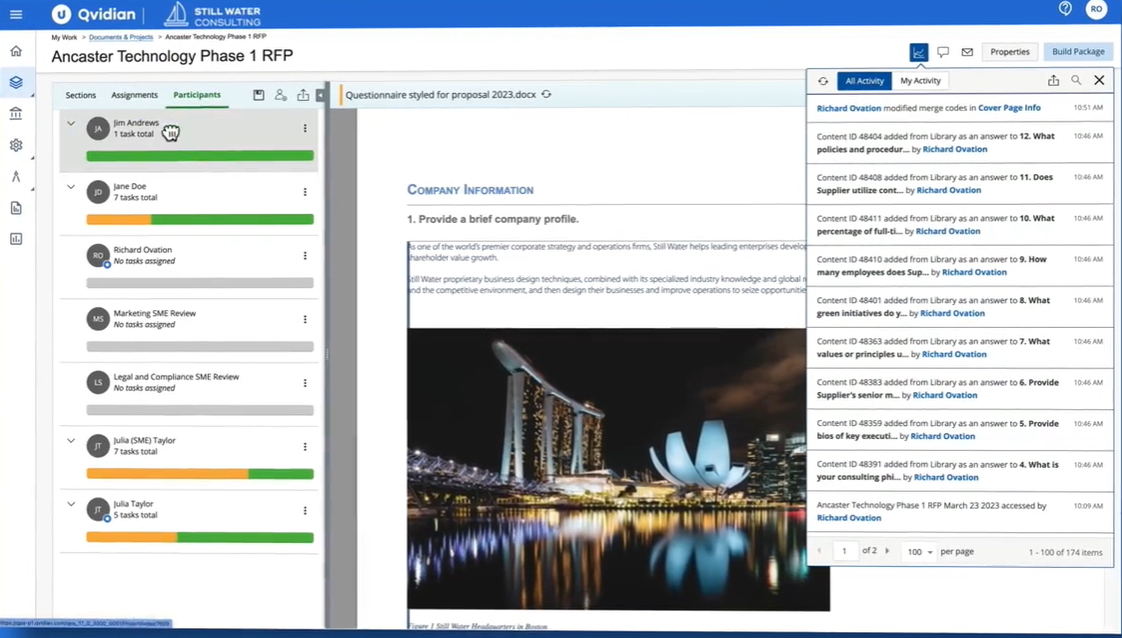
Its generative AI feature, Qvidian AI Assist, runs on IBM watsonx.ai and can analyze an RFP for go/no-go decisions in minutes, rewrite library content for tone and length, and draft fresh answers from your existing library. Qvidian Analytics still tracks recipient engagement for deeper insight, and Qvidian does not store or train on your data.
While Qvidian offers solid organization and an interface that improved after a recent refresh, some users still find its document architecture overly technical and its content update process less than seamless. Worth noting, AI Assist is an optional add-on with an extra fee rather than something baked into every plan.
Top Features of Qvidian
- Qvidian AI Assist, powered by watsonx.ai
- Collaboration Tools
- Analytics with 70-plus Reports
- Audit Trail
Qvidian Pricing
Qvidian, by Upland, does not publish pricing. You will need to request a demo or chat with sales, and note that AI Assist is a paid add-on on top of the base plan.
5. QorusDocs
QorusDocs automates pitches, presentations, statements of work, and RFP responses, all inside Microsoft 365. It pairs AI content generation with response automation, so it works as proposal management with a sales-enablement backbone.
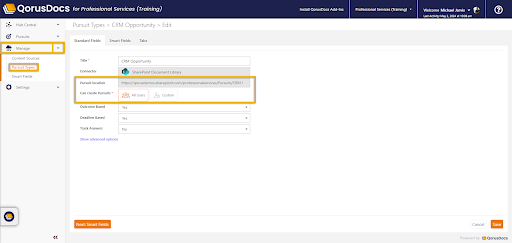
Since June 2024, its AI assistant QPilot, built on Azure OpenAI, has done the heavy lifting, and it now runs through specialized agents for proposals, pitches, SOWs, and RFP responses. The AI is grounded in your approved content library rather than the open web, and it outputs native Word and PowerPoint files instead of raw text you have to reformat. Newer additions include bid/no-bid scoring, built-in ROI calculators, and a Pursuits workspace for cross-team collaboration. QorusDocs also brings experience in legal, architecture, engineering, and IT services, so users get specialized support for their content.
QorusDocs Top Features
- QPilot AI Agents for proposals, pitches, SOWs, and RFPs
- Native Word and PowerPoint Output
- Bid/No-Bid Scoring and ROI Calculators
- Proposal Engagement Tracking
Pricing for QorusDocs
- QorusDocs does not offer a free trial. You will need to request a demo and contact sales for pricing. Every package includes QPilot, Microsoft 365 integration, a governed content library, and enterprise security.
6. Seismic
Seismic is a sales enablement platform that helps you store and access all your content in one place. The founders saw a need for sales and marketing teams to "become more nimble and deliver personalization and customization for their customers."
The core goal of Seismic is to automate the creation of pitchbooks, making it easier for teams to present their products in modern, innovative ways.
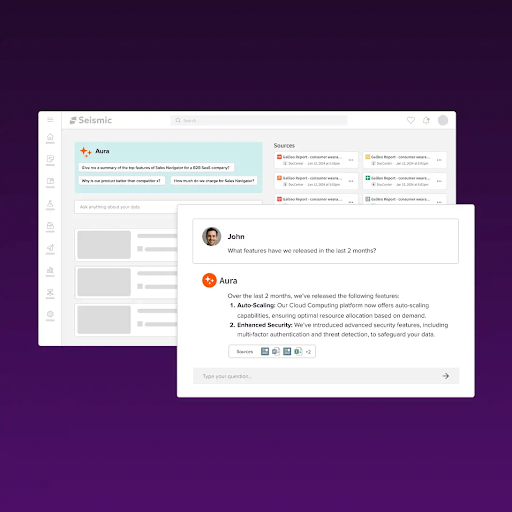
Its AI layer, Aura, launched in 2024 and has expanded fast. Through the Winter and Spring 2026 releases, Seismic pushed Aura into a full set of agents, nine of them covering analytics, meetings, presentations, roleplay, search, and more, plus a Page Builder that spins up interactive sales pages from a prompt. It also added support for Model Context Protocol, so outside AI tools can plug in and share context. The catch for RFP teams has not changed. Seismic is hard to learn end to end, and it has zero native RFP automation, which will cost you time and money if answering questionnaires is the actual goal.
Top Features of Seismic
- Aura AI Agents Across the GTM Workflow
- Large, Centralized Content Library
- Team-Specific Hubs and Buyer Pages
- Interactive Modules for Learning and Coaching
Seismic Pricing
- Seismic does not publish pricing. You will need to contact sales.
Time For You to Choose Your Responsive Alternative?
At the end of the day, picking the right automated response software comes down to what actually fits your business, not just today but months or even years down the line. Every company runs on a different rhythm, and the complexity of your projects and your budget will play a big role in the call.
One thing has shifted since this list first went up. Every tool here now runs generative AI, so the real question is no longer whether a tool has AI. It is where the answers come from. Library tools are only as accurate as the content you maintain. Source-connected tools like 1up pull from your live docs and link back to prove it.
The upside? You do not have to decide blindly. Options like 1up give you a free plan, a free trial, and a demo before you commit. Book a 1up demo today.
FAQs
Your best bet is to look for tools that go above and beyond mere content management. The best RFP automation software will offer you fast AI-powered responses, seamless integrations with your existing tools, and strong collaboration and communication features. We'd give bonus points for a free trial, so you can test it before committing.
How is 1up different from Responsive and other alternatives? While Responsive requires heavy manual upkeep and charges extra for AI access, 1up is built for speed and accuracy. We connect you directly to your knowledge base, autofill complex documents, and even include a browser extension. We're also the only platform here that offers a 14-day free trial.
Not if you've got the right platform. You might need extra admins for tools like Loopio and Responsive, but 1up and Ombud are more lightweight and can be managed by small teams.
Many of these software platforms prefer that you talk to their sales teams so they can sell you on their features. This can help you get a customized plan, but it also means more time on a sales call. If transparency is important to you, look for tools like 1up that offer upfront pricing and free trials.


How to Write an RFP Response That Survives AI Scoring

SIG vs CAIQ vs VSA: A Simple Guide to the Big Three

How to Win Government RFPs With AI (Without Getting Disqualified)

ChatGPT vs. Copilot vs. Claude for RFPs: A Side-by-Side Comparison
.png)
Using Claude for RFPs? Add This One Piece