Most healthcare companies use the same manual steps to answer RFPs (Requests for Proposals):
- They look through old RFPs and shared folders.
- They copy the best answers into the new document.
- They change the words to fit the new form.
- They send parts to experts in product, security, compliance, and legal for checking.
- They put all the feedback together and finish the answers.
This might sound simple, but it actually causes hidden problems at every step.
1. Information is All Over the Place, Not Organized
The most important answers are hidden in old RFPs, shared folders, emails, spreadsheets, and on different computers. There is no one place where all the correct information is kept.
Because there is no main RFP response database of answers, teams have to rely on their memory and manually search for everything. The same "final approved" answers are written again and again because no one is sure they have the most up-to-date version.
Over time, these small differences can make the company look less trustworthy.
2. Keeping Track of Versions is Risky
Healthcare RFPs must use exact language, especially about data security, privacy, and compliance. When many versions of a document are being passed around, it's hard to know which one is the correct, official one.
Small changes can accidentally change the meaning. The legal team might approve one version, but the sales team sends out a different one. New product information might not make it into the final document.
These manual steps make it more likely that old or incorrect answers will be submitted.
3. Expert Reviews Slow Everything Down
Oftentimes the security, compliance, product, and legal teams are asked the same questions over and over instead of checking drafts that are already well-written, they have to:
- Explain the same technical details again.
- Confirm language they already approved before.
- Write explanations that already exist somewhere else.
These constant interruptions slow down both the RFP work and their main jobs. As the number of RFPs increases, these subject matter experts naturally become the reason things get stuck (bottlenecks).
4. Teams Rewrite the Same Things
One of the biggest wastes of time in manual work is rewriting content that has already been written and approved.
Even when good answers exist, teams change the wording to fit new forms, copy answers from PDF files into spreadsheets, or type them again into online forms.
This creates extra, unnecessary work and increases the chance of mistakes.
5. Focusing on RFP Management, Not Strategy
When a lot of RFPs come in, managing the process becomes the main job.
Teams spend most of their time:
- Giving out sections to different people.
- Chasing people for approvals.
- Keeping track of due dates.
- Fixing conflicting edits from different people.
Instead of spending time on making their company's proposals stronger and differentiating from others, they focus only on the logistics.
Under pressure, the quality of the answers often changes. Deadlines become stressful. Sometimes, companies even decide not to respond to new opportunities because they simply don't have enough people or time to do the work.
Healthcare RFP automation solves these problems by turning messy information into an organized system. It changes the team's focus from writing the same things repeatedly to just reviewing and checking answers.
What Is Healthcare RFP Automation?
Healthcare RFP automation uses technology to create a draft of the answers for a proposal. It uses documents that your company has already approved.
Instead of starting with an empty page, teams start with knowledge that is already proven to be correct.
Teams stop searching through shared folders and old proposals. They use one central place for knowledge that includes:
- Past answers to healthcare RFPs
- Documents about products and how to use them
- Rules and documents about security
- Documents and proof that you follow the rules (compliance)
- Approved legal words and standard agreements
The automation system looks at new RFP questions, finds the right information in that central knowledge base, and creates suggested answers based on what your organization has already checked and approved.
But true healthcare RFP automation is more than just faster copying and pasting. It changes how the work is done.
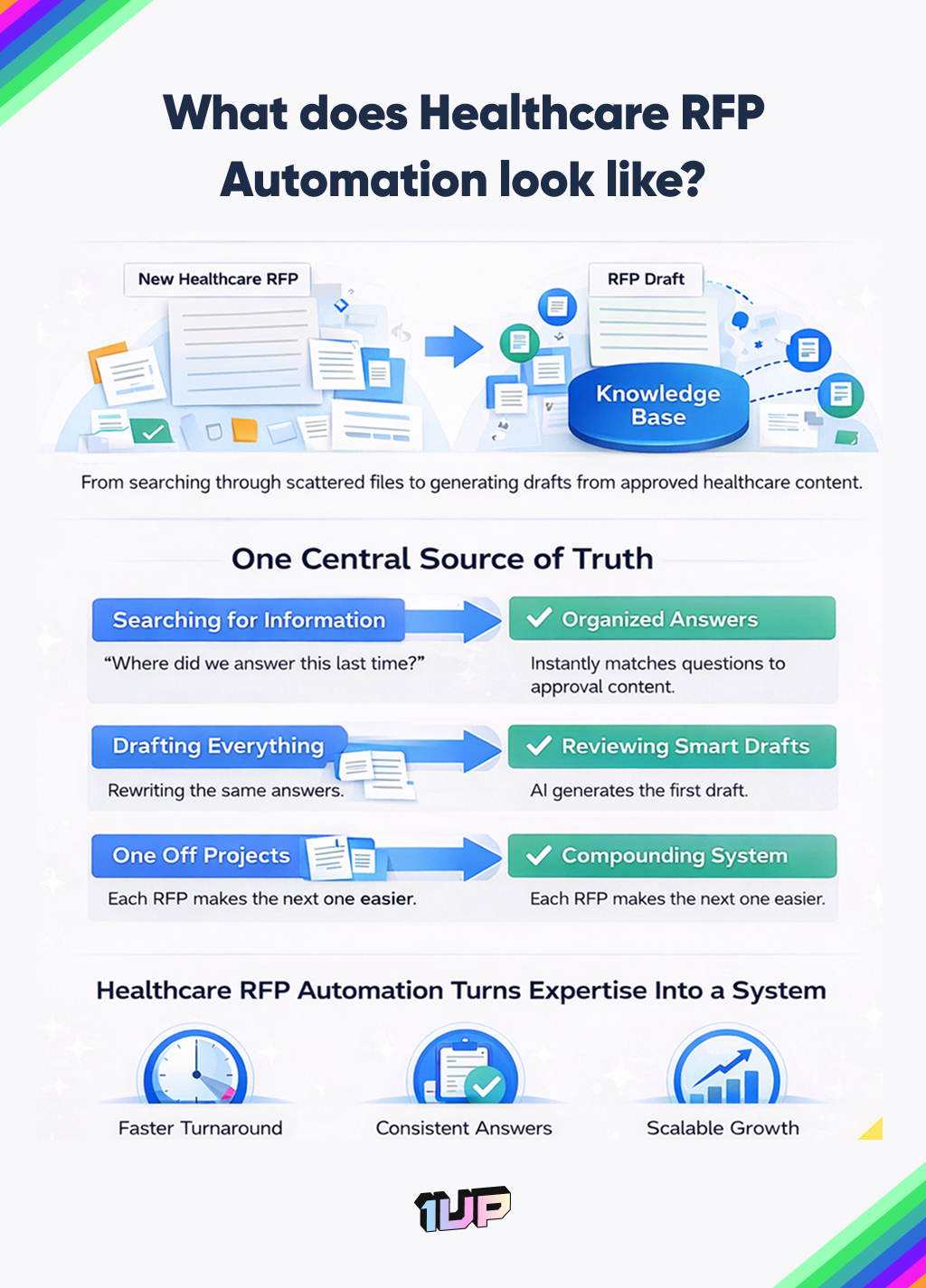
Searching For Info ➡️ Organized Answers
Doing RFP work by hand means you rely on memory and searching manually. Finding what you need in all your company's documents, known as Enterprise search, can be very hard. Automation, on the other hand, relies on organized knowledge.
Instead of asking, “Where did we answer this last time?” the system instantly matches the question to the most relevant, approved answer. This makes it easier for teams and removes the guesswork about whether the language is up-to-date.
Benefit: Teams spend less time hunting for information and more time strengthening their responses.
Drafting Responses ➡️ Reviewing
In the old manual process, experts spend time writing and rewriting the same explanations.
The AI-first RFP process relies on technology to create the first draft from existing, approved content. Experts then focus on reviewing, fixing, and making sure the answer is right for that specific proposal.
This change is small but very helpful. It saves expert time while making sure they still have final control.
Benefit: High value experts stay focused on quality and risk management instead of repetitive writing.
One Off Projects ➡️ Compounding System
Without automation, each RFP is treated as a standalone effort with little to no coordination between those responsible for answering it.
With automation, every submission strengthens the system, only pulling in SMEs when needed.
When teams refine answers and save improved language back into the knowledge base, future RFPs benefit from that work. Over time, the process becomes faster, more consistent, and easier to scale.
Benefit: Every RFP makes the next one easier, turning effort into long term efficiency.
Oversight Bottlenecks ➡️ Automated Expert Reviews
In healthcare, the stakes are high. Accuracy and compliance cannot be compromised.
The goal of automation is not to get rid of the checks done by legal, security, or compliance experts. Instead, it gets rid of the boring, repeated work of writing the same answers over and over, while still keeping the experts in charge.
Teams will still look over, fix, and approve every answer before it is sent. The difference is that they start with clear drafts that come from trusted documents, instead of trying to remember the explanations.
Healthcare RFP automation takes the knowledge of experts and puts it into a system that can be used again and again. This makes it possible to work faster without taking on more risk.
Benefit: Companies get faster and can handle more work, all while keeping the strict control and accuracy that healthcare requires.

How Healthcare RFPs are Being Automated
If you are thinking about using healthcare RFP automation, here is a simple plan to follow.
Step 1: Centralize Your Knowledge
Automation works best when you have a strong, organized company knowledge base.
Gather and organize these things:
- Past answers you sent for healthcare RFPs
- Documents about your security and infrastructure (how your systems are set up)
- Documents about how you follow rules and audit materials (proof of compliance)
- Guides and documents about your products and how to use them
- Legal words and standard agreements that have been approved
This collection of documents becomes your single source of truth. If your content is not organized in one place, automation cannot give you reliable results.
Step 2: Implement an RFP Automation Tool
A good healthcare RFP automation tool should:
- Match questions to your internal documents
- Create structured draft answers
- Help different teams work together easily
- Keep track of different versions
- Allow easy review and editing
The system should make drafting faster while still letting the legal, security, compliance, and product teams check everything. Here’s how 1up does this:
Step 3: Shift From Drafting to Reviewing
One of the biggest improvements comes from changing what the experts on your team do.
Instead of asking experts to write answers again and again, proposal automation gives them a complete draft that comes from approved content.
Experts can then focus on just reviewing and making small changes to the language instead of writing it all from scratch.
This means fewer interruptions for them and faster approvals.
Step 4: Continuously Improve Your Knowledge Base
Every finalized RFP response makes your system better.
After you submit a proposal:
- Identify the strong answers you used
- Save the approved language
- Remove content that is old or no longer correct
- Keep your compliance and security documents current
Over time, your healthcare RFP process becomes faster and more consistent with each submission.

What Makes a Healthcare RFP Especially Complex?
Healthcare organizations are watched more closely than almost any other industry. Every proposal they send must be checked carefully for details about their products, how they follow rules, security rules, and legal agreements. Even small mistakes or differences in the answers can cause big problems.
Healthcare companies have to deal with a special set of pressures:
High regulatory scrutiny
They must give very exact explanations for how they handle, store, and protect private information. Wrong answers can cause serious alarms.
Sensitive data handling requirements
Buyers need to see clear proof that privacy rules, system controls, and risk management are all in place. The answers must be correct and match the company’s official rules.
Cross functional coordination
Healthcare RFPs require input from product, engineering, security, compliance, legal, and sometimes executive leadership. Without structure, coordination becomes the biggest bottleneck.
Increasing RFP volume
As the healthcare market grows, companies get more and more RFPs. More opportunities mean more documentation, tighter deadlines, and more strain on internal teams.
Manual processes struggle under this kind of pressure. When knowledge is scattered and workflows are unstructured, small inefficiencies compound quickly.
When teams use old, manual methods, these problems quickly get worse because information is scattered everywhere.
Healthcare RFP automation fixes these problems in a big way. It helps healthcare teams:
- Keep Answers Consistent: Approved language for security, compliance, and legal questions is used again and again instead of being rewritten. This avoids conflicting answers.
- Finish Checks Faster: Experts start by reviewing a prepared draft instead of writing everything from the start. This allows them to focus on making sure the answer is correct and safe, without having to lower their standards.
- Improve Speed and Quality: Teams move faster because they are using information they already trust, not just their memory or scattered files.
- Handle More Work: By getting rid of repeated writing tasks, companies can take on more bids without overworking their experts.
Most importantly, healthcare RFP automation lowers risk. Instead of relying on guesswork or last-minute changes, all answers are based on official, approved documents that are always being improved. In a business where both speed and being exact are necessary, this combination of benefits is what makes automation so valuable.
Common Mistakes in Healthcare RFP Workflows
Even teams that are well-organized often fall into the same traps when answering healthcare RFPs. The problem is usually not that they don't try hard, but that they don't have a good structure for the work. When the process is done by hand, small mistakes add up fast, especially when you need to be both quick and exact.
Here are the most common mistakes:
1. Just Copying and Pasting Old Answers
Reusing old answers might seem fast, but it can be risky. Old responses may:
- Talk about products that have changed.
- Use words that the legal team has since updated.
- Refer to old security or compliance approvals.
- Be slightly different from the current approved language.
These small differences add up. Because healthcare buyers check answers so closely, inconsistent wording can cause delays or extra questions. Copying and pasting is just a quick fix, not a real system.
2. Hiding Important Information in the Wrong Places
In many healthcare companies, the best answers are buried in places that are hard to search and check for accuracy. Important words and details are often lost in every place imaginable: email threads, chat messages, individual spreadsheets, old PDF files and personal folders on computers.
When teams can't easily find approved content, they have to rewrite answers or ask experts to explain the same things over and over. This is a problem with organizing knowledge. Without one central, clear place for content, teams rely on memory and manual searching, which breaks down as the number of bids increases.
3. Treating Every Bid Like a Brand-New Project
Many teams act as if each RFP is completely unique. But most of the questions repeat, covering things like product features, security, and legal promises. When teams treat each bid as a separate project:
- They start writing all the answers from scratch every time.
- Good answers are not saved and reused properly.
- Improvements made while reviewing are not saved for the next time.
This wastes effort and means your work doesn't help you get better over time. In a better, automated system, every bid you finish helps make the whole system stronger for the future.
4. Asking Experts to Review Too Late
Healthcare bids need to be approved by many teams, like product, security, compliance, and legal. In manual processes, these experts are often brought in at the very end when the deadline is close. This causes:
- Big slow-downs right before the deadline.
- More stress for everyone.
- A higher chance of rushed, risky approvals.
- More time spent going back and forth on changes.
When experts are asked to review messy drafts instead of structured answers that come from approved content, the process becomes slower and more likely to fail.
5. Making Experts Do Repetitive Work
One of the most hidden mistakes is how much time experts spend repeating themselves. Security teams write the same control explanations. Compliance teams restate the same rules. Legal teams re-approve language they already approved. As more bids come in, these interruptions take the experts away from their main, high-value jobs and cause burnout.
Manual workflows force experts to create the same knowledge again and again. Automated workflows capture that expert knowledge so it can be reused.
Healthcare RFP automation fixes these issues by bringing in structure, making the process visible, and allowing for controlled reuse. Instead of relying on scattered documents and memory, teams work from organized, approved content. The difference is not just speed; it is better consistency, lower risk, and the ability to grow.
The Future of Proposals for the Healthcare Industry
Healthcare companies need to grow while also following strict rules and working efficiently.
As the number of bid requests (RFPs) goes up, doing the work by hand will keep causing slow-downs. A system that worked for a small team doing only a few bids won't work in a market that needs things done both quickly and perfectly.
Healthcare RFP automation doesn't get rid of the need for experts. Instead, it lets their knowledge be used across many projects.
When information is all in one place, organized, and easy to use again, teams no longer have to rely on their memory, scattered files, or writing the same thing over and over. They build a system that saves their company’s knowledge and gets better every time they submit a bid.
Teams that organize their content, use automation to create drafts, and make the review process simpler will be able to:
- Respond to more opportunities without making mistakes.
- Use the same, approved language in all their submissions.
- Make review times shorter while still letting experts have final control.
- Help reduce stress and burnout for the product, security, compliance, and legal teams.
Most importantly, they will stop just reacting to problems and start planning ahead. Instead of rushing to put answers together before a deadline, they can focus on making their proposals stronger and standing out from other companies.
The healthcare bid process doesn't have to be slow, messy, or repetitive. With the right system, it becomes organized, consistent, and able to handle growth. It is not just faster, but smarter.
FAQs
Healthcare RFPs require precise language around security, privacy, compliance, and legal commitments. Automation must support strict review processes while ensuring responses are grounded in approved documentation.
No. Healthcare RFP automation creates structured drafts from approved content, but legal, security, and compliance teams still review and approve final responses. The goal is to reduce repetitive drafting, not remove oversight.
A strong knowledge base includes past RFP responses, product and implementation documentation, security policies, compliance evidence, and approved legal language. The more structured and current the content, the better the automation results.


The Payoff of Connecting Questionnaire work to your Sales Pipeline

How to Write an RFP Response That Survives AI Scoring

SIG vs CAIQ vs VSA: A Simple Guide to the Big Three

How to Win Government RFPs With AI (Without Getting Disqualified)

Why Most Internal AI Assistants Get Built and Then Abandoned