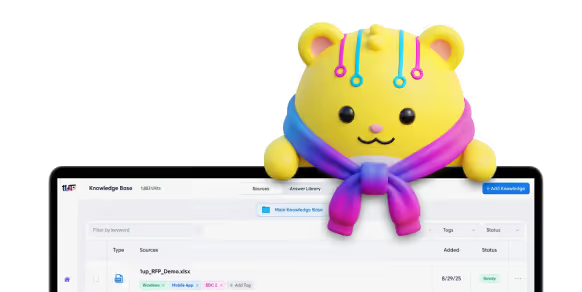
Enterprise knowledge management has always promised to make information easy to find and use, yet businesses now face a different kind of overload because their knowledge lives in too many places and grows too quickly. It is like trying to organize a library where new books appear on every shelf faster than anyone can catalog them.
This means valuable information rarely reaches people when they need it.
It’s a strain employees feel daily. They ask complex questions that rely on deep context. Some answers live only in the minds of company experts. Others are buried in scattered documents. These “un-Google-able” questions slow everything down.
According to McKinsey research, one of the biggest hidden costs in enterprise knowledge management is the amount of time employees lose searching for information they cannot easily access.Searching feels painful. Asking a coworker feels faster. Subject matter experts repeat the same explanations until it becomes part of their job.
This problem has followed every generation of tools. From intranets to early knowledge bases to the hundreds of platforms available now, the experience has barely improved. Organizing content is easier. Finding and using it is not.
With the advent of AI, modern teams are now expecting better. They want knowledge that moves at the speed of the business, gathers itself automatically, updates as information changes, and delivers clear answers in the moment of need. That shift is redefining enterprise knowledge management and raising the standard for how information flows across an organization.
Why Enterprise Knowledge Management is broken today
Companies generate knowledge at a pace that traditional systems cannot handle. Information pours in from many places, including:
• Product Updates
• Sales Materials
• Onboarding Docs
• Process Notes
• Customer Insights
• Engineering Plans
• Support Guides
• Tribal Knowledge
The good news: all this knowledge exists somewhere.
The bad news: employees rarely know where to find it or how to access it.
Most knowledge management tools try to solve this by asking teams to upload, tag, and organize everything manually. The workflow is familiar. Create content, upload it to a knowledge base, push it out to the team, and HOPE people use it. For many companies this process takes weeks or months before anyone sees value. Adoption is the hardest step. When employees cannot quickly find what they need, they stop using the system and the investment goes to waste.
This model leads to three predictable problems:
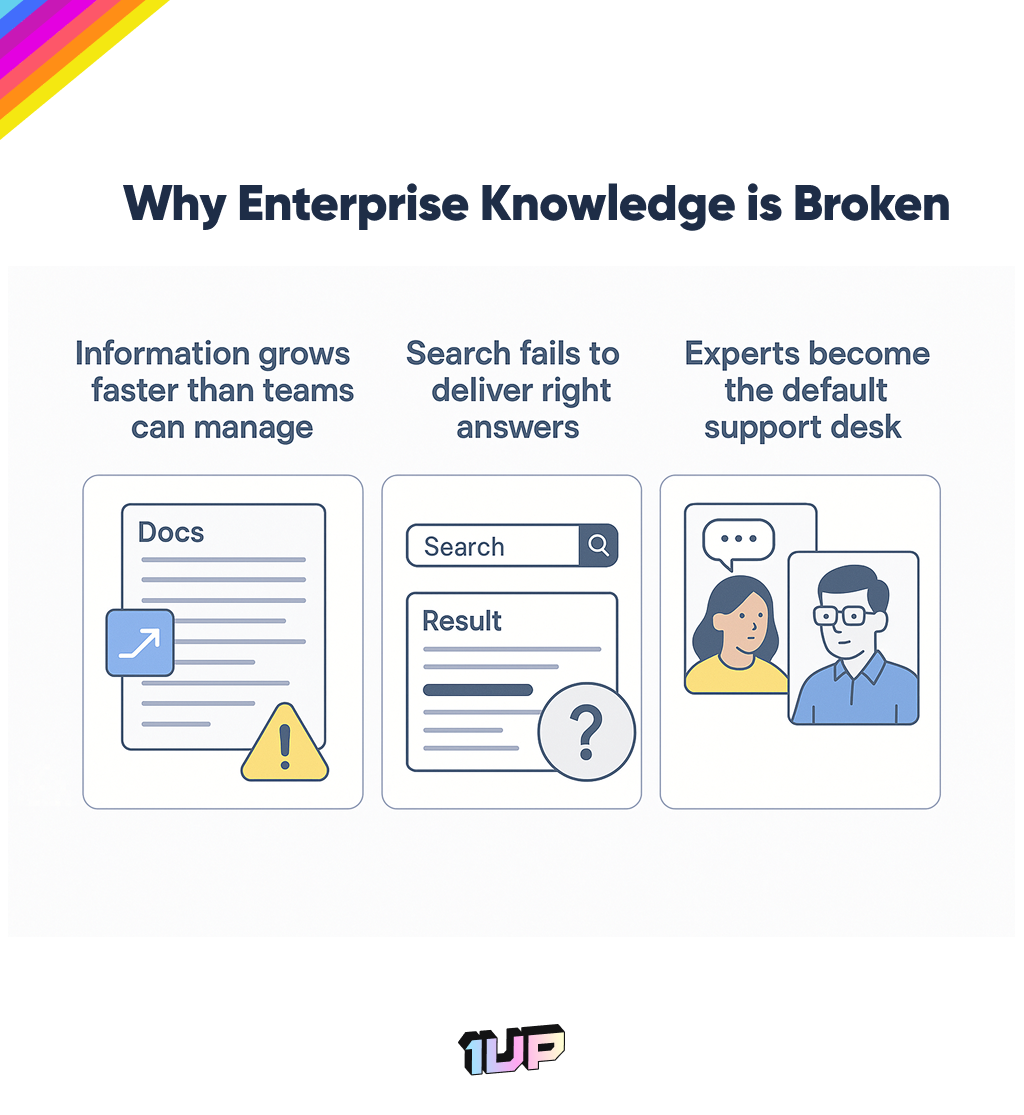
1. Information grows faster than teams can manage
Keeping documentation up to date is a constant battle. A small product change can mean updates across multiple documents and tools. Admins spend countless hours rewriting, sanitizing, and formatting content so that the system can index it. They become data custodians rather than strategic contributors. The knowledge library grows in size but not in usefulness, and updated knowledge rolls out slowly across the organization.
2. Search fails to deliver the right answers
Search is often where the experience breaks down. Traditional knowledge bases depend on keyword matching. If employees do not use the exact phrase the system expects, results are incomplete or irrelevant. For admins this means endless formatting and cleanup to make content readable to the system. For users it turns search into a coin flip. They know the answer exists somewhere, yet the system cannot surface it. Even skilled knowledge workers struggle with this because they must become good at searching rather than simply asking the question they need answered.
3. Experts become the default support desk
When search feels unreliable employees fall back on the fastest path. They ask a coworker. Studies from Harvard Business Review show that enterprise knowledge management breaks down when employees rely on coworkers instead of documented answers, which reinforces the cycle of interruptions and repeated explanations.
Subject matter experts get pulled into repeat conversations and become the unofficial help desk for the entire company. This helps in the moment but drains productivity. The people with the most institutional knowledge spend their days answering the same questions instead of focusing on work that moves the business forward.

The truth is simple. Traditional knowledge management tools store information, but they do not help people use it. Modern teams need knowledge that stays fresh, understands context, and delivers answers instantly. A new generation of tools makes that possible.
Reimagining knowledge in the AI era
The bottlenecks in traditional knowledge systems all point to the same conclusion. Enterprise knowledge management needs a new foundation. The good news is that foundation already exists. AI has changed knowledge management forever.
The rise of large language models created a technical foundation that makes modern enterprise knowledge management possible at scale. Modern knowledge automation uses large language models (LLMs) to collect information from across the company, understand it, and deliver answers on demand. Instead of teams manually rewriting and tagging content, the system ingests documents as they are. PDFs, URLs, spreadsheets, product docs, support notes, and internal guides can all be connected directly. Ingestion happens in minutes and stays fresh without constant intervention. Tools like 1up are designed specifically around this idea and make it possible for teams to stand up an intelligent knowledge layer without heavy technical work.
Setup takes minutes, not months (if done right)
Legacy tools require admins to sanitize and format documents so the system can read them. Good knowledge automation removes this burden. The system analyzes the content, resolves formatting issues, and syncs updates automatically. Teams no longer spend hours preparing files. They simply connect the sources to a response library and let the model do the heavy lifting.
Here's how 1up sets up your AI knowledge assistant:
Search goes from keyword matching to real understanding
Traditional search breaks because it depends on perfect phrasing. LLM-based systems understand both content and context. They treat documents as living sources of meaning rather than static text. Employees can ask questions in natural language and get clear answers drawn from multiple internal sources. They do not need to guess the right keyword or click through layers of folders. The system meets them where they are.
Admins stop cleaning data and start creating impact
A modern enterprise knowledge base should not require constant rewrites or manual structure. Knowledge automation handles ingestion and organization, which frees admins from low value cleanup work. They can focus on improving documentation, refining processes, and helping teams succeed rather than acting as librarians for a system that cannot adapt.
Coworker distractions drop. A LOT.
When employees trust the knowledge system, they stop interrupting experts for answers. Complex questions that once required several minutes of digging can now be answered in seconds. The system searches across product documentation, engineering notes, internal pages, and past answers to return a response that would take a human much longer to assemble.
Where automation is changing the game
Enterprise knowledge automation shows its real value when you see how it cuts through daily bottlenecks across different teams.
Example: Sales engineering moves faster in customer conversations
Sales engineering teams feel the impact immediately. A typical SE might dig through multiple documents during a live customer call to locate a configuration detail or technical explanation. With knowledge automation the answer appears instantly, pulled from the right collection of internal sources. The time saved during a high stakes conversation often changes the outcome of the call.

Example: Business development gets instant access to the right materials
Business development reps spend a surprising amount of time searching for pitch decks, battlecards, and talking points. Automation surfaces these materials on demand, which cuts prep time and keeps reps focused on high value outreach rather than on document hunting.
Example: Security questionnaire responses generate themselves
Security questionnaires are another area where automation shines. These forms require detailed responses that sit across multiple teams. Completing them manually can take hours. With knowledge automation the system analyzes each question, locates the relevant information, and produces draft answers in seconds. This accelerates vendor reviews and removes a major source of friction from the sales cycle.
Here's what that looks like:
3 Keys to automating Enterprise knowledge
The solution is always automation, isn't it?
Knowledge Automation is a new way to quickly deliver intelligence across an organization by way of Large Language Models (LLMs).
This approach relies on LLMs to intake information, organize it, and generate answers to queries of varying complexity. It addresses the key pains of legacy knowledge management. Here are what we consider to be the key elements of a modern Enterprise KB:
- The setup process takes minutes, not weeks.
Documents no longer need to be sanitized, rewritten, or formatted in a specific way. Users simply connect PDFs, URLs, Spreadsheets, and other file types into the system. Information ingestion is automatic and easily refreshed without user intervention. - The search experience is excellent.
Using a combination of retrieval methods ensures that both content and context is utilized when searching the database. Documents are not just searched for, they are "understood" by the system. The end-user no longer needs to provide perfect search terms or structure their queries as they would for a Google keyword search. Instead, questions are asked in natural language, more similar to a ChatGPT prompt. - Admins no longer need to spend time sanitizing content.
This is probably the most glossed over element of what "good" knowledge automation looks like. An administrator does not need to spend time cleaning up documents before uploading them. The system should analyze the documents intuitively and automatically correct any formatting issues uncovered. Files and folders should be easy to sync, and web-based content should be regularly refreshed.
Finally, good enterprise knowledge automation should decrease the volume of coworker distractions. In this system, answers to complex questions are generated using multiple internal company sources in seconds, much faster than any human ever could.
Here's what that looks like at scale:
Large language models opened the door to a smarter and more adaptive way of managing information. Automation is quickly becoming the baseline for modern teams that need reliable answers in the flow of work. When knowledge can retrieve itself, update itself, and deliver context aware responses in seconds, companies move with more speed and confidence.
Instant answers do more than save time. They improve accuracy, reduce interruptions, and help every team operate at a higher level. Sales, support, engineering, marketing, and operations all benefit from knowledge that stays fresh and surfaces itself when needed. This is the new standard for enterprise knowledge and it is reshaping how organizations work.
FAQs
Enterprise knowledge management is challenging because information grows faster than teams can organize it. Knowledge spreads across tools, teams, and formats, which makes it difficult for employees to know where to look. Traditional systems rely on manual tagging and updates, so content becomes outdated quickly, search results are inconsistent, and experts end up answering the same questions over and over.
AI improves enterprise knowledge management by ingesting content automatically, understanding the meaning behind documents, and delivering accurate answers in natural language. Large language models remove the need for manual cleanup and tagging, keep knowledge fresh, and allow employees to ask any question without guessing keywords or digging through folders.
Enterprise knowledge automation helps every team, but the impact is especially strong for sales engineering, support, business development, and operations. These groups rely heavily on fast access to technical details, product information, and process documentation. Automation gives them instant answers, reduces interruptions, and frees experts from repetitive questions.


The Payoff of Connecting Questionnaire work to your Sales Pipeline

Why Most Internal AI Assistants Get Built and Then Abandoned
.jpg)
Building AI Governance for Enterprise Knowledge

Why Your Internal AI Assistant Gives Wrong Answers: A Document Audit Guide
Your Buyer Is in the Room and You're Not: 5 AI-Native Sales Rooms